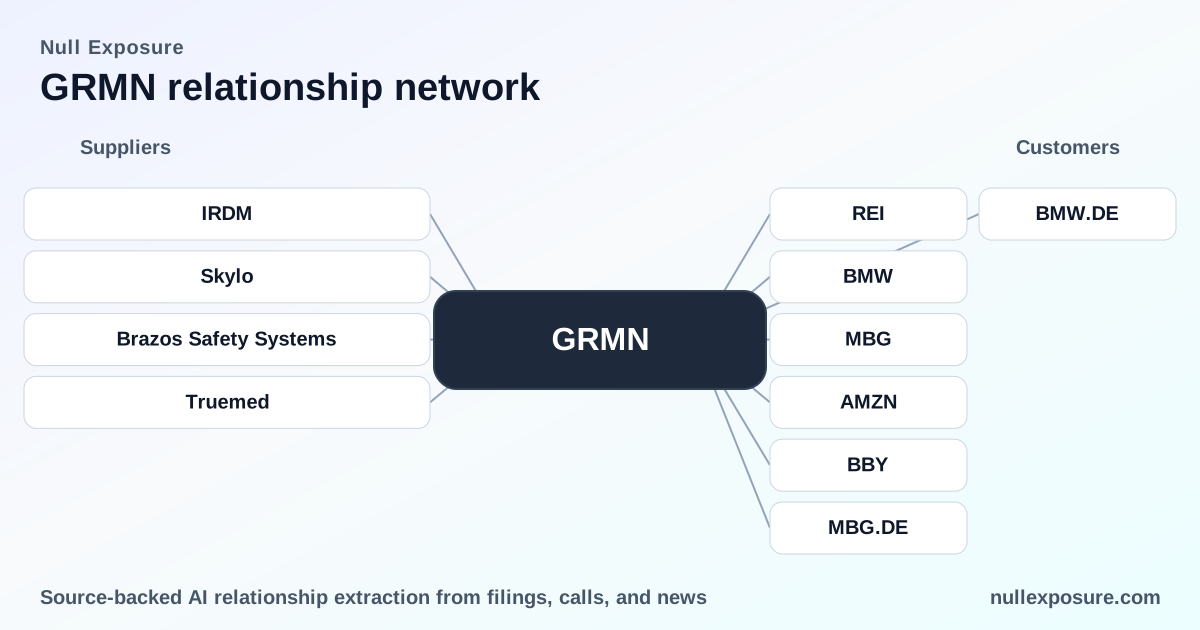
Garmin Ltd. (GRMN) — supplier relationships that drive connectivity, safety, and payments
Garmin monetizes a hybrid hardware-software business: high-margin devices sold across aviation, marine, automotive and consumer fitness, complemented by recurring services and connectivity subscriptions (satellite SOS, mapping, data services). The company converts product leadership into durable cash flow through device sales, software-enabled upgrades and ancillary subscription revenue tied to third-party networks and payments partners. For investors evaluating supplier risk and opportunity, the critical questions are: which external networks underpin Garmin’s differentiated features, how concentrated those relationships are, and how contract posture and maturity of partners affect continuity of service. Learn more and explore supplier intelligence at https://nullexposure.com/.
How Garmin’s supplier map informs the business model
Garmin’s financials show a profitable, cash-generative technology manufacturer: Revenue TTM $7.25 billion, Gross Profit $4.26 billion, Operating Margin ~28.9%, Profit Margin 23%. The company trades at a trailing P/E of 27.3 and EV/EBITDA ~20.5, reflecting a premium for recurring services and durable device franchises. These economics place a premium on uninterrupted third‑party services where Garmin has integrated external connectivity and payments.
Key operating-model characteristics driven by supplier relationships:
- Contracting posture: Garmin operates with a mix of supplier integrations and commercial partnerships rather than full vertical control; the product feature set relies on third‑party network and service agreements for satellite messaging and transaction processing.
- Concentration: The satellite-enabled SOS and messaging functions are delivered through a small set of network providers, creating focal points of dependency when those features are strategically important.
- Criticality: Supplier services such as satellite connectivity are mission-critical to Garmin’s safety-focused value propositions (e.g., SOS, aviation analytics) and therefore have outsized impact on product utility and customer retention.
- Maturity and diversification: Garmin’s supplier roster shows diversification across domains — satellite networks, safety analytics, and payments — which reduces single-vendor risk but preserves exposure where a single partner owns unique network access.
No formal contract constraints were listed in the available supplier signals; the absence of explicit constraint disclosures is itself a company-level signal indicating no public supplier limitations surfaced in the review period. Investors should track future filings and partner disclosures to detect contract renewals, exclusivity clauses, or capacity limits.
Supplier relationships investors should track (what the record shows)
Garmin’s recent news-driven supplier signals include four named partners. Each relationship below is described in plain English with source citation.
-
Iridium — Garmin’s inReach emergency messaging leverages Iridium’s satellite network to deliver SOS coverage and two-way messaging for remote users; reporting notes Iridium alongside Skylo as network providers for inReach SOS capability. According to EnduranceSportsWire and AIJourn articles published in March 2026, Garmin credits Iridium for satellite coverage that enables the dedicated SOS alert function for inReach users (Mar 2026).
Source: EnduranceSportsWire and AIJourn coverage of Garmin’s inReach SOS report (first seen Mar 9, 2026). -
Skylo — Garmin integrates Skylo’s satellite relay capability to enable limited texting and GPS coordinate relay on select devices, with company executives highlighting the “seamless” integration on new wearables; trade reporting covered Skylo’s role in the fēnix 8 Pro satellite messaging feature. TS2.tech reported on the fēnix 8 Pro’s satellite texting and Skylo’s contribution, noting Garmin executive commentary on the integration (Mar 2026).
Source: TS2.tech and corroborating industry coverage (Mar 2026). -
Brazos Safety Systems — Garmin entered a partnership to provide aviation safety analytics, signaling deeper data and services integration in its aviation business line; industry reporting cited the new collaboration as an expansion of Garmin’s aviation safety and data capabilities. SahmCapital reported on the partnership announcement describing Garmin’s move into expanded aviation safety analytics with Brazos (Feb–Mar 2026).
Source: SahmCapital coverage of Garmin’s motorsports and aviation product expansion (Feb 2026). -
Truemed — Garmin announced a collaboration with health-care payments provider Truemed to enable customers to use pre-tax HSA and FSA funds for qualifying Garmin purchases, positioning payments integration as a point-of-sale convenience and demand driver in health-focused segments. An earnings call transcript summarized the Truemed collaboration as a company initiative during the quarter (reported in Q4 2025 / FY2026 coverage).
Source: InsiderMonkey transcript of Garmin’s Q4 2025 earnings call (reported Mar 2026).
What these supplier links imply for investors
Taken together, these relationships underscore three investment-relevant dynamics:
- Connectivity is outsourced but strategic. Garmin’s safety and remote-communications features depend on satellite network access that it does not wholly own, which elevates counterparty importance. The Iridium and Skylo relationships confirm Garmin’s reliance on specialized network providers for flagship features like SOS and satellite texting.
- Services drive stickiness and recurring revenue. Partnerships that enable in-device subscriptions or payments conversion (Skylo for connectivity; Truemed for payments) enhance the recurring element of Garmin’s revenue mix and reduce churn for device users who rely on those services.
- Sector-specific integration reduces single-point product risk. Aviation analytics integration with Brazos Safety Systems demonstrates Garmin’s strategy to embed third‑party capabilities to expand addressable service revenue in professional segments, diversifying supplier exposure across industries.
Investors should watch contract renewal timelines, exclusivity terms, and traffic or capacity disclosures for satellite partners, as any changes to those agreements would have immediate effects on product functionality and revenue retention.
Near-term risk & catalyst checklist
- Monitor satellite partner announcements (renewals, pricing changes, network capacity) because satellite connectivity is mission-critical for several user-facing features.
- Track payments and health-spend integrations adoption metrics since HSA/FSA acceptance can materially affect demand in the health and fitness segment.
- Watch aviation analytics commercialization with Brazos to assess revenue expansion and margin mix in professional services.
For ongoing supplier risk monitoring and to access a broader supplier view, visit https://nullexposure.com/.
Conclusion — what investors should do next
Garmin’s product economics and margins position it as a premium hardware-plus-services company, but the value of several marquee features is directly tied to a small set of external partners. Investors should prioritize tracking contractual terms, renewal timing and integration depth for Iridium, Skylo, Brazos Safety Systems and Truemed. Those suppliers are strategic levers for retention, safety positioning and new revenue streams.
To evaluate Garmin’s supplier risk more systematically and to subscribe to supplier monitoring for GRMN, start here: https://nullexposure.com/. For a deeper, scenario-driven read on how supplier events could affect valuation and cash flow, explore additional resources at https://nullexposure.com/.