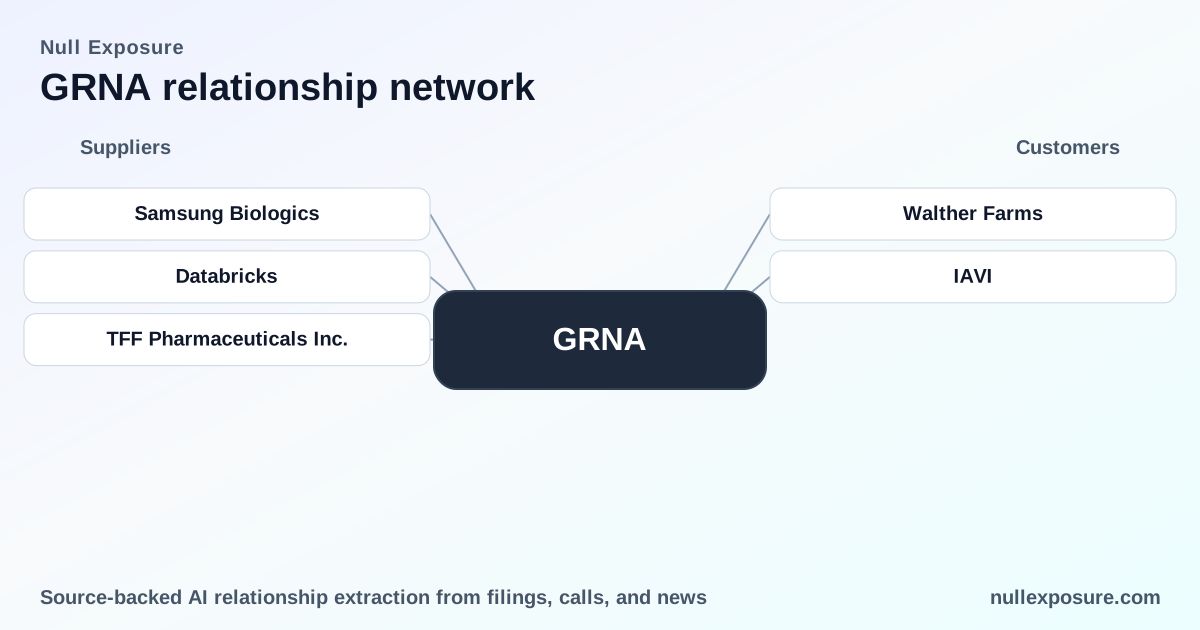
GreenLight Biosciences (GRNA) — Supplier Relationships That Drive Scale and Risk
GreenLight Biosciences monetizes its RNA platforms by partnering across the development and manufacturing chain: the company outsources large-scale mRNA production to contract biologics manufacturers, licenses or co-develops vaccine and therapeutic candidates with public and private partners, and leverages third-party technology providers for analytics and formulation work. Revenue flows will therefore depend on successful tech transfer to CDMOs, the cadence of co-development milestones, and the company's ability to convert development-stage assets into commercial supply agreements. For those evaluating GRNA supplier exposure, the supplier roster—manufacturing, analytics, and formulation partners—defines both the path to commercialization and concentrated operational risk. Visit https://nullexposure.com/ to compare these supplier footprints across peers.
Why supplier relationships matter to investors
GreenLight’s business model converts IP and process know‑how into partnered product programs; manufacturing partnerships are not optional—they are the commercial fulcrum. Outsourcing to established CDMOs accelerates time-to-market but concentrates execution risk outside the balance sheet. Technology and formulation partners compress development timelines and reduce capex, but they also introduce vendor dependency and potential operational gating points for launches.
- Primary revenue drivers: milestone and supply agreements tied to vaccine candidates, plus licensing of RNA technologies.
- Execution risk: contract negotiation, capacity access, and successful engineering runs at CDMOs determine near-term manufacturability.
- Operational leverage: partnerships with data and formulation specialists accelerate optimization and stability programs that define product shelf life and market access.
Explore comparable supplier maps and exposure analytics at https://nullexposure.com/.
Supplier roster: who GreenLight is working with (and why it matters)
Below I cover every supplier relationship reported in public sources. Each entry includes a concise, plain-English summary and the source for that disclosure.
Samsung Biologics — commercial-scale CDMO partner
GreenLight announced a partnership with Samsung Biologics for commercial-scale manufacturing of its mRNA COVID-19 vaccine candidate, and later completed a first commercial-scale engineering run under that collaboration. According to BioSpace reporting on the initial agreement and subsequent Investing News coverage, Samsung Biologics will provide end-to-end contract development and manufacturing services that GreenLight needs to scale human-health mRNA production (BioSpace, FY2021; Investing News, FY2022).
Source: https://www.biospace.com/greenlight-biosciences-and-samsung-biologics-announce-collaboration-to-build-capacity-for-messenger-rna-vaccine-manufacturing and https://investingnews.com/greenlight-biosciences-and-samsung-biologics-complete-first-commercial-scale-engineering-run-for-mrna-covid-19-vaccine/
Databricks — AI and analytics technology provider
GreenLight’s team leveraged Databricks’ GenAI tooling (Mosaic AI, Model Serving, Vector Search, and Databricks Apps) to accelerate certain development tasks, indicating a reliance on third-party advanced analytics for model-driven workflows. Databricks documented GreenLight’s use of its platform during the 2024 Databricks GenAI World Cup, highlighting the operational role of cloud AI tools in GreenLight’s R&D pipeline (Databricks blog, FY2025).
Source: https://www.databricks.com/blog/2024-databricks-genai-world-cup-americas-winners-adaptivefilters-greenlight-biosciences
TFF Pharmaceuticals Inc. — formulation and feasibility testing partner
GreenLight delivered mRNA product candidate materials to TFF Pharmaceuticals for feasibility formulation work and testing of a shelf-stable powder mRNA vaccine approach, indicating active efforts to improve product stability and downstream formulation resilience (European Pharmaceutical Review, FY2021). This relationship targets a tangible product attribute—shelf stability—that materially affects distribution economics and commercial reach.
Source: https://www.europeanpharmaceuticalreview.com/news/146980/biotechs-to-test-feasibility-of-a-shelf-stable-powder-mrna-covid-19-vaccine/
What the supplier mix reveals about GreenLight’s operating model
From the supplier list and public disclosures, derive these company-level operating characteristics that frame GRNA’s commercial risk and opportunity.
- Contracting posture: outsourced and partner-driven. GreenLight deliberately contracts out commercial-scale manufacture and specialized formulation work rather than investing in large-scale internal CMO capacity; this lowers capex but transfers critical execution to third parties.
- Concentration risk: high in manufacturing. The prominence of Samsung Biologics as the named commercial-scale CDMO creates a concentrated dependency for human health mRNA production; any hiccup in that relationship would materially affect near-term supply potential.
- Criticality: supplier relationships are mission-critical. Manufacturing and formulation partners directly determine ability to deliver commercial product, so supplier performance translates into revenue realization or delay.
- Maturity signals: progressing from pilot to commercial engineering. Completion of a commercial-scale engineering run signals manufacturing readiness is advancing beyond lab scale toward industrial execution—this is a positive operational milestone for monetization timelines.
- Capability leverage: technology partners accelerate development. Use of Databricks for GenAI and TFF for formulation indicates GreenLight is outsourcing technical capabilities where partners have comparative advantage, compressing development cycles without building the full stack internally.
Investment implications and risk checklist
GreenLight’s supplier strategy scales prospectively but creates pinch points investors should monitor. Key investment considerations:
- Monitor Samsung Biologics milestones and capacity commitments. The partnership’s transition from engineering runs to routine commercial supply underpins revenue recognition and product launch timing.
- Watch formulation outcomes with TFF for shelf stability progress. Successful powder mRNA formulation materially expands addressable markets and reduces cold‑chain costs—this is a direct determinant of commercial viability.
- Assess data and analytics dependence. Continued reliance on third-party AI platforms accelerates development but creates vendor lock-in for model-driven workflows and reproducibility.
For a comparative view of supplier footprints and exposure across companies, see https://nullexposure.com/.
What investors should track next
- Public disclosures or press releases from Samsung Biologics confirming commercial supply agreements, batch release timelines, and capacity allocation.
- Technical readouts from TFF on stability studies and formulation scalability.
- Any further third-party partnerships indicating diversification of manufacturing or critical services.
Final take
GreenLight’s supplier map shows a deliberate strategy to externalize heavy manufacturing and specialist technical functions while retaining core RNA IP and product strategy. That strategy accelerates time-to-market but concentrates execution risk around a small number of mission-critical partners—most notably Samsung Biologics. Investors should privilege supplier milestones and capacity confirmations as primary indicators of commercial progress. If you want a side-by-side supplier risk comparison across the sector, start with a supplier exposure scan at https://nullexposure.com/.