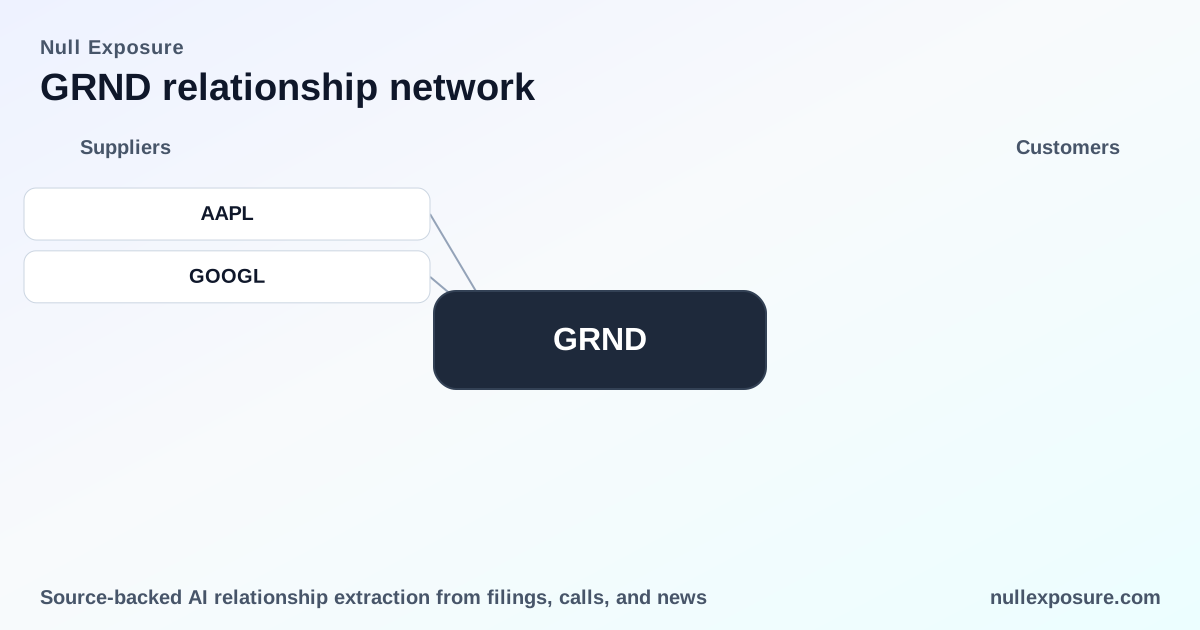
Grindr Inc (GRND): Supplier Relationships and Commercial Constraints that Drive Risk and Value
Grindr operates a location-based social and advertising platform for the LGBTQ+ community and monetizes primarily through advertising, premium subscriptions, and in-app purchases processed through mobile app stores and payment channels. Revenue is driven by engaged, location-aware user behavior and targeted ad inventory, while cost and operational continuity are concentrated in a small set of third-party service providers and distribution channels. For investors evaluating supplier risk and supplier-facing counterparty strategies, this profile isolates the commercial relationships that are both operationally critical and financially material. For detailed supplier intelligence and relationship mapping, visit NullExposure.
Quick investment thesis: how Grindr makes and protects cash flow
Grindr generates revenue by selling targeted advertising and subscription services to a highly engaged user base; advertising service providers and app store distribution are integral to both monetization and payment processing. Strong gross margins (reported gross profit $327.3M on $439.9M revenue TTM) underscore the platform economics, but concentrated vendor exposure and dependency on app-store payment rails create outsized operational and negotiating leverage for suppliers. Institutional investors should weigh high margin growth against supplier concentration and distribution risk.
The supplier relationships that matter right now
Below I cover every supplier relationship flagged in the source results and summarize the commercial role and observable dependency.
Apple — app distribution and payment access
Grindr distributes its iOS client through Apple’s App Store and uses Apple’s platform for access and payments, which makes Apple a distribution partner and payment gatekeeper for iPhone users. A MarketScreener news item (March 9, 2026) explicitly notes Grindr’s availability in Apple’s App Store: https://www.marketscreener.com/news/grindr-inc-investigated-for-breaches-of-fiduciary-duty-contact-the-djs-law-group-to-discuss-your-ce7d5adddf8ef023.
Takeaway: App Store control over payments and distribution gives Apple structural leverage over Grindr’s consumer monetization on iOS.
Google Play — Android distribution and payments
Grindr relies on Google Play for Android distribution and payment processing, making Google Play a second critical distribution and payments channel. The same MarketScreener article (March 2026) references availability on Google Play: https://www.marketscreener.com/news/grindr-inc-investigated-for-breaches-of-fiduciary-duty-contact-the-djs-law-group-to-discuss-your-ce7d5adddf8ef023.
Takeaway: Together with Apple, Google Play represents the dominant route to market for mobile users and a concentrated bargaining front for commission structures and platform policies.
(For deeper supplier mapping and monitored vendor change alerts, see NullExposure.)
What the company’s disclosures say about supplier concentration and roles
Grindr’s own filings and disclosures frame supplier relationships as both operationally essential and financially concentrated. For the year ended December 31, 2024, the company reported that no customers represented 10% or more of revenue, but three vendors accounted for 60.7%, 15.4%, and 13.3% of cost of revenue, which the company classifies as critical vendor exposure. The company filing also documents reliance on third parties—cloud, hosted web services, advertising service providers, and app store distribution channels—for processing sensitive user data and for payment processing. These sections show a mixed posture: high operational dependency coupled with vendor concentration that creates single‑point pressures on costs and continuity.
Operating model constraints that shape negotiation and risk
Several company-level constraints emerge from the filings and the relationship evidence:
- Contracting posture: Grindr contracts with multiple third-party advertising service providers and directly with advertisers, but distribution and payments are funneled through a small number of platform providers (Apple/Google), which limits Grindr’s ability to unilaterally change end-customer billing mechanics.
- Concentration and criticality: Vendor concentration is material: three vendors account for the majority of cost of revenue and the company explicitly treats those relationships as critical to operations. This concentration increases counterparty leverage and creates potential single‑vendor failure risk.
- Data and operational maturity: Grindr relies on mature cloud and hosted providers (for example, references to Amazon Web Services in public filings) to process sensitive user data; this indicates a conventional cloud-first architecture but also outsources security, compliance, and uptime risk to service providers.
- Distribution dependency: The app-store distribution model is entrenched and functions as both channel and payment processor; this raises persistent platform policy and fee exposure that impacts gross margin sustainability.
These constraints are presented at the company level unless the constraint excerpt explicitly names a relationship (for distribution the filing explicitly names Apple App Store and Google Play).
How these supplier relationships translate into investor risk and upside
- Cost pressure and fee compression: Apple and Google’s app-store economics are non-negotiable levers that can compress subscription and in-app revenue net of fees. This affects free-cash-flow conversion and valuation multiples more than direct advertising costs.
- Operational continuity risk: Heavy concentration among a handful of vendors—three vendors representing the bulk of cost of revenue—creates outsized counterparty operational risk; any outage or pricing change could materially affect short-term results.
- Regulatory and reputational windows: Platform policy enforcement (content moderation, privacy rules) and scrutiny (as noted in news coverage) can introduce episodic risk to distribution or ad-monetization.
- Upside via premium features and direct advertiser relationships: Grindr’s direct contracting with advertisers and its strong user metrics provide upside to offset platform fees, contingent on expanding ad product suite and first-party monetization.
Practical implications for procurement and investor monitoring
- Prioritize monitoring of platform policy updates and app-store fee structures; Apple and Google are principal levers on near-term revenue realization.
- Stress-test financial models for a 100–300 bps compression in subscription/ad take rates driven by platform fees or increased third-party ad costs.
- Track vendor concentration trends in filings: if the top three vendors remain >50% of cost of revenue, the company remains exposed to single-supplier shocks.
For ongoing supplier signal tracking and audit-ready supplier maps, visit NullExposure.
Actionable next steps for investors
- Revisit valuation sensitivity to platform fee changes and vendor outage scenarios; adjust risk premiums if vendor concentration remains unchanged.
- Engage management on supplier diversification plans, direct billing alternatives, and ad inventory controls to assess governance and mitigation strategy.
- Add a watchlist alert for any material change in app-store policy or vendor concentration disclosures in quarterly filings.
For a supplier-focused intelligence briefing tailored to institutional investors, go to NullExposure.
In summary: Grindr’s economics are strong but vendor concentration and platform distribution dependence are material constraints that create asymmetric downside to earnings and cash flow. Investors should treat Apple and Google Play as strategic counterparties in any commercial assessment and press management for diversification or mitigation measures.