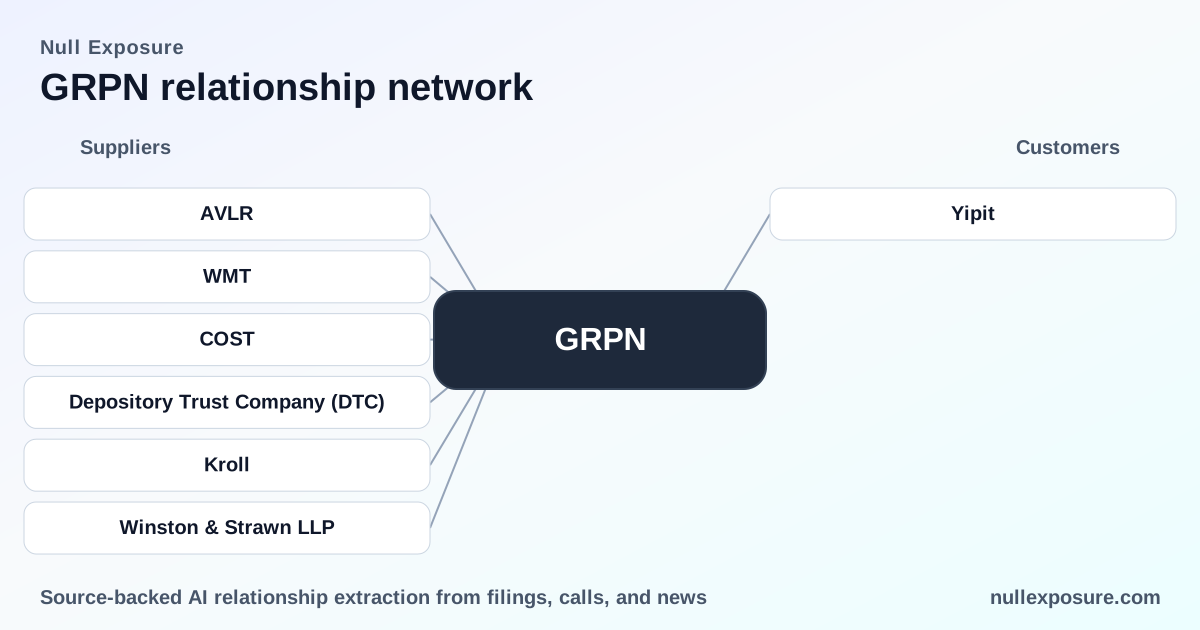
Groupon's Supplier Map: Who Enables Its Marketplace and What Investors Should Know
Groupon operates a two-sided marketplace that connects consumers with local and national merchants, monetizing primarily through transaction fees, merchant commissions, and marketing services sold to those merchants. The company's competitive position depends on its ability to source attractive merchant offers, ensure tax and regulatory compliance across jurisdictions, and execute capital markets and corporate actions efficiently — all of which require a network of third‑party suppliers and service providers that support day‑to‑day operations and occasional corporate events. For an investor evaluating supplier risk and strategic leverage, the relationships below outline the providers that materially touch Groupon’s operating model. Learn more and track supplier exposures at https://nullexposure.com/.
What the supplier relationships reveal about how Groupon runs the business
Groupon’s supplier footprint shows a mixed contracting posture: the company relies on both short-term merchant arrangements (commissions and sales relationships typically recognized over 12–18 months) and longer-term incentive agreements for enterprise marketing services. Company disclosures reference an active three‑year incentive marketing agreement with Major Rocket LLC, which demonstrates willingness to enter multi‑year performance-linked contracts for enterprise sourcing. These characteristics produce the following company-level signals:
- Contracting posture: A hybrid of short-term merchant arrangements (12–18 month expected durations for sales commissions) and selective long-term incentive agreements for enterprise sourcing and marketing.
- Concentration and criticality: Critical service providers include tax compliance and transfer agents for corporate actions; merchant partnerships (e.g., membership deals with large retailers) are volume drivers but individually replaceable.
- Maturity of relationships: Operational relationships like tax and legal counsel are mature and recurring; rights‑offering and corporate services engagements are event-driven but operationally critical when invoked.
- Supplier role: Groupon treats many providers as service partners (marketing, tax compliance, legal, transfer/agent services), reflecting a reliance on external capabilities rather than owning the full stack.
These patterns influence margin stability, compliance risk, and execution reliability during corporate events such as rights offerings.
The supplier roster that matters to shoppers and shareholders
Avalara — tax calculation and reporting
Groupon implemented Avalara AvaTax and Avalara Returns to calculate sales and use tax and to manage tax reporting and returns across the U.S., embedding Avalara into its compliance workflow. According to an Avalara press release, Groupon adopted these products to stay compliant and continue serving customers nationally (Avalara newsroom, July 27, 2022). https://newsroom.avalara.com/2022-07-27-Groupon-Manages-Global-Tax-Reporting-with-Avalara
Walmart’s Sam’s Club — merchant partnership for consumer offers
Groupon distributed promotional memberships tied to Walmart’s Sam’s Club, offering membership discounts that drive consumer acquisition and top-line volume for the marketplace. InvestorPlace covered a Groupon promotion offering 50% off Sam’s Club memberships as part of Groupon’s merchant promotions (InvestorPlace, 2023). https://investorplace.com/2023/01/groupon-layoffs-2023-what-to-know-about-the-latest-grpn-stock-job-cuts/
Costco — distribution partnership for paid memberships
Groupon acted as a reseller or promotional channel for Costco memberships, bundling sign‑ups with promo codes to stimulate both membership sales and ancillary Costco merchandise purchases; this expands Groupon’s revenue mix beyond single‑use coupons. A news report covering the Costco membership promotion lists the consumer offer and the timeframe for the promotion (AOL News, FY2025 reporting). https://www.aol.com/articles/groupon-offering-epic-discount-costco-184616205.html
Depository Trust Company (DTC) — critical transfer and settlement coordination
Groupon relied on Kroll to coordinate closely with DTC during a rights offering because of the number of holders and the volume of oversubscriptions, underscoring DTC’s central role in clearing and settlement for equity actions. Kroll’s issuer services coverage describes the operational dependence on DTC to ensure accurate share calculations and post‑offering allocation (Kroll publication, FY2025). https://www.kroll.com/en/publications/issuer-services/groupon-rights-offering-issuer-services
Kroll — subscription and information agent for corporate action
Kroll’s Issuer Services U.S. team served as subscription and information agent for Groupon’s rights offering, managing the investor communications, subscription mechanics, and allocation calculations that are operationally sensitive during capital raises (Kroll issuer services, FY2025). https://www.kroll.com/en/publications/issuer-services/groupon-rights-offering-issuer-services
Winston & Strawn LLP — legal counsel for corporate processes
Winston & Strawn LLP represented Groupon as legal corporate counsel for the rights offering, providing transactional and securities counsel necessary for regulatory compliance and offering documentation (Kroll publication, FY2025). https://www.kroll.com/en/publications/issuer-services/groupon-rights-offering-issuer-services
How these relationships translate into investor risk and opportunity
Groupon’s suppliers split neatly into two functional buckets: operational enablers (Avalara, merchant partners such as Costco and Sam’s Club) and corporate event specialists (Kroll, DTC coordination, and legal counsel). Each bucket presents distinct investor implications:
- Operational enablers drive margin and compliance. Avalara’s tax services reduce regulatory friction and potential tax-related exposures across jurisdictions; merchant promotions expand top-line but can compress margins if heavily subsidized. Consistent tax compliance is a de‑risking factor for the platform economy where sales tax rules are fragmented.
- Event specialists affect capital flexibility and execution risk. Kroll, DTC coordination, and Winston & Strawn are essential when Groupon executes rights offerings or other equity actions; failures or slippage in these engagements create outsized dilution or timing risk. Reliable corporate services preserve execution optionality in capital markets.
Midway CTA: For a deeper read on supplier concentration and its effect on capital allocation, visit https://nullexposure.com/.
Practical takeaways for investors and operators
- Merchant relationships are short-to-medium term and revenue‑driving; marketing incentives can be multi‑year and performance‑linked, which supports targeted growth but introduces counterparty performance risk.
- Tax and legal partners are strategic and high‑criticality; operational continuity with providers like Avalara and strong legal counsel mitigates compliance and disclosure risk.
- Event-driven suppliers are mission‑critical during capital raises; the rights offering evidence demonstrates Groupon’s reliance on specialized third parties for shareholder‑level execution.
Final CTA: Track changes in supplier relationships and get supplier-risk intelligence at https://nullexposure.com/.
Bottom line
Groupon runs a marketplace that depends on a modest but functional set of third‑party relationships: merchant partners and tax processors sustain the consumer business, while issuer agents and legal counsel enable capital-market actions. For investors, the supplier map highlights where operational resilience matters (tax, legal) and where management can adjust economics (merchant promotions and marketing arrangements). Evaluate Groupon’s next funding or promotional moves through this lens to separate short‑term promotional lift from sustainable revenue improvements.