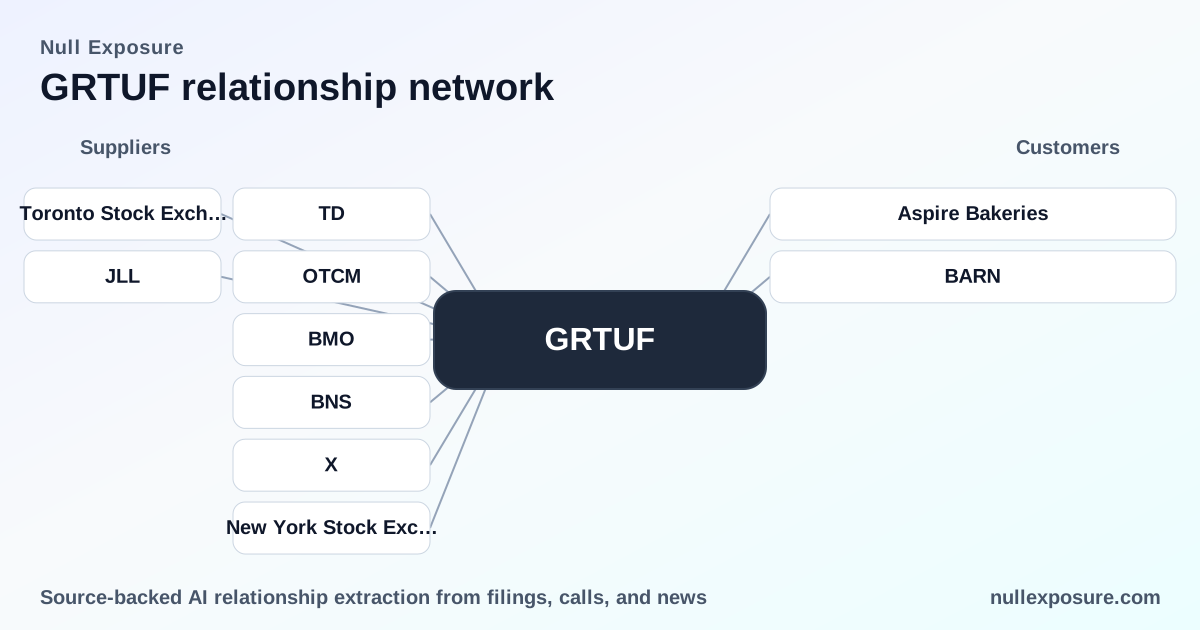
Granite REIT (GRTUF) — Who Granite contracts with, and what it means for investors
Granite Real Estate Investment Trust is a Toronto-headquartered industrial REIT that acquires, develops, owns and manages logistics, warehouse and industrial buildings across North America and Europe. The business monetizes through rental income, property development gains and active capital markets engagement — including an at-the-market (ATM) equity distribution program and multi-exchange listings that provide liquidity and optionality for capital raising.
Explore a structured vendor and capital-markets view of Granite’s supplier relationships and what they reveal about the REIT’s operating posture. If you evaluate counterparty exposure or underwriting risk, see more at https://nullexposure.com/.
Quick take: capital markets and marketplace plumbing matter as much as the real estate
Granite uses institutional dealers and public trading venues to manage liquidity and fund growth. The ATM program and agreements with major Canadian dealers make equity issuance a repeatable, low-friction tool, while cross-listing on OTCQX increases U.S. investor access. These commercial relationships reduce execution risk on follow-on equity and broaden the investor base — important for a REIT with active development and dividend commitments.
Who Granite works with — line by line
Below I cover every relationship pulled from the available reporting. Each entry is a concise, plain-English take and includes the cited source.
TD Securities Inc.
Granite named TD Securities as one of the agents under its renewed ATM equity distribution agreement, giving TD a role in selling units into the market when Granite elects to issue through the program. Source: press release reported via The Globe and Mail / Business Wire, March 2026.
BMO Capital Markets
BMO Capital Markets is listed alongside other major dealers as an agent on Granite’s ATM program, positioning BMO to execute block or drip equity sales on behalf of the REIT. Source: press release reported via The Globe and Mail / Business Wire, March 2026.
Scotiabank
Scotiabank is a co-agent on the February 25, 2026 equity distribution agreement, providing an additional senior Canadian dealer for ATM executions and placement support. Source: press release reported via The Globe and Mail / Business Wire, March 2026.
Toronto Stock Exchange (TSX)
Units issued under the ATM program will be sold directly through the TSX or other recognized Canadian marketplaces, confirming the TSX is the primary venue for domestic liquidity and issuance activity. Source: press release reported via The Globe and Mail, March 2026.
OTC Markets Group Inc. (OTCQX)
Granite qualified to trade on the OTCQX Best Market under the symbol GRTUF, increasing U.S. investor access to the REIT’s shares via an established OTC venue. Source: OTC Markets Group announcement reported January 2026 and follow coverage in Proactive Investors (March 2026).
New York Stock Exchange (historical)
Public reporting notes that Granite previously traded on the New York Stock Exchange and currently trades on the TSX; the NYSE reference is disclosure context for past listing history rather than an active venue. Source: GlobeNewswire / OTC Markets coverage, January 2026.
JLL (Jones Lang LaSalle)
Granite used JLL’s leasing resources to pre-lease a large building at a 1.7-million-square-foot business park, illustrating use of an external brokerage and leasing partner for tenant placement and project activation. Source: RENX coverage of a FY2022 lease transaction.
What these relationships signal about Granite’s operating model
Treat the following as company-level signals about Granite’s posture and constraints, not as attributes of any single counterparty.
- Capital access and contracting posture: The existence of a multi-agent ATM agreement with top Canadian dealers and TSX execution rights shows Granite adopts an opportunistic issuance model — able to tap public equity markets incrementally rather than rely solely on large negotiated raises. This reduces timing risk when funding development or acquisitions but increases dependence on dealer willingness and market reception.
- Liquidity and investor reach: Dual listing history and qualification on OTCQX signal deliberate steps to broaden investor access across North America, improving retail and U.S. institutional liquidity for the trust’s units.
- Concentration and criticality: Granite’s core product is industrial logistics real estate; that geographic and asset-class concentration creates operational leverage to sector cycles. Counterparty relationships (brokers, exchanges, leasing agents) are important but not singularly critical to asset performance — the tenants and occupancy drive cash flow.
- Maturity and governance: The REIT shows the hallmarks of a mature public real-estate issuer: positive operating margins, steady dividend per share, and substantial institutional ownership (company filings show ~73% institutional ownership). These are consistent with a governance profile that supports repeat capital markets transactions.
Investment implications and risks for operators and counterparties
- Capital markets dependence is a double-edged sword. The ATM program and dealer network give Granite flexibility to raise equity without staging a full public offering, which supports growth and dividend coverage. However, if market sentiment shifts against industrial REITs or dealers reduce syndicate commitments, optionality narrows quickly.
- Market access reduces execution drag. Qualification on OTCQX and TSX execution rights lower friction for U.S. and Canadian investors to buy and sell Granite securities, supporting price discovery and the viability of follow-on offerings.
- Operational exposure remains to property fundamentals. Leasing partners such as JLL improve tenant placement and reduce vacancy risk on large projects, but portfolio-level occupancy and rental rates ultimately determine cash flow and the capacity to service dividends and development pipelines.
Learn more about how these supplier relationships affect exposure and counterparty risk at https://nullexposure.com/.
Recommendations for investors evaluating Granite’s counterparties
- Monitor dealer engagement around any announced ATM placements: volume, pricing, and underwriting counsel set the tone for dilution and capital cost.
- Track liquidity across TSX and OTCQX quotes to assess whether cross-listed trading is materially supporting institutional flows.
- Evaluate lease-level performance on major projects where third-party brokers were used to pre-lease space — successful large pre-leases (as with the JLL-assisted transaction) materially derisk development outcomes.
For a deeper supplier-level risk profile and ongoing monitoring, visit https://nullexposure.com/ to request tailored exposure reports.
Bottom line
Granite REIT combines a traditional industrial real-estate cash-flow model with an active capital markets strategy: repeatable ATM issuance supported by top Canadian dealers, broader U.S. access through OTCQX, and professional leasing partners to de-risk development. That architecture gives investors flexibility and operational scale, while leaving the core sensitivity to industrial leasing cycles and market appetites for REIT equity. For further counterparty intelligence and continuous tracking, see https://nullexposure.com/.