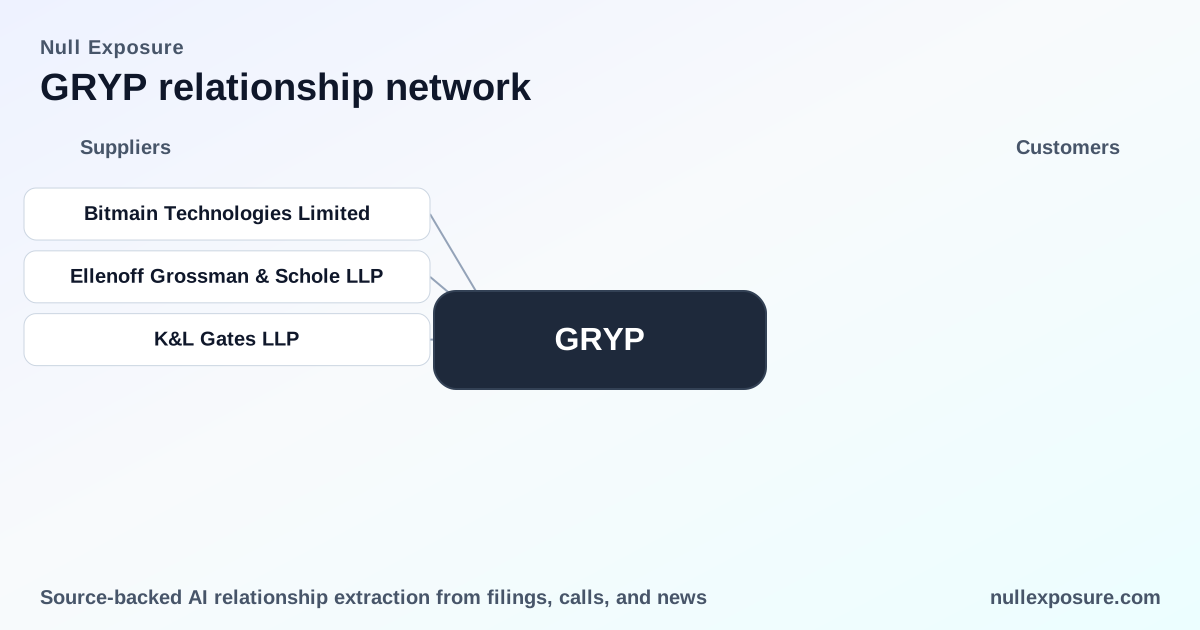
GRYP supplier map: hardware, legal counsel, and what it means for investors
Gryphon Digital Mining (GRYP) operates and monetizes by deploying ASIC bitcoin miners in third‑party hosted data centers and extracting Bitcoin as the primary revenue source, while also participating in hosting and asset‑management activities tied to its mining fleet. The company sources mining hardware from specialists, contracts colocation capacity, and uses outside legal advisers for transactions — a capital‑intensive and vendor‑dependent model where supplier relationships directly shape operating leverage and execution risk.
For a deeper supplier risk profile and relationship tracking, visit https://nullexposure.com/.
How GRYP’s commercial model turns hardware into revenue
Gryphon’s business converts deployed computing hardware into block rewards and transaction fees, with the economics driven by hash rate, uptime in hosted facilities, energy costs embedded in hosting contracts, and the age/efficiency of ASIC inventory. Revenue is therefore a function of hardware scale and hosting reliability rather than software licensing or recurring subscriptions. That puts supplier selection — both equipment vendors and datacenter hosts — at the center of operational performance and margin volatility.
- Contracting posture: Gryphon outsources facility operations to third‑party hosted mining data centers, reducing direct facilities capex but increasing counterparty reliance.
- Concentration: the fleet composition is skewed toward a single recognized equipment supplier, creating vendor concentration risk for upgrades, spare parts, and warranty coverage.
- Criticality: hardware vendors and host operators are critical for uptime and hash‑rate delivery; any disruption has immediate revenue impact.
- Maturity: the model is capital‑intensive and cyclical; lifecycle risk from ASIC obsolescence is a persistent factor for profit sustainability.
If you are benchmarking supplier exposure, review these relationship signals on the company profile at https://nullexposure.com/ to prioritize due diligence.
The supplier list every investor should read
Below I cover every supplier relationship surfaced in public reporting and news captured for GRYP. Each entry is a concise, plain‑English summary with a source you can follow for the primary disclosure.
Bitmain Technologies Limited — the hardware backbone
Gryphon operates roughly 9,000 Bitmain ASIC mining computers installed in third‑party hosted mining data centers located in New York, making Bitmain the primary equipment vendor for the fleet and a key determinant of hash‑rate and efficiency. According to MarketScreener reporting referencing company disclosures (FY2024), those Bitmain machines represent the core deployed inventory driving mining output. A prior MarketScreener mention referencing FY2020 documents the same vendor relationship and fleet description, indicating continuity in vendor sourcing over multiple reporting periods. (Sources: MarketScreener news items, March 2026; MarketScreener FY2020 coverage.)
Ellenoff Grossman & Schole LLP — transaction counsel on record
Barry Grossman, Anthony Ain, and Meredith Laitner of Ellenoff Grossman & Schole LLP acted as legal counsel for Gryphon in the reported transaction disclosures, signaling the firm’s role in structuring or documenting deals and regulatory filings for the company. The engagement is documented in MarketScreener coverage of the company’s FY2024 filings and related transaction reporting in March 2026. (Source: MarketScreener, March 2026.)
K&L Gates LLP — external legal advisory
Michael A. Hedge and Jason C. Dreibelbis of K&L Gates LLP are listed as legal advisors to Gryphon in the same public reporting, indicating parallel or complementary outside counsel roles for corporate or transaction matters. That dual‑counsel footprint can reflect complexity in deal structuring and the need for specialized regulatory or transactional advice. (Source: MarketScreener, March 2026.)
What the supplier map implies for operators and investors
The supplier mix — heavy on Bitmain hardware and supported by external law firms for transactions — creates a predictable set of strategic implications:
- Operational leverage concentrated in hardware efficiency. With ~9,000 Bitmain ASICs forming the active fleet, small changes in uptime, power pricing embedded in hosting contracts, or hardware failure rates translate directly into P&L swings.
- Vendor concentration risk is material. Reliance on a single OEM increases exposure to supply chain delays, firmware or quality issues, and spare‑parts bottlenecks; procurement flexibility is limited without an active strategy to diversify models or suppliers.
- Third‑party hosting transfers capex but increases counterparty dependency. Outsourcing datacenter operations limits capital on the balance sheet but puts contractual terms, SLAs, and local energy markets at the center of continuity risk and margin management.
- Legal advisory footprint signals transaction cadence. The use of two established law firms for deal work suggests ongoing M&A, financing, or structuring activity that merits attention when modeling future capital needs or covenant frameworks.
If you want a supplier‑first view of GRYP’s operating exposure and counterparty list, explore the company profile and reports at https://nullexposure.com/ for structured monitoring.
Investment implications and risk checklist
For investors and operators evaluating GRYP supplier relationships, prioritize these items when performing diligence:
- Validate hardware warranty, service level agreements, and spare parts access from the OEM. Hardware uptime and efficiency are the revenue production engine.
- Review colocation contracts for force majeure, power pricing escalators, and termination rights; hosting vendors control the physical uptime.
- Scrutinize transaction filings and counsel disclosures for upcoming financings or asset purchases that will affect leverage and dilution.
- Monitor fleet age and refresh cadence to model hash‑rate decline and capital expenditure requirements.
Bottom line and next steps
Gryphon’s supplier profile is straightforward and highly consequential: the company converts Bitmain ASICs hosted in third‑party facilities into Bitcoin revenue, with legal advisers documented for transaction work. For active investors, the primary risks are vendor concentration and hosting counterparty performance; the primary levers are fleet efficiency and contract terms. For ongoing monitoring and supplier risk scoring, see the detailed supplier dashboards and alerts available at https://nullexposure.com/.
For tailored due diligence or to integrate supplier exposure into your investment model, visit https://nullexposure.com/ and request the GRYP supplier brief.