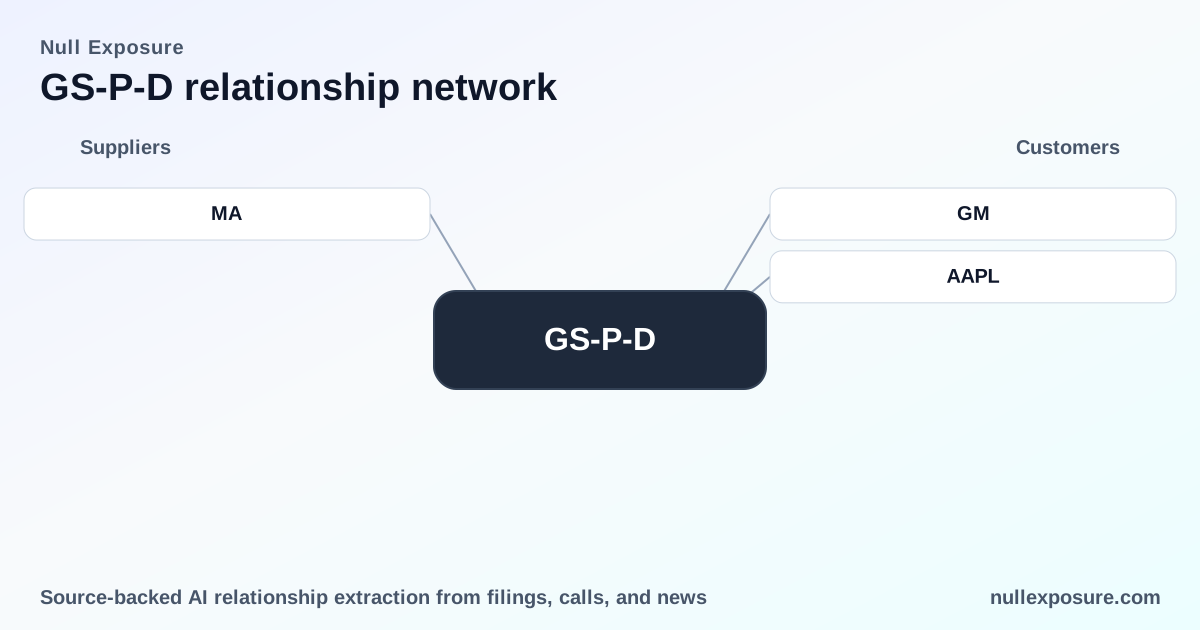
Goldman Sachs (GS-P-D): What the Mastercard Link Reveals About Supplier Risk and Strategy
Goldman Sachs is a diversified financial services franchise that monetizes through investment banking fees, trading and principal investments, asset and wealth management fees, and targeted consumer-lending products delivered through partnerships and its Marcus platform. The preferred share series GS-P-D represents capital packaging for the bank; its valuation and risk profile are influenced by the firm’s counterparty relationships — especially payment-network and issuing agreements that enable retail products. For investors and operators evaluating supplier posture, the Mastercard partnership is a live example of how Goldman offloads distribution and infrastructure while retaining credit and fee economics.
Learn more about supplier exposures and relationship signals at https://nullexposure.com/.
Why one partnership matters more than it looks
Goldman’s consumer strategy is deliberately hybrid: it keeps credit risk and product economics on its balance sheet while outsourcing network rails and merchant acceptance to third parties. That arrangement creates a set of predictable business-model characteristics:
- Clear contracting posture: Goldman typically operates as the issuer and credit owner while licensing network services (e.g., Mastercard) under commercial agreements.
- Concentration trade-offs: Consumer initiatives are diversified across product types, but each product often hinges on a small set of network and distribution partners.
- Operational criticality: Payment-network access is mission-critical to card programs — network outages or contract shifts would immediately impair go-to-market capability.
- Maturity and optionality: Card programs are extensions of Marcus and represent a scaling strategy rather than a core institutional revenue stream.
These points drive both upside (scalable fee and interest income) and downside (counterparty and operational concentration) for investors in GS-P-D.
The relationship ledger — partner-by-partner readout
Mastercard Inc
Goldman issued a co-branded card product under the Mastercard network, with the My GM Rewards card described as being issued by Mastercard through Goldman Sachs, marking a continued expansion of Marcus into co-branded credit offerings. According to a Yahoo Finance report on March 9, 2026, this card is the second credit card Goldman has offered via its Marcus consumer app and underscores Goldman’s reliance on network partners for consumer distribution and payment processing (Yahoo Finance, Mar 9, 2026).
How the Mastercard tie fits Goldman’s operating model
Goldman structures consumer products so that credit risk and pricing stay on its balance sheet while network and acceptance are supplied by partners. That division of labor reduces the need for Goldman to operate payment rails and accelerates product launches through established network reach. For operators, this means vendor management is focused on contract terms, service-level agreements, and contingency planning rather than basic capability build.
From a supplier-risk perspective, the Mastercard relationship is a standard issuer-network arrangement: Goldman controls underwriting and account management; Mastercard supplies authorization, clearing, and merchant services. That split compresses certain operational risks into the contract layer (e.g., interchange settlement windows, dispute flows) while leaving credit cycles and loss reserves as Goldman’s core exposure.
What this implies for risk and valuation
- Counterparty dependency: Payment networks are highly standardized but strategically indispensable; loss of a network agreement would be disruptive and require expensive remediation.
- Contract leverage: Goldman’s negotiating leverage is meaningful because it brings underwriting scale and distribution potential, but networks retain pricing power for access and settlement terms.
- Regulatory overlay: Co-branded card programs combine banking oversight with consumer protection regimes; regulatory shifts on interchange or disclosures have direct P&L consequences.
- Reputational linkage: Co-brand partners can amplify or dampen brand risk; a product failure on the network side transmits to Goldman’s consumer brand and balance sheet.
Investors should treat network agreements as non-trivial operational assets whose terms and continuity influence earnings stability for consumer lending verticals that support the firm’s overall capital structure.
Constraints and company-level signals you should watch
The available relationship data contains no explicit contractual constraints flagged against GS-P-D in this review. That lack of named constraints is itself a company-level signal: there are no published supplier-imposed limitations captured here to restrict Goldman’s use of its partners. Investors should still monitor three company-level characteristics as they evaluate supplier exposure:
- Contracting posture: Goldman predominantly retains credit and revenue rights while contracting for network services — expect standard issuer-network terms rather than full-service outsourcing.
- Concentration: Consumer products depend on a small number of payment networks and issuer processors, creating single-point dependencies at the product level.
- Criticality and maturity: Card programs are operationally critical to consumer distribution and are a mature extension of Marcus rather than an experimental pilot.
These signals inform diligence priorities: secure visibility into contract length, termination clauses, SLA credits, and migration contingencies.
Explore deeper supplier relationship analytics and monitoring at https://nullexposure.com/ to stay ahead of counterparties that affect capital and earnings.
Practical actions for investors and operators
- Demand copies or summaries of key network agreements and termination mechanics for valuation stress testing.
- Model scenarios that stress interchange, authorization outages, and regulatory changes to isolate earnings sensitivity.
- Ensure contingency plans for card re-issuance, BIN migration, and dispute-handling to quantify remediation costs.
Bottom line: The Mastercard-issued My GM Rewards card is a straightforward example of Goldman’s operating model — it isolates credit economics inside the bank while relying on external networks for distribution and settlement. That structure accelerates product reach and revenue capture but concentrates operational and contractual risk in a few supplier relationships. For holders of GS-P-D, the economic durability of preferred equity depends as much on these third-party arrangements as on high-level capital metrics.
For a full view of supplier exposures and to track changes to partner relationships over time, visit https://nullexposure.com/.