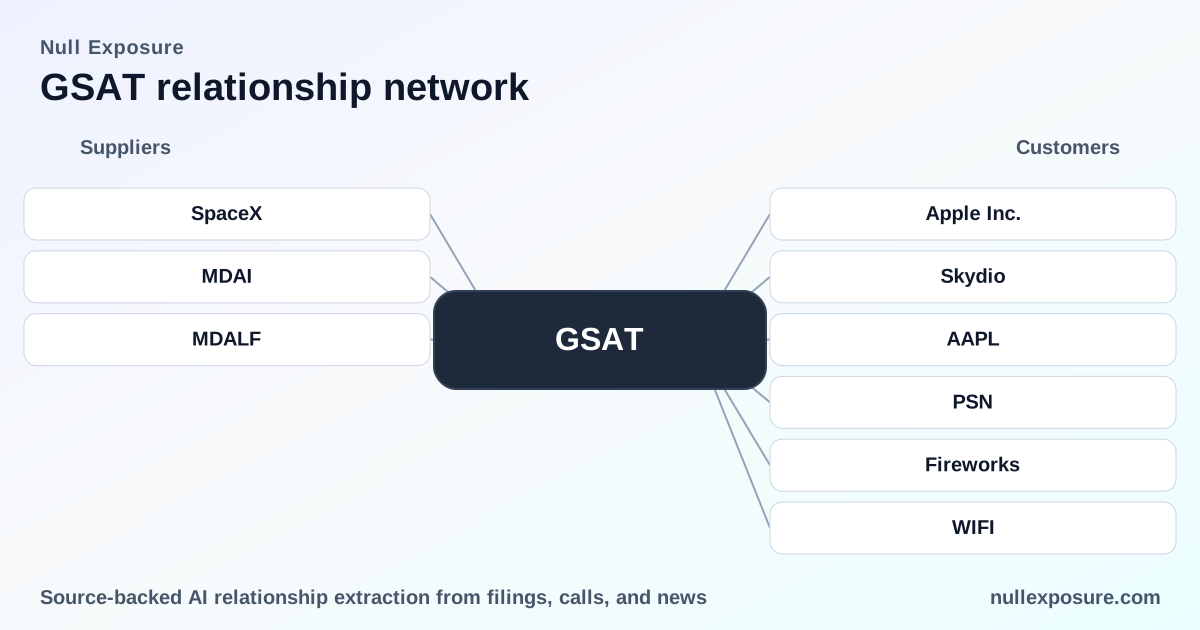
Globalstar (GSAT): Supplier relationships that determine launch cadence and capital intensity
Globalstar operates and monetizes a mobile satellite services platform: it sells connectivity and managed services to IoT and voice customers while underwriting a capital program to refresh and expand its low‑earth orbit satellite fleet. Revenue comes from service subscriptions and terminal sales, but the company’s near‑term growth and cost structure are governed by large hardware procurements and launch agreements. For investors, the value‑creation hinge is execution of procurement and launch schedules, and the supplier relationships documented in company filings and press coverage are the critical levers.
Explore more supplier intelligence at https://nullexposure.com/
Why suppliers matter more than typical vendors for GSAT
Globalstar is not a pure software operator: it is a capital‑intensive telecom operator whose product is a network in space. That makes supplier counterparty risk functionally equivalent to operational risk. Large manufacturing contracts determine capacity, and launch arrangements determine timing — both of which directly affect revenue ramp and capital requirements. The company’s market capitalization and valuation multiples already reflect this profile: elevated EV/Revenue and EV/EBITDA multiples indicate investor expectations tied to future network value rather than current margins.
Direct relationship summaries (every result covered)
SpaceX — launch services recorded in the 2024 Form 10‑K
Globalstar has a Launch Services Agreement with SpaceX that provided a launch window from April to September 2025 for the first set of satellites under the agreement with MDA, and Globalstar entered an additional agreement in October 2024 for launches tied to the Extended MSS Network. According to Globalstar’s 2024 Form 10‑K, these contracts are scheduled and explicit in the company’s deployment timeline. (Globalstar 2024 Form 10‑K)
SpaceX — press coverage on 2026 launch expectations
A March 2026 SpaceIntelReport article noted Globalstar was hoping for two SpaceX launches in 2026 but was only certain of one, which frames investor focus on delivery risk and cadence uncertainty for its next‑gen fleet. (SpaceIntelReport, Mar 9, 2026)
MDA — satellite procurement agreement and amended contract price
Globalstar’s 2024 Form 10‑K discloses a satellite procurement agreement with MDA to acquire at least 17 satellites (up to 26), with an amended contract price of $329.3 million for the initial 17 satellites, plus options for additional units and ancillary equipment purchases including SOCC components totaling roughly $9.2 million. The agreement includes customary termination provisions and delivery timing targeted for 2025. (Globalstar 2024 Form 10‑K)
MDA Space — expanded contract reporting in external press
Industry reporting in late 2025, as cited by TS2.tech referencing Reuters, states MDA Space expanded its contract with Globalstar to about C$1.1 billion to manufacture more than 50 advanced digital satellites for Globalstar’s next‑generation LEO program, indicating a materially larger manufacturing pipeline than the initial procurement disclosed in the 10‑K. (Reuters via TS2.tech, Dec 2025)
What the supplier map tells investors about GSAT’s operating model
The relationship entries and constraints combine into a clear operational blueprint:
- Contracting posture: project‑driven and capital‑committed. The presence of large, multi‑year procurement and launch agreements makes Globalstar a project sponsor rather than a transactional buyer. This creates concentrated contractual commitments that determine forward capital deployment.
- Concentration and criticality: a small number of counterparties control delivery. SpaceX (launches) and MDA (manufacturing) are high‑impact suppliers; delays or cost changes at these parties directly affect revenue recognition and capital needs. The disclosed spend band — an amended contract price of $329.3 million and press reports of C$1.1 billion — signals high concentration of spend and high criticality.
- Maturity and transition: hardware‑centric expansion with embedded services. Constraint signals classified Globalstar as a licensee in intellectual property dealings and as a manufacturer customer and service purchaser. This mix shows the company is migrating from legacy MSS service operations to a next‑generation LEO hardware platform, blending procurement, launch orchestration, and services support.
- Operational risk tied to schedule adherence. The launch windows and staged delivery obligations indicate that revenue growth is contingent on on‑time launches — a classic telecom capex scheduling risk where supplier performance equals revenue realization.
These characteristics are derived from company filings and constraint excerpts: licensing evidence (an IP license agreement) and explicit procurement and launch language together form a company‑level signal that Globalstar runs a capital‑intensive, supplier‑dependent operating model.
If you are evaluating counterparties or credit exposure, start by stress‑testing schedule slips and cost overruns for the MDA and SpaceX arrangements. More supplier analysis is available at https://nullexposure.com/.
Financial and strategic implications — risk and upside
- Upside: Successful delivery of the next‑gen constellation accelerates service offerings and expands addressable IoT markets, supporting Globalstar’s premium multiples if revenue scales and unit economics improve.
- Risk: Concentrated manufacturing and launch commitments create execution risk; deviations in launch cadence (SpaceX certainty for one launch vs. hoped‑for two) compress near‑term revenue and can increase financing needs.
- Balance sheet sensitivity: Large up‑front procurement commitments (hundreds of millions) increase funding reliance, elevating the importance of counterparty credit and contract termination/force majeure clauses disclosed in the 10‑K.
How investors should act now
- Monitor confirmed launch manifest updates from SpaceX and delivery confirmations from MDA as the primary leading indicators of GSAT’s operational progress.
- Evaluate funding flexibility: given the high capital spend band revealed in filings, assess the company’s ability to bridge any shortfalls with equity, debt, or supplier financing.
- Track third‑party reporting for contract scope changes — the discrepancy between the 10‑K procurement figure and later press reports of a significantly larger C$1.1 billion program is a material signal on program scale and counterparty exposure.
For more structured supplier intelligence and to benchmark these relationships against peers, visit https://nullexposure.com/.
Final takeaway
Globalstar’s value is driven by successful execution of a concentrated supplier strategy: manufacturing scale from MDA and reliable launch cadence from SpaceX. Investors should underwrite GSAT with an operational lens — supplier performance is the principal determinant of timing and scale for revenue growth. For deeper supplier profiles and ongoing monitoring, see https://nullexposure.com/.