Goosehead Insurance (GSHD): Supplier Relationships and Operational Constraints for Investors
Goosehead Insurance operates as a scaled independent personal-lines insurance agency that monetizes by selling policies through a network of advisors and leveraging technology-enabled agency services to capture distribution economics and margin on commissions. Revenue comes from insurance premiums sold via its agency network, with profitability driven by agent productivity, recurring servicing efficiencies, and a technology stack outsourced in part to third parties that enable scale. For investors evaluating supplier risk and partner concentration, focus on the company’s outsourcing posture, publicity/PR partners, and targeted operational integrations that affect lienholder and lender workflows. For a quicker view of supplier risk tools and mapping, visit https://nullexposure.com/.
What investors need to know up front
Goosehead’s model is distribution-first: it invests in recruiting and scoring advisors while outsourcing key IT and customer-facing functions to external providers. That outsourcing is material to operations—the company explicitly links vendor performance to cost outcomes and the ability to deliver expected savings. Go to https://nullexposure.com/ for supplier risk dashboards and procurement intelligence.
Supplier map: every relationship captured in the dataset
Below are the relationships found in the collected sources, presented with concise, investor-focused context and source links.
-
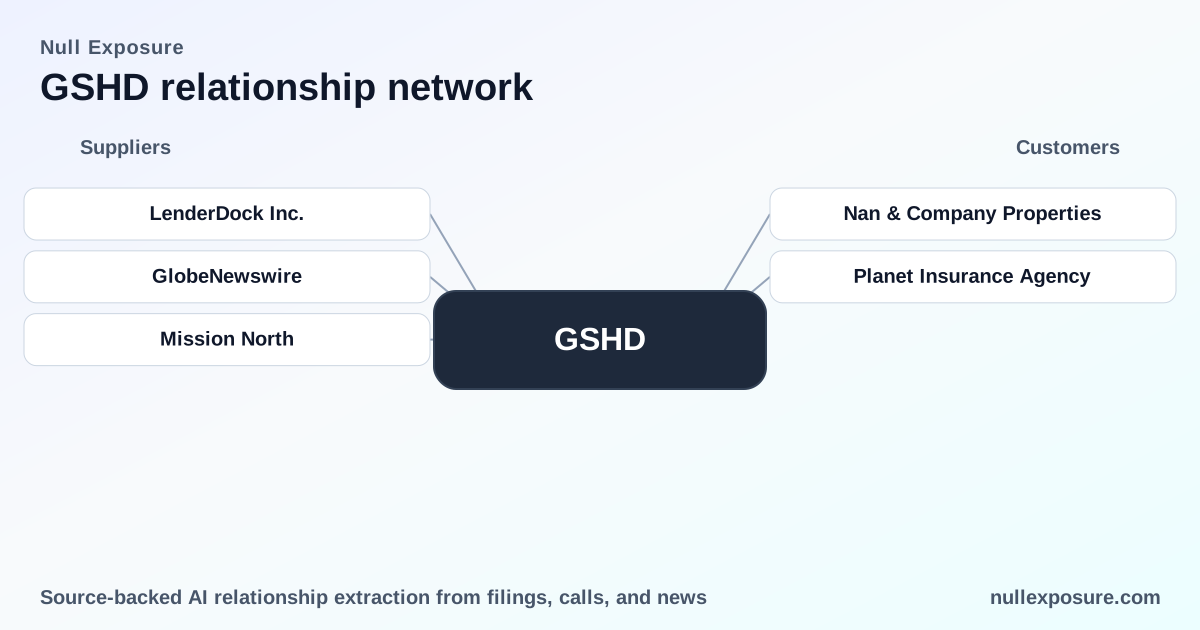
LenderDock Inc. — Goosehead entered a partnership to digitize lender-servicer interactions, automating lienholder verifications and mortgage correction requests to streamline mortgage-related workflows. This is a targeted operational integration that reduces manual lien management cost and error risk. Source: LenderDock press release, FY2022 — https://insurancenewsnet.com/oarticle/lenderdock-and-goosehead-insurance-partner-to-digitize-lender-servicer-interactions
-
GlobeNewswire — GlobeNewswire is a distribution channel used by Goosehead to publish earnings and corporate announcements, including the Feb 10, 2026 notice to report fourth-quarter and full-year 2025 results. This reflects the company’s public communications cadence and reliance on third-party newswire services to reach capital markets. Source: GlobeNewswire press release, Feb 10, 2026 — https://www.globenewswire.com/de/news-release/2026/2/17/3239716/0/en/Goosehead-Insurance-Inc-Announces-Fourth-Quarter-and-Full-Year-2025-Results.html
-
Mission North — Mission North is repeatedly listed as Goosehead’s PR contact across multiple press releases and third-party reposts in 2024–2026; effectively the firm acts as Goosehead’s public relations agency and primary media contact. The recurrence across filings and releases indicates a stable communications outsourcing arrangement. Source examples: Mission North press releases and PR contact listings (2024–2026) — e.g., https://markets.financialcontent.com/redlandsdailyfacts/article/gnwcq-2025-1-10-goosehead-insurance-inc-announces-new-300-million-term-loan-b-and-declares-a-one-time-special-dividend-of-591-per-share
These three names cover the complete set of distinct counterparties identified in the provided records. Each shows a different functional role: LenderDock for operational integration, GlobeNewswire for disclosure distribution, and Mission North for media and investor relations.
Operational constraints and what they mean for investors
Goosehead’s public language and the collected excerpts reveal several structural characteristics of its supplier relationships:
-
Outsourcing is materially important. The company warns that failure of outsourced providers to perform can force additional costs and prevent realization of expected savings; this elevates vendor performance to a financial lever, not a mere convenience. (Company disclosure language captured as a materiality signal.)
-
Technology and service providers are central to the operating model. Goosehead explicitly relies on third-party IT vendors—including Salesforce.com—for agency management, sales/service support, electronic communications, and selected finance functions, and it contracts vendors for regular risk assessments and annual penetration testing. This indicates a contracting posture that is intentionally externalized for core enabling systems rather than fully insourced. (Source: company disclosure excerpts.)
-
Relationships are active and governed. The dataset flags supplier relationships as active and indicates Goosehead employs risk assessment and penetration testing performed by third parties, signifying a mature vendor governance program in place, though governance effectiveness is an investor-level due diligence question.
-
Concentration and criticality. While the supplier list here is not exhaustive of all vendors, the mentions of enterprise platforms (Salesforce) and specialist integrators like LenderDock suggest concentration around a few critical providers—a single failed integration or prolonged outage could have outsized operational and financial effects.
Financial and strategic implications
-
Cost and margin sensitivity: Because third-party performance is tied to cost-savings, vendor contract terms, SLAs, and remediation rights will directly influence future operating margins and EBITDA realization. Investors should prioritize disclosure of vendor concentration in MD&A and contract summaries.
-
Execution risk in integrations: The LenderDock integration reduces manual lien handling and operational friction with lenders—if successful, it boosts advisor efficiency and reduces off-cycle remediation expense. Conversely, failed integrations transfer risk back to corporate expense lines.
-
PR and market signaling: The persistent use of Mission North and wire services like GlobeNewswire shows a deliberate communications playbook that supports predictable market announcements and investor engagement—important for sentiment and valuation in a P/E-rich stock (trailing P/E ~43 on the latest data).
For a supplier risk scorecard and to see how these relationships map against vendor-criticality and contract posture, check the platform at https://nullexposure.com/.
Practical diligence steps for investors and operators
- Request the vendor roster and identify single points of failure, especially around enterprise systems (CRM, billing, agency management).
- Validate SLAs, indemnities, and remediation clauses for material vendors; quantify potential remediation costs in worst-case scenarios.
- Review governance artifacts: third-party risk assessment reports, penetration-test summaries, and the cadence of vendor performance reviews.
- Confirm integration milestones and KPIs for operational partnerships such as LenderDock.
Bottom line
Goosehead has engineered a distribution-first business augmented by outsourced technology and communications partners, with explicit disclosure that vendor performance is material to cost and outcomes. The most consequential supplier exposures are operational integrations and enterprise IT providers—areas where a small set of failures would have visible financial and customer impact. For active investors and operators, the priority is examining vendor concentration, SLA strength, and governance effectiveness.
If you want an investor-grade supplier risk profile or a vendor concentration heatmap for Goosehead and its peers, explore our supplier intelligence tools at https://nullexposure.com/.