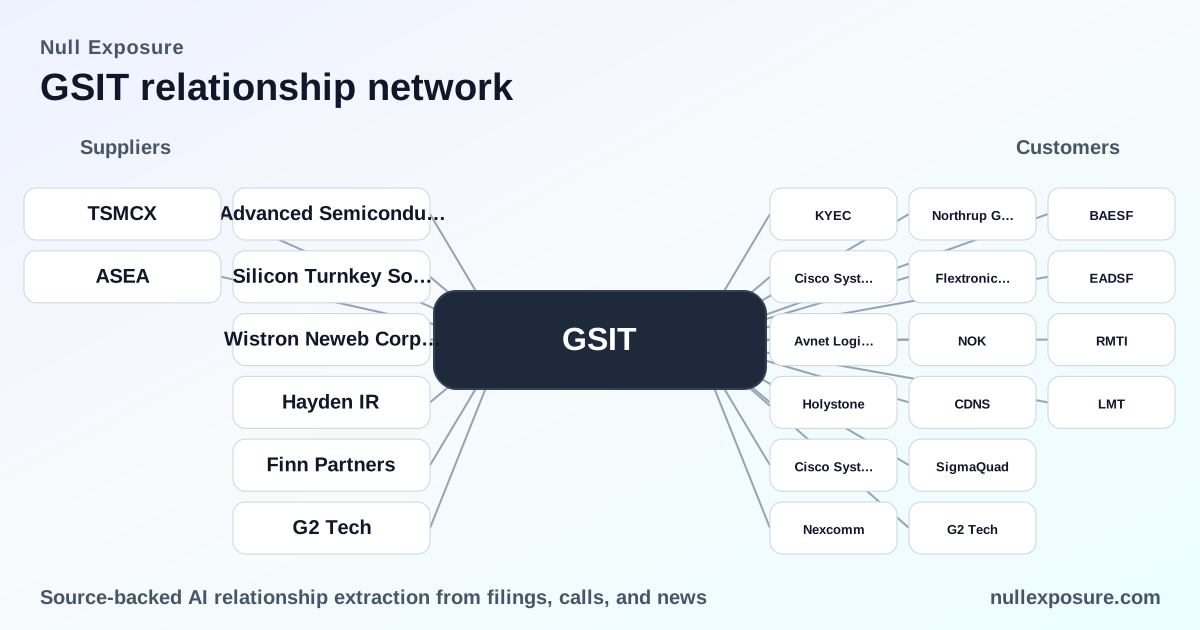
GSI Technology (GSIT): Supplier map, concentration risks, and operational implications for investors
GSI Technology is a factoryless semiconductor designer that monetizes by selling highly specialized memory products — Very Fast SRAM and compute-in-memory APUs — into networking, industrial, aerospace and defense end markets. The company outsources wafer fabrication, assembly and testing while capturing margin on design, firmware and system integration for applications that require low-latency edge inference and radiation-hardened performance. Revenue is product-sale driven; profitability depends on design differentiation, supply-chain continuity, and the ability to scale small-batch specialized components. For a deeper supplier-risk view, see NullExposure’s platform: https://nullexposure.com/
How GSI’s operating model shapes supplier importance
GSI operates a classic fabless model: it keeps design and IP in-house and contracts out manufacturing, packaging and board assembly. That posture reduces capital intensity and speeds access to advanced process nodes, but it also creates concentration and geographic single points of failure because core inputs (wafers and packaging) come from a small set of external vendors. According to GSI’s FY2025 10‑K, the company outsources wafer fabrication, assembly and wafer-sort testing to independent suppliers so it can "focus on our design strengths, minimize fixed costs and capital expenditures and gain access to advanced manufacturing technologies." This is a deliberate contracting strategy that trades fixed-cost leverage for supply-line dependency.
Key operating-model implications:
- Concentration risk is material: GSI sources wafers for core SRAM and APU products from a single foundry (TSMC), creating supplier dependency that directly impacts production continuity and cost control.
- Geographic exposure to APAC: critical packaging and board manufacturing occur in Taiwan and other APAC locations, amplifying geopolitical and logistics risk.
- Outsourcing maturity reduces CapEx but raises supplier management and quality-control demands, particularly for specialized products like radiation-hardened parts.
Explore the full platform for supplier diligence and monitoring: https://nullexposure.com/
Supplier-by-supplier readout (what each relationship means for investors)
Taiwan Semiconductor Manufacturing Company (TSMC)
GSI obtains wafers for its Very Fast SRAM and APU products from a single foundry, TSMC. This is a core manufacturing dependency that concentrates production risk and links GSI’s supply continuity to TSMC’s capacity and node roadmaps (FY2025 10‑K). Source: GSI FY2025 10‑K.
Advanced Semiconductor Engineering (ASE)
Most of GSI’s wafers are packaged at ASE in Taiwan, making ASE a critical node in final test and packaging for GSI’s product flow and exposing the company to APAC logistics and political risk (FY2025 10‑K). Source: GSI FY2025 10‑K.
Silicon Turnkey Solutions Inc.
GSI’s radiation‑hardened products are assembled and tested at Silicon Turnkey Solutions Inc., located near GSI’s Sunnyvale HQ, indicating an onshore assembly capability for defense- and aerospace-qualified parts that reduces some geopolitical logistics risk for those product lines (FY2025 10‑K). Source: GSI FY2025 10‑K.
Wistron Neweb Corporation
Boards for GSI’s APU product line are manufactured by Wistron Neweb Corporation in Taiwan, meaning completed system‑level hardware assembly depends on an APAC board‑manufacturer relationship (FY2025 10‑K). Source: GSI FY2025 10‑K.
G2 Tech
GSI announced a government‑funded proof‑of‑concept with Israel’s G2 Tech and two agencies (including a U.S. defense agency) to integrate its Gemini‑II compute‑in‑memory APU into the Sentinel autonomous perimeter security system, signaling early defense program traction for edge multimodal inference (news summary, FY2026). Source: SimplyWall summary of 2026 POC.
Hayden IR (Investor Relations)
GSI uses Hayden IR for investor relations; contact details were listed in the Jan 29, 2026 GlobeNewswire press release, indicating an active external IR arrangement to manage capital-markets communications (GlobeNewswire, Jan 29, 2026). Source: GlobeNewswire press release (2026‑01‑29).
Finn Partners (Media Relations)
Finn Partners acts as media relations support for GSI and is cited as the media contact in the same Jan 29, 2026 press release, showing reliance on an external PR firm for product and milestone announcements (GlobeNewswire, Jan 29, 2026). Source: GlobeNewswire press release (2026‑01‑29).
What the supplier map implies for risk-adjusted valuation and operations
GSI’s supplier footprint is compact and strategic: TSMC for wafers, ASE for packaging, Wistron for boards, and local assembly at Silicon Turnkey for radiation‑hardened units. That configuration supports rapid product development and competitive unit economics when supplies are available, but it concentrates operational risk along a small number of external partners.
Investment-relevant constraints and takeaways:
- Concentration: Single‑foundry dependence on TSMC is an explicit business constraint; wafer supply interruptions would directly curtail revenue. This is a structural concentration, not a short-term inventory issue (FY2025 10‑K).
- Geographic exposure: Packaging and assembly activities are substantially in APAC (ASE and Wistron presence in Taiwan), elevating geopolitical and logistic risk as a company-level signal tied to the supply chain (FY2025 10‑K).
- Contracting posture: GSI’s deliberate outsourcing reduces capital requirements and accelerates access to leading-edge manufacturing while increasing the importance of supplier management and contingency planning (FY2025 10‑K).
- Operational criticality: Wafers are an integral input; any sustained disruption to wafer supply reduces production of core products and compresses revenue, making supplier relationships operationally critical.
If you are evaluating GSIT from a supplier-risk or operational due-diligence perspective, prioritize monitoring TSMC capacity allocations, ASE packaging lead times in Taiwan, and any shifts in onshore assembly for defense-qualified products.
For ongoing supplier monitoring and to map concentration exposures visually, visit: https://nullexposure.com/
Bottom line for investors and operators
GSI is a design-led, factoryless semiconductor company that monetizes through specialized memory and APU products, but its financial performance is tightly coupled to a small number of external manufacturers and packagers. That structure benefits margins when supply is uninterrupted but creates measurable single‑source and geographic concentration risks. Investors should price in supply‑chain concentration while operators should push for contractual protections, dual-sourcing where feasible, and visibility into foundry roadmaps.
For supplier intelligence and to set up alerts on any changes to these relationships, go to: https://nullexposure.com/