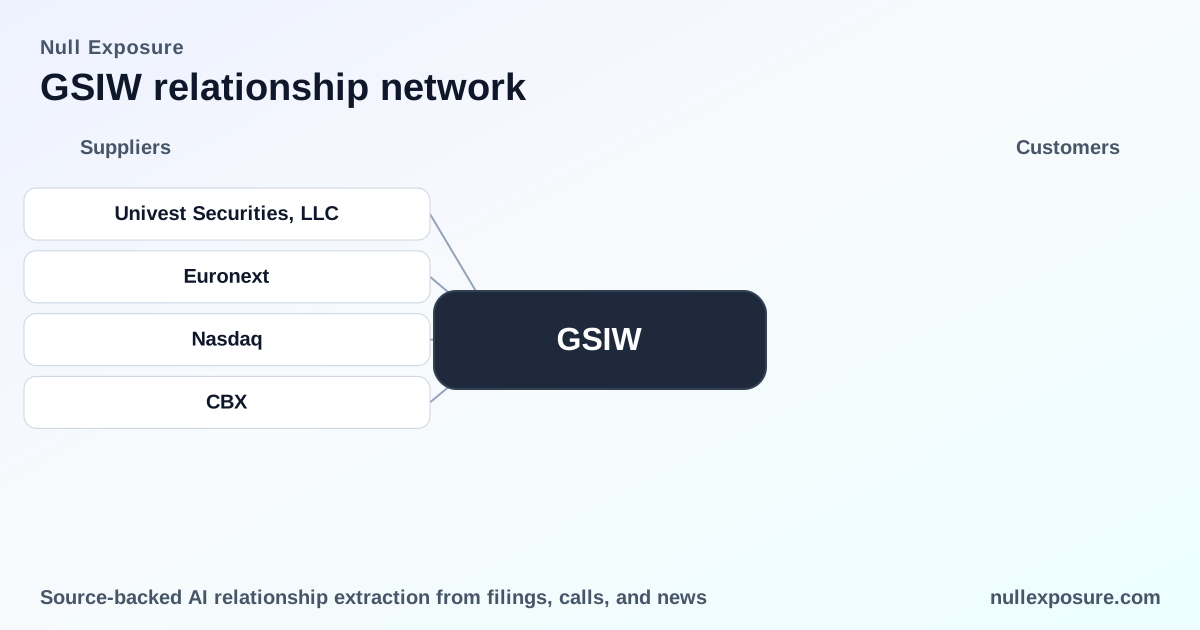
Garden Stage Limited (GSIW): supplier relationships, capital posture, and what operators need to know
Garden Stage Limited sells eco‑friendly gardening products and associated services to amateur and professional gardeners and funds expansion through public markets and private placement activity. The company monetizes primarily through product and service revenue while relying on equity capital markets and placement agents to finance growth; its public listing on Nasdaq and recent registered direct offering demonstrate a hybrid operating model that combines consumer product economics with capital‑markets funding dynamics. For investors and counterparties evaluating supplier relationships, the central question is whether Garden Stage’s commercial operations are sufficiently scaled and stable to support long‑term vendor performance given its aggressive capital‑raising posture and concentrated free float.
Visit https://nullexposure.com/ for more supplier and capital markets intelligence on GSIW.
How Garden Stage runs its business and why that matters to suppliers
Garden Stage is described as a sustainable gardening and horticulture operator that reinvests heavily in R&D and sells product solutions to a fragmented end market, while simultaneously operating as a public company that accesses capital through underwritten and registered offerings. This creates a dual operating model:
- Contracting posture: The company shows a clear reliance on external capital to bridge negative operating cash flow — the July 2025 registered direct offering executed with Univest Securities is an explicit example of this reliance and indicates that capital markets counterparties are strategic suppliers to Garden Stage’s operations. According to the GlobeNewswire announcement, Univest closed a $4.2 million registered direct offering for Garden Stage, reflecting active use of broker‑dealer distribution to raise equity capital (July 25, 2025).
- Concentration and liquidity: Shares outstanding are large (218.15 million) while the public float is tiny (≈1.05 million), and institutional ownership is minimal (2.73%), which creates highly uneven liquidity and counterparty concentration risk for service providers who price contracts against perceived market capitalization rather than realized trading depth. These figures are drawn from the company’s public profile and filings (CIK 1954269).
- Criticality of exchanges and market access: Garden Stage’s business continuity and financing depend on consistent exchange access and broker relationships; liquidity and secondary market mechanics matter more than for a typical private consumer goods firm because future cash needs are financed in the public markets.
- Maturity and margin profile: Financials show very small revenue (Revenue TTM ~$8.09 million) and extreme operating losses (EPS −35.27, Profit Margin −93.2%), signaling an early‑stage commercial profile or a significant mismatch between market valuation and operational performance. These are company reported metrics and shape supplier credit terms and payment expectations.
These operating characteristics should guide vendor terms, collateral requirements, and pricing for any long‑dated supplier commitments. For deeper relationship benchmarking, see our analysis and supplier mapping below. If you need detailed counterparty reports, start here: https://nullexposure.com/.
Relationship inventory — every supplier and market counterparty mentioned in public records
Univest Securities, LLC
Univest acted as placement agent and closed a $4.2 million registered direct offering for Garden Stage, providing immediate equity funding to the company and demonstrating a close capital markets supplier relationship. According to the GlobeNewswire release dated July 25, 2025, Univest executed the offering on behalf of Garden Stage.
Euronext
Trading commentary and market pages reference Euronext as one of the exchanges where similar securities trade, indicating that market participants and retail channels view Garden Stage in the broader cross‑exchange trading ecosystem; TradingView’s GSIW symbol page lists Euronext among relevant venues for comparable trading activity (FY2026 TradingView listing).
Nasdaq
Garden Stage is listed and traded on Nasdaq, which is the company’s primary public market and an operationally critical supplier of market access, listing services, and disclosure infrastructure. TradingView’s symbol page identifies Nasdaq as a trading venue for GSIW (FY2026 TradingView listing) and the company’s public profile confirms Nasdaq listing status (CIK 1954269).
Nyse
Third‑party market pages mention NYSE as a comparable exchange context for GSIW and similar instruments; while Garden Stage’s formal listing is on Nasdaq, NYSE references on market platforms reflect how broker‑dealer distribution and retail routing can direct interest through multiple venues. See TradingView’s GSIW listing page for the market summary (FY2026 TradingView listing).
What these relationships imply for counterparty risk and supplier strategy
These relationships create a clear set of commercial and operational implications for vendors, logistics partners, and financial counterparties:
- Capital markets suppliers are critical: The Univest placement shows Garden Stage executes reliance on registered offerings rather than debt, so underwriters and placement agents are strategic suppliers whose cost and execution quality materially affect working capital and vendor payment capacity.
- Liquidity mismatch elevates payment risk: Tiny float and low institutional ownership mean market value is sensitive to trades and disclosure events; suppliers must price that illiquidity into payment terms and credit lines.
- Valuation disconnect raises credit questions: Market valuation metrics (e.g., Price/Book ~211x, Price/Sales ~518x) combined with negative margins reflect a corporate profile where market prices do not align with operational cash generation, which increases counterparty exposure if future equity raises are delayed or repriced.
- Exchange access matters for secondary funding: Continuous listing on Nasdaq (and visibility on trading platforms referencing other exchanges) sustains the firm’s ability to raise equity; loss of that access or trading suspension would be an immediate supplier risk trigger.
Diligence checklist for operators evaluating supplier exposure
Actions operators and investors should prioritize before extending material credit or long‑term contracts:
- Verify recent placement documents and confirm availability of committed capital from placement agents such as Univest; request closing notices and use of proceeds documentation.
- Stress‑test liquidity: analyze free float, average daily volume, and contingent financing sources; calibrate payment terms to a conservative scenario where equity markets are closed for 3–6 months.
- Contract clauses: require step‑in rights, advance notice for reorganizations, and payment acceleration tied to subsequent equity raises.
For tailored counterparty reports and monitoring of GSIW’s market activity, visit https://nullexposure.com/.
Bottom line
Garden Stage’s operating model combines consumer product revenue generation with explicit reliance on capital market suppliers to fund expansion. Key supplier relationships — underwriting (Univest) and exchange access (Nasdaq and marketplace routing) — are central to cash flow and go‑forward viability. For vendors and institutional counterparties, manage exposure through tighter payment terms, documented capital commitments, and active monitoring of market liquidity and disclosure events. Further supplier intelligence and continuous monitoring are available at https://nullexposure.com/.