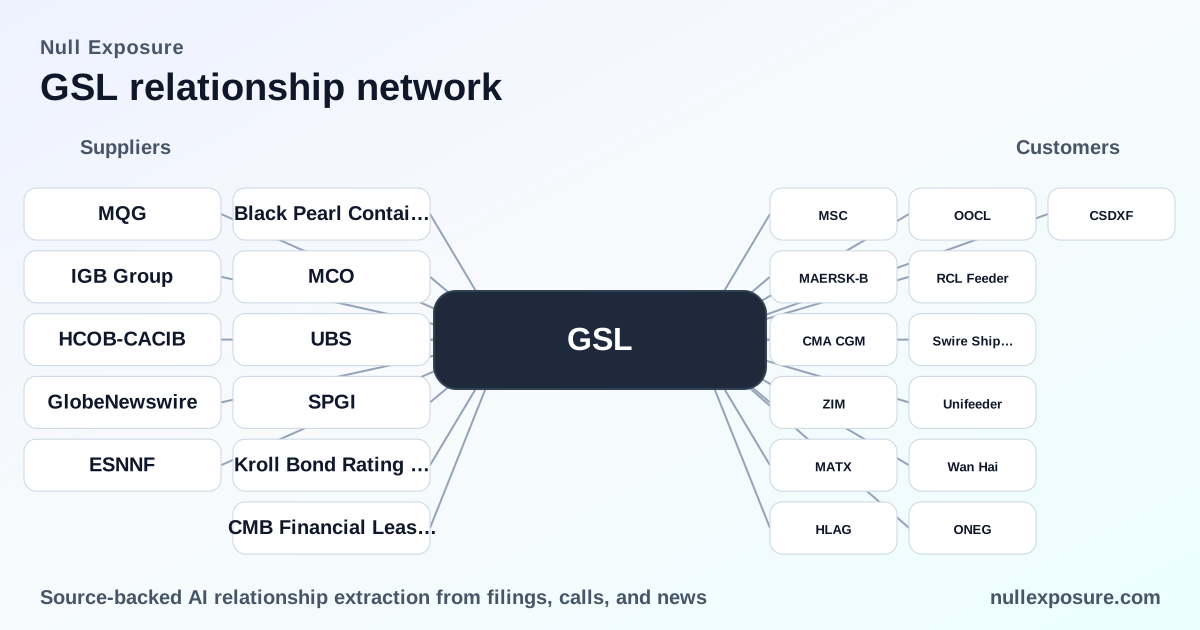
Global Ship Lease (GSL): How counterparties shape cashflow and capital structure
Global Ship Lease operates a simple, cash-generative business model: it owns container ships and monetizes them through long-term charters, sale-and-leaseback structures and opportunistic asset sales to container operators. The company’s profitability and dividend capacity flow from high utilization and favorable charter rates, while its balance-sheet agility is driven by revolving and term debt facilities that manage vessel maturities and preserve liquidity. For investors, the critical lens is not only fleet economics but the network of lenders, lessors, and rating agencies that underwrite GSL’s access to capital and the timing of refinance events.
For a full supplier-risk view and counterparty tracking, visit the NullExposure homepage: https://nullexposure.com/
Key operating signals that drive supplier and financing risk
GSL’s commercial posture and financing choices create a defined set of company-level signals investors must price into valuations:
- Contracting posture: GSL leans on long-term, fixed-rate charters and sale‑and‑leaseback structures, insulating revenue volatility and enabling predictable cashflow coverage for debt service.
- Capital concentration: The company runs a compact set of banking counterparties and lessors rather than a widely dispersed funding base; that concentration induces single-counterparty risk during market stress.
- Counterparty criticality: Relationships with rating agencies and senior lenders are strategic: ratings affirmations support covenant headroom and access to syndicated credit lines.
- Maturity management and liquidity flexibility: Recent prepayments and a new UBS facility indicate active liability management to push out maturities and smooth near-term refinancing risk.
These are company-level signals, not assertions tied to any single counterparty unless explicitly noted in the primary sources.
For a deeper map of counterparties and how they influence GSL’s funding runway, see NullExposure: https://nullexposure.com/
Relationship roll-call: counterparties, what they did, and why it matters
Below I cover every named counterparty from the available reporting. Each entry is a concise, plain-English summary with source context.
Black Pearl Containers LLC
GSL acquired two post-Panamax containerships from Black Pearl Containers under the company’s Right of First Refusal on Poseidon Containers’ assets after a 2018 merger, reinforcing GSL’s strategy of fleet growth via targeted acquisitions. This transaction was reported in Cyprus Shipping News in November 2019.
Moody’s
Moody’s reaffirmed GSL’s credit rating with a stable outlook alongside other agencies, which preserves borrowing capacity and supports market confidence in GSL’s liquidity profile; this was noted in coverage of Q3 2025 results by Container News.
S&P Global Ratings
S&P Global Ratings also reaffirmed GSL’s rating with a stable outlook during the same rating round, signaling cross‑agency alignment on GSL’s credit fundamentals as reported in Container News covering Q3 2025.
Kroll Bond Rating Agency (KBRA)
KBRA joined peers in maintaining a stable rating for GSL, reinforcing a three‑agency consensus that underpins the company’s access to capital markets, as reported in Container News’ Q3 2025 coverage.
UBS
GSL agreed to an $85.0 million credit facility with UBS that was used in March 2025 to prepay and refinance facilities that would otherwise mature in mid‑2026, improving liquidity flexibility and extending maturities; this was disclosed in the company’s Q4 2025 results distributed via GlobeNewswire and reported by Manila Times, and summarized in Container News’ Q3 2025 report.
CMB Financial Leasing Co. Ltd
As part of liability management, GSL recorded a $0.7 million prepayment fee tied to the full repayment of a sale‑and‑leaseback obligation with CMB Financial Leasing Co. Ltd, reflecting active settlement of leasing liabilities as disclosed in the Q4 2025 results (GlobeNewswire / Manila Times).
Macquarie
GSL repaid the outstanding balance of a Macquarie credit facility totaling $17.5 million during April 2025, an action that reduced near-term funding runway pressure and was disclosed in the company’s Q4 2025 report via GlobeNewswire and Manila Times.
HCOB‑CACIB
The outstanding balance under the HCOB‑CACIB facility—reported at $46.8 million—was fully repaid in April 2025, part of a concerted effort to simplify the maturity schedule and was disclosed in the Q4 2025 release (GlobeNewswire / Manila Times).
ESUN
GSL fully repaid the ESUN credit facility balance of $5.9 million in March 2025, reducing small‑ticket lender exposure and simplifying the debt stack; this repayment was included in the Q4 2025 company disclosure distributed via GlobeNewswire and reported by Manila Times.
IGB Group
IGB Group is identified as the company’s investor and media contact (Bryan Degnan / Leon Berman) in filing notices for investor communications, a practical relationship for market engagement referenced in a QuiverQuant news item about a Q3 2025 conference call.
GlobeNewswire
GlobeNewswire served as the distribution channel for GSL’s public reporting (including Q4 2025 results and investor notices); QuiverQuant reproduced a GlobeNewswire press release summarizing the company’s Q3 2025 conference call, which is the conduit through which several of the above disclosures entered public markets.
What these relationships mean for investors — risks and upside
- Liquidity and refinancing risk materially reduced: The $85 million UBS facility and selective prepayments of Macquarie, HCOB‑CACIB and ESUN borrowings indicate active maturity extension, a positive for near-term liquidity. This reduces the probability of forced asset sales in 2026.
- Concentrated but stable credit profile: Reaffirmations from Moody’s, S&P and KBRA provide a stable ratings framework that supports funding access; however, a small set of banking counterparties concentrates execution risk if conditions turn adverse.
- Operational flexibility via sale‑and‑leaseback relationships: Transactions with lessors like CMB enable capital recycling with manageable prepayment costs; these structures are core to GSL’s asset-light growth levers.
Investment implication and next steps
GSL’s core earnings are supported by charter revenues and disciplined liability management; the counterparty map shows deliberate simplification and maturity extension, which materially lifts the short-term liquidity profile for shareholders. Investors evaluating position sizing should weigh the high dividend yield and low P/E against concentrated funding relationships and cyclical container rates.
For a direct view into counterparty exposures and updated supplier tracking, visit NullExposure and subscribe: https://nullexposure.com/
If you want a tailored briefing that maps GSL’s counterparties to covenant dates and refinancing windows, contact our research desk and we will prepare an executive summary linking counterparties to cash‑flow timelines. Explore NullExposure for the full supplier-risk toolkit: https://nullexposure.com/
Final takeaway: GSL combines asset-backed cashflow with proactive debt reshaping; the lenders and rating agencies named in recent filings convert that operating resilience into tangible financing optionality, a dynamic investors should value and monitor closely.