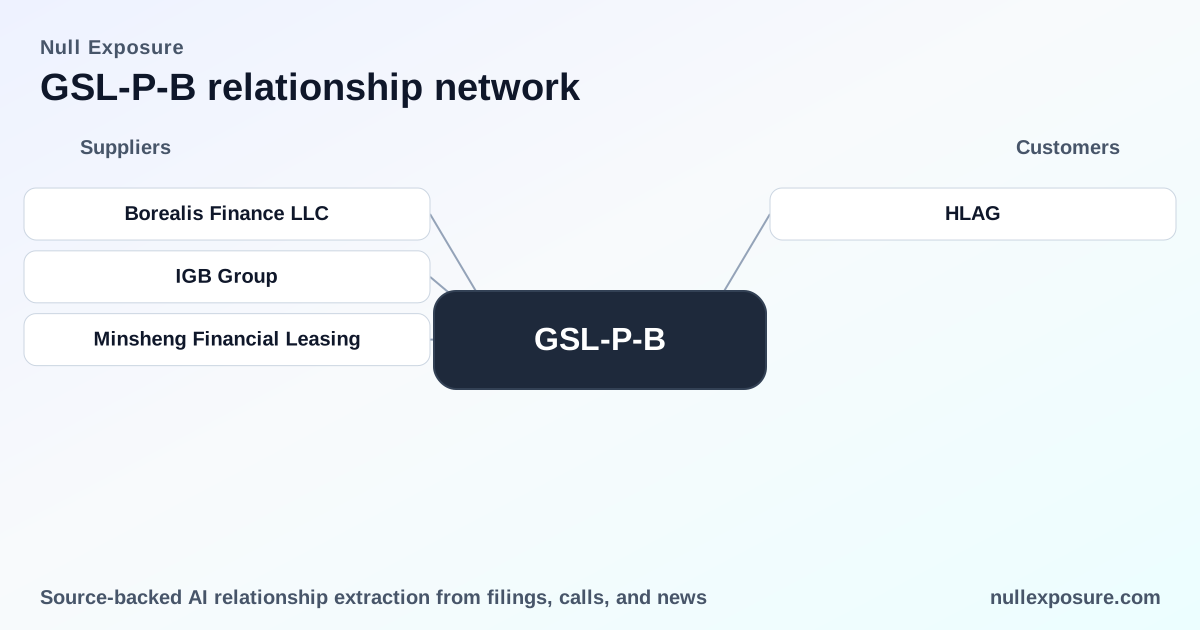
Global Ship Lease (GSL-P-B): Supplier relationships that move the fleet and the balance sheet
Global Ship Lease operates as an owner and manager of containerships that monetizes through asset-backed leasing and fleet transactions financed by a mix of debt, preferred and equity instruments. The Series B depository shares (GSL-P-B) sit against that operating profile: capital raised through securities and private placements supports acquisitions and fleet rotation, while external counterparties — sellers, lessors and communications firms — plug into both the operating and financing lifecycle.
Explore deeper supplier mappings and counterparty signals at https://nullexposure.com/.
Why these supplier links matter to investors
The three supplier relationships surfaced in public press coverage reveal a compact but consequential network around GSL’s fleet strategy. Read together, they show an operator that acquires second‑hand tonnage via bilateral deals, finances purchases with debt/private placements, and outsources investor communications. Those dynamics translate into concrete investor implications:
- Contracting posture: GSL conducts large, one-off asset purchases and uses private placements and note issuance to bridge financing; this is an acquisitive posture rather than a purely organic growth model.
- Concentration: Repeated large-ticket deals with major leasing houses or financial counterparties create counterparty concentration risk at the asset-acquisition layer.
- Criticality: Sellers and financiers are critical to fleet growth and renewal; disruptions to access or pricing from these counterparties directly affect fleet expansion and leverage.
- Maturity of relationships: The counterparties named are sophisticated industry participants, indicating mature, institution-level dealings rather than ad-hoc spot transactions.
These are company-level operating signals derived from the transaction and communications links summarized below; no explicit contractual excerpts tying a particular constraint to a named relationship were provided.
Who GSL is transacting with — the supplier list investors should know
Borealis Finance LLC
GSL purchased 12 containerships from Borealis Finance LLC for an aggregate US$233.9 million in a deal that included a private placement of US$35 million of GSL’s 8.00% senior unsecured notes (trading under ticker GSLD), demonstrating GSL’s use of deal-structured financing to fund fleet upgrades. This transaction was outlined in a WFW press release that referenced the FY2021 sale and was reported March 9, 2026. (Source: WFW press release, reported March 9, 2026.)
IGB Group
IGB Group acted as the investor and media contact for GSL’s public communications in the cited FY2026 announcement, indicating that GSL leverages external investor-relations expertise for market-facing disclosures and investor engagement. The contact names Bryan Degnan and Leon Berman were listed in the company’s press release distributed via Yahoo Finance. (Source: Yahoo Finance press release, FY2026.)
Minsheng Financial Leasing
GSL acquired a quartet of boxships in a roughly US$274 million deal where the seller was identified through S&P databases as China’s Minsheng Financial Leasing, illustrating GSL’s willingness to transact with large Chinese leasing houses for second‑hand tonnage. The purchase was reported by industry publication Splash247 during coverage of the FY2024 transaction. (Source: Splash247 coverage, FY2024.)
What these relationships indicate about GSL’s operating model
The linkage pattern — large asset purchases from finance/lessor counterparties plus external investor-relations support — frames several investor-relevant conclusions:
- Asset-centric capital deployment: GSL grows and refreshes its fleet primarily through discrete acquisitions financed with debt and structured placements, not through publicly disclosed operating cashflows in the instrument snapshot provided. This drives capital intensity and sensitivity to financing markets.
- Financing reliance: The use of private placements and senior unsecured notes as part of transaction consideration highlights reliance on credit markets and investor appetite for yield instruments tied to GSL’s credit profile.
- Counterparty sophistication and scale: Dealing with entities like Minsheng and Borealis illustrates that GSL’s counterparties are large lessors/financiers, reducing execution risk on individual transactions but concentrating exposure to a small set of industry players.
- Public disclosure posture: Engagement of an external PR/IR firm for investor communications signals a disciplined and market-aware disclosure strategy, useful for monitoring liquidity and secondary market sentiment in preferred securities.
Explore supplier and counterparty risk profiles on our homepage: https://nullexposure.com/.
Key takeaways for investors and operators
- GSL finances fleet growth with deal-level structured financing; private placements and note issuance are a core part of transaction consideration.
- Counterparty exposure is concentrated among major leasing and finance houses, which supports efficient execution but concentrates bilateral risk.
- Communications outsourcing to firms like IGB Group indicates active investor engagement, useful for monitoring issuance and liquidity events.
- Public instrument-level reporting for GSL-P-B in the provided snapshot is limited, so investors should prioritize transaction announcements, note placement terms, and counterparty profiles when assessing credit and liquidity risk.
Next steps for due diligence
Investors and operators should prioritize three actions:
- Verify note terms and covenants for GSL’s senior unsecured issuances (including the referenced 8.00% notes) and track any subsequent amendments or redemptions.
- Map recurring counterparties across the fleet pipeline to quantify concentration risk and counterparty credit exposure.
- Monitor press releases and IR communications for timing and structure of future private placements or asset sales; subscribe to disciplined market surveillance.
For a consolidated view of GSL supplier relationships and to commission bespoke counterparty analysis, visit https://nullexposure.com/.
Bold, transaction-level signals — the Borealis acquisition, the Minsheng boxship purchase and the use of IGB Group for investor communications — together define a maritime lessor whose growth is transaction-driven and financing-sensitive. Investors should treat supplier and financing counterparties as first‑order inputs when modeling GSL-P-B performance and liquidity.