Golden Sun Education Group (GSUN): Auditor signal elevates financial risk profile
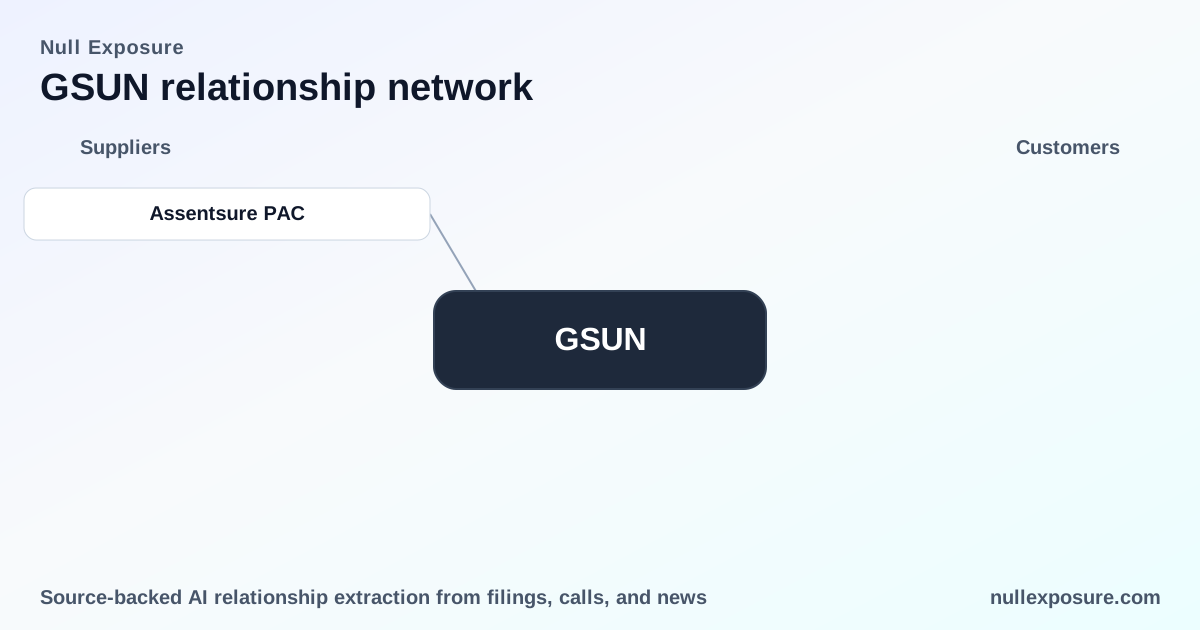
Golden Sun Education Group Limited operates as an education and management services provider in the People's Republic of China, monetizing through tuition, training services, and related management fees from schools and educational programs. Listed on NASDAQ under GSUN, the company produces modest revenue while operating with negative profitability and limited market capitalization; its supplier footprint, as recorded, centers on its external auditor relationship, which has direct implications for financial transparency and going-concern assessment. For investors and operators evaluating supplier relationships, the auditor engagement is not a routine vendor contract—it is a governance hinge that directly affects capital access and market credibility. Learn more at https://nullexposure.com/.
The recorded supplier relationships investors need to read first
Below are the supplier relationships surfaced in public reports. Each entry is summarized in plain English with the cited source.
- Assentsure PAC — At the company’s annual general meeting, shareholders ratified the appointment of Assentsure PAC as the independent registered public accounting firm for Golden Sun, formalizing the auditor engagement for FY2024. According to a GlobeNewswire press release announcing the AGM results in October 2024, the appointment was ratified by shareholders.
- Assentsure PAC — In a later reporting episode, the company’s auditor, Assentsure PAC, issued an unqualified opinion while explicitly expressing doubt about Golden Sun’s ability to continue as a going concern for FY2026, signaling acute liquidity or solvency pressures. A MarketScreener note covering the FY2026 auditor report highlighted the going-concern disclosure.
Why the auditor relationship matters more than a typical supplier contract
Auditors are not commoditized suppliers: they validate the numbers that underpin credit, equity valuations, and regulatory standing. The transition to—or continuation with—Assentsure PAC therefore has outsized implications for investor risk. The AGM ratification in late 2024 established formal governance continuity while the FY2026 going-concern disclosure escalated financial distress into a public signal that will influence lenders, counterparties, and prospective partners.
- Governance and credibility: An auditor’s independence and reporting language drive market confidence. An unqualified opinion coupled with a going-concern statement replaces routine assurance with a red flag that requires immediate attention from management and stakeholders.
- Contracting posture: Audit engagements are annual and contractual; the AGM ratification indicates standard renewal mechanics, but the substance of the auditor’s opinion determines whether that relationship supports or undermines capital access.
Company-level operating signals that shape supplier risk
Beyond the auditor relationship, Golden Sun’s operating profile delivers clear company-level signals relevant to supplier and investor evaluations:
- Size and capital constraints: Market capitalization is small at approximately $3.5 million, and shares outstanding total roughly 9.6 million. This places Golden Sun in a micro-cap profile where single events—an adverse auditor opinion, revenue shortfall, or regulatory action—produce outsized balance-sheet effects.
- Profitability and cash pressure: The last available figures show negative EBITDA and EPS (EBITDA of -2,032,615; diluted EPS -1.83), with narrow gross profit (about $801,780 on roughly $35.48 million revenue). Operating cash cushion is limited and the business is loss-making.
- Valuation and leverage signals: Price-to-sales ratio under 0.10 and price-to-book around 0.43 indicate low market valuation relative to sales and equity, consistent with distress pricing in small-cap education names.
- Concentration and ownership: Institutional ownership is minimal (about 0.37%), insiders hold roughly 2.67%, and analyst coverage is effectively absent—this reduces the stabilizing effect of professional ownership and reduces public scrutiny, increasing volatility and counterparties’ due-diligence burden.
- Market sensitivity: Beta near 1.94 suggests above-average sensitivity to market moves, which coupled with low liquidity increases the cost of capital and heightens dilution risk if equity financing becomes necessary.
These are company-level signals—use them as the baseline when assessing supplier contracts, payment terms, and counterparty exposure.
Practical implications for investors and operators
The combination of a formal auditor engagement and a going-concern disclosure changes the playbook for stakeholders:
- Operational counterparties and suppliers should price credit risk accordingly. Payment terms, retention of deliverables, and collateral expectations are now governed by a higher probability of covenant breaches or insolvency processes.
- Investors must prioritize cash-flow and covenant metrics over headline revenue growth. Given the small market cap and negative margins, monitor quarterly cash burn, restricted cash disclosures, and any related-party transactions that could affect solvency.
- Governance actions deserve real-time tracking. Changes to the auditor, audit committee statements, or management commentary on liquidity are material events that will materially affect valuation and counterparty behavior.
For a concise supplier-risk briefing tailored to your portfolio exposure to GSUN, visit https://nullexposure.com/.
What to watch next — high-impact indicators
Focus on a short list of measurable, high-consequence indicators over the next two quarters:
- Auditor follow-on language: any escalation beyond going-concern or a resignation by Assentsure PAC would be an immediate negative.
- Cash and equivalents and short-term borrowing facilities: look for disclosure of financing arrangements, draws on credit lines, or default notices.
- Related-party flows and revenue concentration: given small margins, any concentration of revenues or payments to counterparties could shift recovery outcomes.
- Management’s remediation plan: concrete steps (cost cuts, asset sales, capital injection) will determine whether the going-concern statement is transitory or structural.
If you track these items for multiple suppliers and counterparties, NullExposure provides consolidated monitoring and alerts at scale — see https://nullexposure.com/ for details.
Bottom line: treat the auditor as a strategic supplier
Golden Sun’s public record shows an auditor relationship that is both formally established and materially consequential. An auditor’s going-concern disclosure is an elevated supplier signal—one that changes credit calculus, counterparty terms, and valuation dynamics immediately. For investors and operators, the appropriate response is proactive monitoring: demand clarity in filings, tighten exposure limits, and prioritize liquidity-first covenants in supplier agreements.
To subscribe to ongoing supplier-risk briefings and receive alerts on GSUN and similar micro-cap exposures, visit https://nullexposure.com/.