GT Biopharma (GTBP): Supplier relationships that shape a clinical-stage commercial outcome
GT Biopharma is a clinical-stage immuno-oncology company that monetizes by developing and eventually commercializing therapies built on the TriKE® (Tri-specific Killer Engager) platform, which it licenses from university inventors and advances through sponsored research and outsourced manufacturing toward INDs and clinical trials. Today GTBP generates no product revenue; its supplier footprint — licensing, clinical collaborators, contract manufacturers, and paid-media partners — determines how fast and efficiently the company can convert R&D into a commercial asset and therefore how investors should size operational and execution risk.
For a concise view of supplier exposures and relationship signals, visit the Null Exposure homepage: https://nullexposure.com/
Why GTBP’s suppliers are the value drivers here
GT Biopharma’s operating model is not built around internal manufacturing or large commercial infrastructure. Instead, the company depends on external science, manufacturing and communications partners to develop lead molecules and progress INDs. That creates two structural features investors must internalize:
- Concentration and criticality. The company discloses meaningful spend and accounts payable concentrations to its primary research and manufacturing partners, which make those suppliers operationally critical.
- Licensing-driven IP posture. The core TriKE technology is controlled through an exclusive license, meaning GTBP’s freedom-to-operate and long-term margins depend on the licensor relationship and license economics.
These are not academic concerns: supplier timing and payments appear directly in the company’s public filings and press releases and therefore will influence milestone timing, cash burn and dilution outcomes.
Explore supplier-level intelligence and signal maps at Null Exposure: https://nullexposure.com/
Itemized supplier and partner relationships you need to track
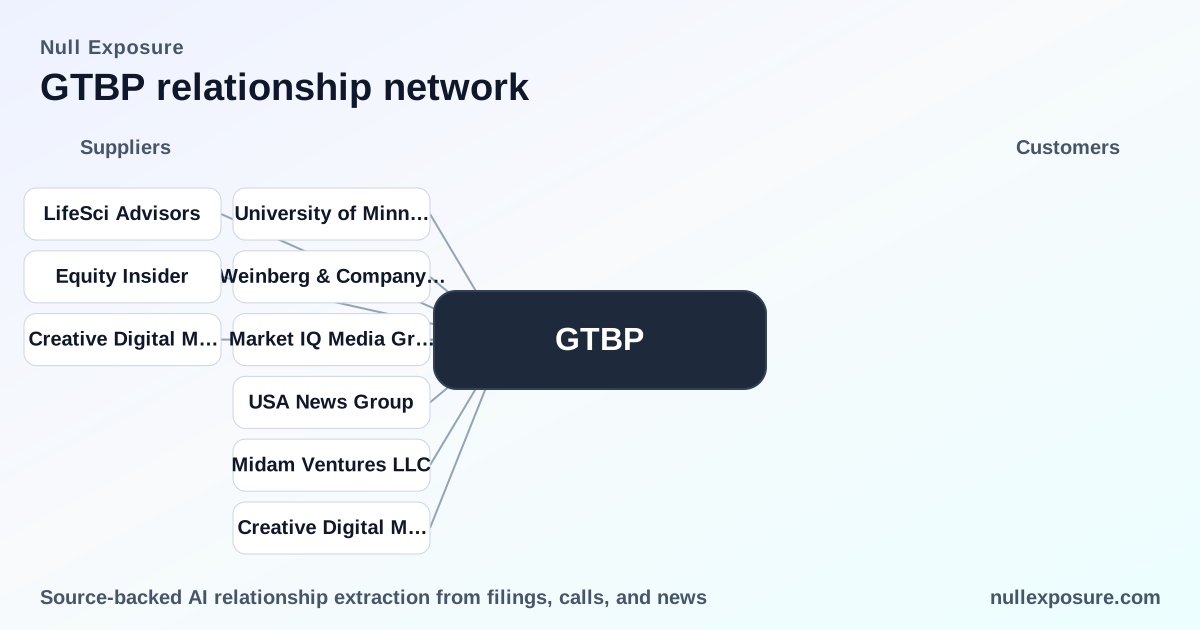
Below are every relationship flagged in available public reporting, with a one- to two-sentence plain-English summary and a concise source citation.
-
University of Minnesota — GT holds an exclusive worldwide license to the TriKE® technology and conducts sponsored research and investigator‑initiated clinical activity with the University. According to GT Biopharma press releases and clinical updates (GlobeNewswire and related coverage, FY2025–FY2026), the University is both the licensor and an active research partner supporting INDs and early trials.
-
Weinberg & Company, P.A. — An accounting firm that GT consulted with as management reevaluated classification of stock purchase rights related to its Series L preferred stock. That work was disclosed in a Form 8‑K summarized by ADVFN/Form 8‑K reporting (FY2026).
-
Market IQ Media Group Inc. — A paid media distributor that has been engaged to publish advertising or promotional articles about GT Biopharma on behalf of GT or third parties. Coverage of these arrangements appears in industry media and press distribution summaries (SahmCapital and AIjourn, FY2025).
-
USA News Group — A syndicator used to distribute Market IQ Media Group content on GT Biopharma, indicating a paid distribution channel outside traditional investor relations. Distribution disclosures were reported in SahmCapital and related press items (FY2025).
-
Creative Digital Media Group (CDMG) — The creative/media vendor identified as the party that approved and provided paid advertising content for GT, with disclosures noting paid relationships and ownership interests. SahmCapital and CantechLetter coverage include CDMG approval and payment language tied to GTBP communications (FY2025–FY2026).
-
Midam Ventures LLC — A promoter engaged historically for a short paid promotional campaign for which GT paid $150,000 in a March–April 2021 period. This engagement is described in earlier press reporting on GT’s board and promotion arrangements (PennyStocks.com, FY2020).
-
LifeSci Advisors — GT’s listed investor relations firm and contact for media and investor inquiries, named repeatedly in company press releases. Multiple GlobeNewswire releases and other investor communications list LifeSci Advisors (Corey Davis, Ph.D.) as IR contact (FY2022–FY2026).
-
Equity Insider — A news/commentary outlet that issued GT Biopharma commentary distributed via presswire channels in early 2026. The CantechLetter wire identifies Equity Insider commentary published on behalf of GT (Jan 2026).
What the constraints in filings and releases tell investors
GTBP’s supplier constraints and contract characteristics are visible in the company’s public statements and filings:
- Licensing (University of Minnesota): GT’s exclusive patent license with the Regents of the University of Minnesota is central to GT’s IP and product strategy; that relationship is explicitly documented in GT press filings and past license agreements. This makes the University relationship both a legal linchpin and a source of scientific continuity.
- Manufacturing framework (Cytovance): Filings disclose a Master Services Agreement with Cytovance Biologics for biologic development and manufacturing and significant spend via that arrangement, signaling reliance on a contract manufacturer to meet preclinical and clinical supply needs. The filings name Cytovance directly in that context.
- Materiality and spend band: Company disclosures record mid-single-digit million dollar commitments to sponsored research and contract manufacturing over multi-year horizons (evidence of spend in the $1–$10M band), and GT explicitly notes a concentration of expenses and accounts payable to Cytovance and the University of Minnesota — a material supplier concentration for a micro‑cap clinical-stage biotech.
- Relationship maturity and stage: The University and Cytovance arrangements are active and tied to ongoing trials and IND work, while GT also lists prospective manufacturer evaluations for next-generation candidates (company-level signal of a mix of active and prospect stage supplier relationships).
These constraints combine to create a profile of high operational leverage to a few third-party partners, significant single-source risk, and predictable near-term R&D cash outflows — all critical inputs to scenario modeling for investors.
For detailed supplier signal maps and time-stamped evidence, see https://nullexposure.com/
How investors should act on these signals
- Treat the University of Minnesota license and Cytovance manufacturing relationship as gating factors for the value of GT’s TriKE program: delays or disputes would push out milestones faster than typical development timing assumptions.
- Monitor IR and paid-media disclosures (Market IQ/USA News/CDMG/Midam) as indicators of narrative management and potential promotional activity that can influence retail sentiment but do not change clinical risk.
- Use the published spend bands and disclosed commitments to model near‑term cash needs and likely dilution scenarios; the $1M–$10M supplier commitments are meaningful to a company with no product revenue.
Explore supplier exposure dashboards and evidence links at Null Exposure to track changes in these relationships: https://nullexposure.com/
Bottom line
GT Biopharma’s path to commercial value is firmly dependent on a small set of external suppliers and licensors — principally the University of Minnesota for IP and sponsored research and a contract manufacturer framework for biologics production — alongside a matrix of paid media and IR providers that shape market perception. Investors should prioritize monitoring contractual disclosures, sponsored research cadence, contract manufacturing commitments and clear, dated IR filings when modeling timelines and capital raises. For a centralized, timestamped view of these supplier signals and the primary source references, visit Null Exposure: https://nullexposure.com/