Globa Terra Acquisition (GTERA): A concise risk-return read for counterparties and investors
Globa Terra Acquisition Corporation operates as a blank‑check public vehicle—raising capital on Nasdaq to pursue a business combination with one or more private companies and monetizing through transaction fees, sponsor economics (founder shares and promote), and capital deployed in the trust account prior to closing. As a pre-combination SPAC listed under the ticker GTERA, the company's economics are driven entirely by its ability to complete a qualifying merger and the commercial terms of that deal. For counterparties evaluating supplier or underwriting relationships, the core decision is whether reliance on a short-lived, deal‑oriented vehicle fits your risk appetite and revenue model. Learn more about this issuer at https://nullexposure.com/.
Why this matters: GTERA carries no operating revenue and functions as a financial conduit. Its value to suppliers and partners depends on successful deal execution, sponsor alignment, and capital structure outcomes.
How GTERA structures its capital and why that matters to partners
Globa Terra is listed on Nasdaq and is classified in public data as a shell / SPAC vehicle headquartered in Mexico City. Market data records a market capitalization of roughly $292.9 million and 17.89 million shares outstanding, with trading clustered near IPO pricing bands (52-week range roughly $9.93–$10.29). The public shell nature produces three practical consequences for suppliers and service providers:
- Short contracting horizon and event-driven revenue: Counterparties will typically face discrete, timebound engagements (IPO services, diligence, PIPE documentation, transaction advisory) rather than ongoing operating contracts.
- Counterparty concentration risk: The success of a SPAC is highly concentrated on the sponsor team, the chosen target, and a small set of financial counterparties (underwriters, legal and accounting firms).
- Balance-sheet simplicity, execution complexity: The SPAC itself reports zero operating revenue and margins; economic payoff for suppliers is tied to post-deal combinations, escrow releases, and fee schedules set for the transaction.
If you need a centralized source for diligence and relationship tracking on SPAC counterparties, visit https://nullexposure.com/ for curated signals and supplier profiles.
Market snapshot that frames negotiation posture
Public metrics show no reported revenue or operating profit for GTERA, consistent with its SPAC profile. Equity holders are primarily institutional (public filings list ~72.4% institutional ownership), which influences the governance and timeline pressure for completing a business combination. Suppliers should price engagements to reflect that cash flows are contingent on deal completion and often backed by trust-account mechanics rather than operating cash flows.
Who GTERA is working with right now — the full relationship list
Below is every relationship identified in the public results for GTERA, summarized plainly and sourced.
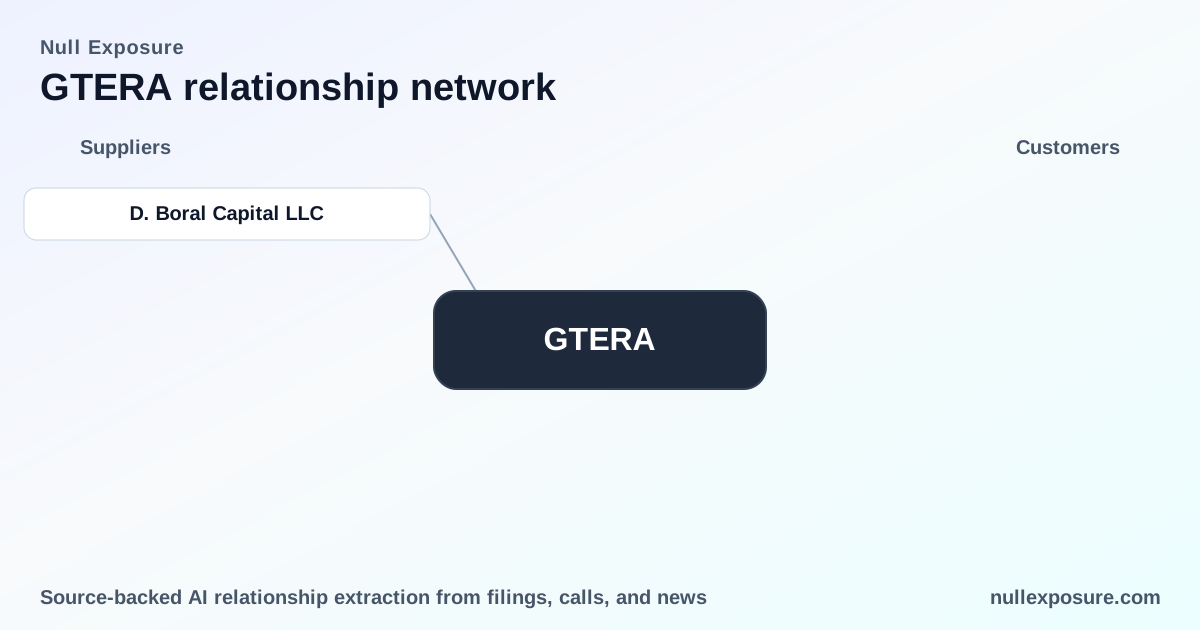
- D. Boral Capital LLC — The firm acted as the sole book‑running manager for GTERA’s $152 million initial public offering. This establishes D. Boral as the primary underwriting partner for GTERA’s capital raise and positions them as the key distribution and syndication contact for that transaction (ACCESS Newswire via The Globe and Mail, March 9, 2026: https://www.theglobeandmail.com/investing/markets/markets-news/ACCESS%20Newswire/33283625/globa-terra-acquisition-corporation-announces-pricing-of-152-million-initial-public-offering/).
That is the complete set of relationships surfaced in the provided results. D. Boral’s role as sole book‑runner concentrates execution risk and distribution control in a single underwriting counterparty, which has downstream implications for pricing, syndication, and potential PIPE placements.
Constraints and company-level operational signals that shape supplier engagement
There are no explicit external constraints listed in the provided relationship constraints. From the company profile and SPAC structure, however, several company‑level signals are clear and should inform contracting posture:
- Contracting posture: transactional and front‑loaded. Expect engagement models that are short-term, deliverable-driven, and tied to milestone payments aligned with IPO/merger events.
- Concentration: high supplier and counterparty concentration. With a single book-runner on the IPO, the sponsor and underwriter dynamic becomes the operational fulcrum for future deal flow and fee allocation.
- Criticality: binary continuity. The SPAC’s lifecycle is event-driven; if a qualifying merger fails, many supplier revenues will not materialize or will be renegotiated.
- Maturity: pre-revenue, capital‑market native. GTERA is not an operating company; it is a capital vehicle whose maturity is measured by transaction completion rather than product traction.
These signals recommend fee structures that protect suppliers—retainers, staged billing, and clear break fees—rather than open-ended payment deferrals.
Risk vectors every counterparty should price into agreements
- Deal failure risk. The principal commercial risk is the SPAC not closing a business combination within its prescribed time, which converts expected contingent revenue into non-recoverable cost.
- Counterparty concentration. Reliance on a single book-runner increases negotiation leverage on the underwriting side and can compress supplier margins if syndication is limited.
- Governance and investor pressure. A high institutional ownership base accelerates timelines and can force transaction terms that prioritize investor liquidity over supplier economics.
- Regulatory and reputational scrutiny. SPAC transactions face heightened regulatory focus; suppliers should scope compliance and disclosure obligations up front.
Price and structure engagements accordingly: prioritize upfront non-refundable work for critical deliverables, include clear conditions precedent tied to escrow/trust account liquidity, and retain termination protections.
Final read: tactical steps for investors and operators
For investors and vendors evaluating relationships with GTERA, the case is straightforward: this is a pure execution and underwriting risk play. Value flows if GTERA completes a strategically attractive business combination and if underwriting partners like D. Boral successfully syndicate follow‑on capital. Contracts should reflect the event-driven nature of the vehicle and protect supplier cash flows in the face of potential deal failure.
- If you are a potential supplier, require staged payments, break fees, or escrow protections.
- If you are an investor or capital provider, monitor underwriting concentration and the sponsor’s track record of completed combinations and post‑merger performance.
For a consolidated view of counterparties and ongoing signals tied to SPACs like GTERA, visit https://nullexposure.com/ to access supplier profiles and relationship tracking.
Take action: review GTERA counterparties in context, price for execution risk, and secure contractual protections now at https://nullexposure.com/.