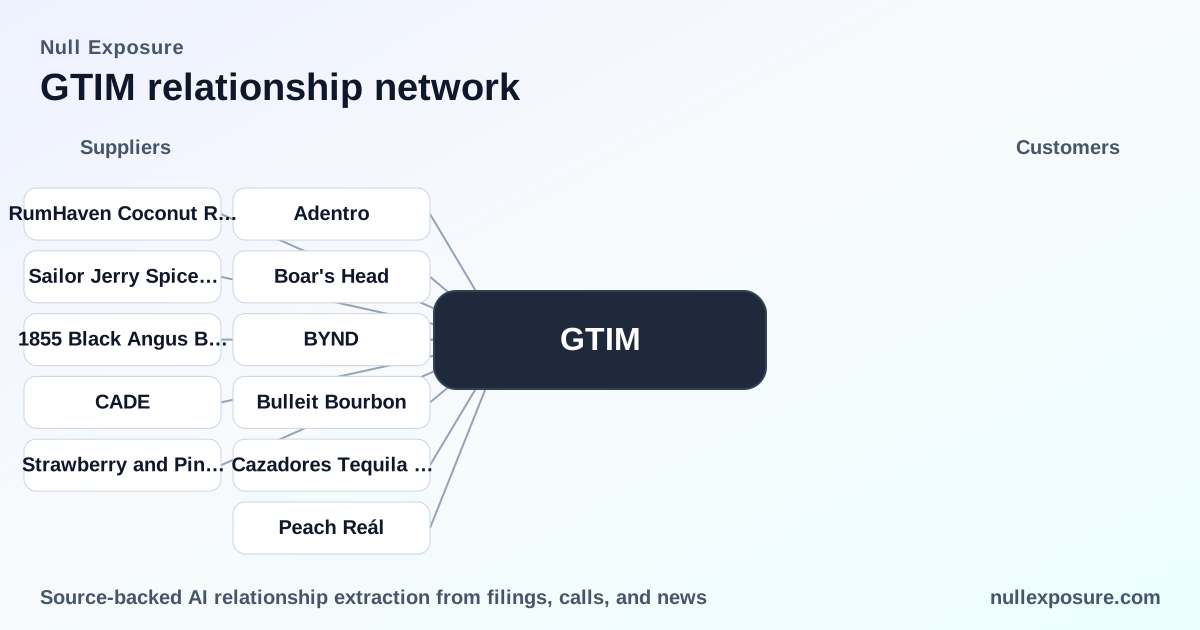
Good Times Restaurants (GTIM): Supplier and financing map for investors
Good Times Restaurants Inc. operates and monetizes a two‑brand restaurant platform — the Good Times burger-and-fries chain and the higher‑AUV Bad Daddy’s Burger Bar — by selling food and beverage in company‑operated locations and selectively using credit to fund new restaurant development and partner buyouts. Revenue is generated at the store level; profitability depends on supply cost control, menu partnerships, and access to secured financing for growth. For investors evaluating GTIM’s supplier and financing relationships, the mix shows typical restaurant operating patterns: branded ingredient partnerships that support menu marketing, a concentrated physical‑goods distribution channel, short‑term commodity purchasing for proteins, and a material secured credit facility that underpins growth. Learn more about supplier exposures and mapping at https://nullexposure.com/.
What investors need to know up front
Good Times runs an asset‑heavy restaurant model with long‑term lease commitments and a secured credit facility that ties financing to nearly all company assets. At the same time, food inputs are a mix of annual fixed‑price contracts for commodity items and vendor partnerships used to drive menu innovation and customer traffic. This operating mix creates two clear risk buckets for investors: supply‑cost volatility and concentration in distribution, plus financial covenants and collateralization driven by its bank facility.
Explore the broader supplier universe and risk scoring at https://nullexposure.com/ for a downloadable supplier map.
Supplier and partner relationships (one-by-one review)
Below are the supplier, branding and financing relationships referenced in public reporting and media — each summarized in plain English with source attribution.
Adentro
Bad Daddy’s uses visit‑based marketing expertise from Adentro to target guests and optimize ad spend; the relationship dates back to 2019 according to coverage of marketing initiatives. Source: FB101 feature on Bad Daddy’s marketing partnership (reported March 2026).
Boar’s Head
Boar’s Head supplies deli‑style proteins used in Bad Daddy’s limited‑time menu items (for example, the Pastrami Burger referenced in menu copy). Source: RestaurantNews menu announcement (January 15, 2020).
Beyond Meat, Inc. (BYND)
Bad Daddy’s added the plant‑based Beyond Burger as a protein option on its menu, reflecting a branded protein partnership used to broaden customer choice and capture plant‑based demand. Source: RestaurantNews coverage of the menu addition (July 28, 2020).
Bulleit Bourbon
Bulleit Bourbon is one of the branded spirits featured in seasonal cocktail promotions at Bad Daddy’s, illustrating beverage partnerships used to drive average check through specialty cocktails. Source: RestaurantNews summer specials (June 12, 2024).
Cazadores Tequila Reposado
Cazadores appears as a named spirit in a seasonal menu cocktail, indicating the use of branded tequila for promotional beverage sets. Source: RestaurantNews summer specials (June 12, 2024).
Peach Reál
Peach Reál is listed as an ingredient in a mocktail/cocktail on Bad Daddy’s seasonal menu, demonstrating the company’s reliance on specific mixers/flavor houses for beverage execution. Source: RestaurantNews summer specials (June 12, 2024).
RumHaven Coconut Rum
RumHaven coconut rum is another branded spirit used in Bad Daddy’s limited‑time drink offerings, supporting promotions aimed at upselling beverages. Source: RestaurantNews summer specials (June 12, 2024).
Sailor Jerry Spiced Rum
Sailor Jerry is included among spirits in the seasonal cocktail lineup, again reflecting branded beverage placements. Source: RestaurantNews summer specials (June 12, 2024).
1855 Black Angus Beef
Bad Daddy’s launched smashburgers featuring 1855 Black Angus Beef, signaling a premium beef supplier relationship used to position menu quality. Source: RestaurantNews summer specials (June 12, 2024).
Strawberry and Pineapple Reál
Strawberry and Pineapple Reál are ingredient brands cited in cocktail recipes on the seasonal menu; these relationships reflect packaged ingredient suppliers for beverage program consistency. Source: RestaurantNews summer specials (June 12, 2024).
Cadence (CADE) — credit facility (TradingView summary)
Good Times maintains a Cadence Credit Facility with borrowing capacity up to $8.0 million used for new restaurant development, buyouts of non‑controlling partners, and general corporate purposes; this facility is a center of debt financing for growth initiatives. Source: TradingView summary of the company’s SEC 10‑K (FY2025 reporting).
Cadence Bank (CADE) — credit facility outstanding (QZ)
Reporting cites the Cadence credit facility as allowing borrowings to $8.0 million, with a reported outstanding balance of $500,000 as of the referenced report date, confirming active but limited utilization of the line at that snapshot. Source: QZ earnings coverage (firms’ FY2024 disclosure summarized).
How the constraints shape GTIM’s operating risk profile
Use these constraints as company‑level signals about contracting posture, concentration and criticality:
-
Contracting maturity is mixed: Good Times carries meaningful long‑term obligations — long‑term operating leases and a ten‑year subordinate promissory note — alongside the Cadence credit facility that itself has multi‑year maturity. These long‑dated commitments increase fixed‑cost leverage and require predictable operating cash flow to service. (Company filings; referenced Cadence and promissory note language.)
-
Short‑term commodity contracts exist for protein inputs: The company enters annual fixed‑price contracts for chicken and other commodities, exposing margins to annual renegotiation cycles rather than only spot purchasing. This reduces short‑term price volatility for contracted items but concentrates negotiation points. (Company disclosure on annual chicken contracts.)
-
Distribution concentration is a structural exposure: Good Times distributes nearly all Good Times restaurant supplies and the majority of Bad Daddy’s through a single distributor, US Foods, with two‑to‑five weekly deliveries; management treats this as replaceable but it remains a single‑point operational dependency. (Company disclosure regarding distribution through US Foods.)
-
Material financing is secured and therefore critical: The Cadence Credit Facility is secured by a first priority interest in substantially all assets, making the bank relationship materially important to both growth funding and downside recovery. Investors should view the facility as a structural lender relationship with collateral claims. (SEC‑filed credit agreement language summarized in public reporting.)
-
Service‑provider dependencies are operationally relevant: Accounts receivable exposure to third‑party delivery aggregators and reliance on cybersecurity insurance and breach response vendors are service dependencies that affect revenue capture and incident response capability. (Company disclosure on receivables and insurance programs.)
Investment implications and next steps
- Supply‑side: menu partnerships (Beyond Meat, 1855 beef, branded spirits) are positive for top‑line marketing and allow GTIM to differentiate offerings without capital expenditure; however, distribution concentration through US Foods and annual commodity contracts introduce operational and negotiation risk to margins.
- Capital structure: the Cadence facility is central. The loan provides low‑cost optionality for development and buyouts but is secured against company assets, elevating downside creditor priority.
- Overall: GTIM’s model is typical for regional restaurant operators — asset and lease heavy, reliant on a narrow distribution channel, and supplemented by branded supplier relationships that support menu-driven traffic.
For a deeper supplier risk score and a mapped view of GTIM’s partner network, visit https://nullexposure.com/ and download the supplier exposure brief.
If you want a tailored review comparing GTIM’s supplier concentration to peers in the casual‑dining segment, request a custom analysis at https://nullexposure.com/ and we will produce a focused comparison for your investment memo.
Disclaimer: This article synthesizes publicly reported supplier references and company disclosures to outline relationship structure and risk factors; investors should consult GTIM’s SEC filings and direct vendor agreements for contract‑level verification.