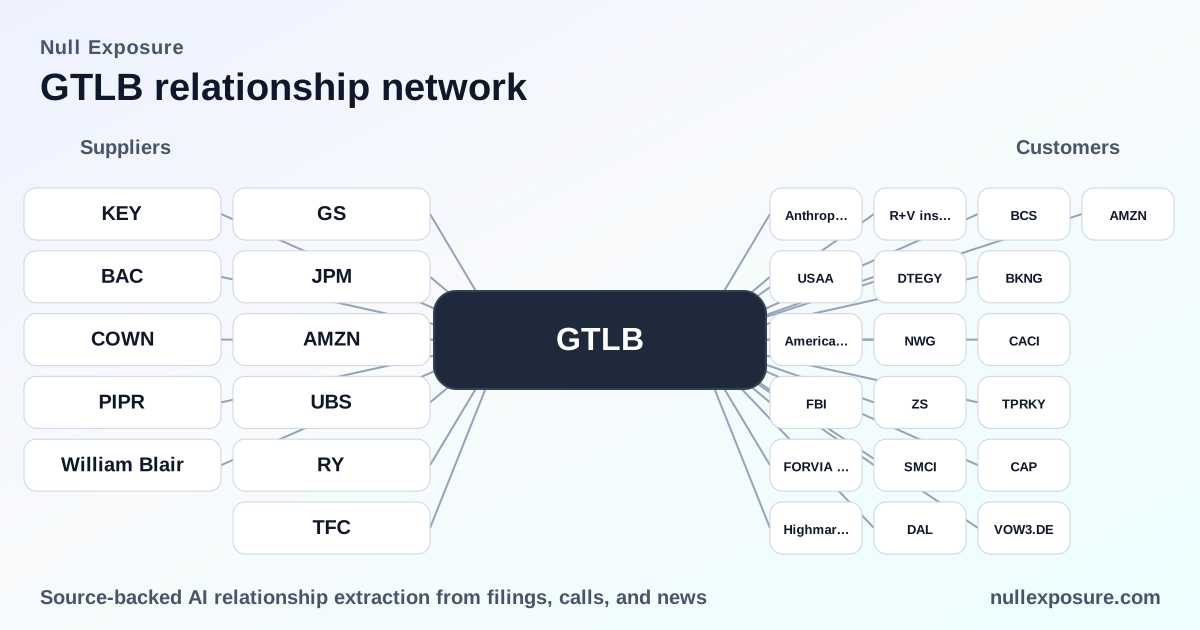
GitLab (GTLB) supplier relationships: what investors should know
GitLab builds software that manages the entire software development lifecycle and monetizes primarily through subscription billing for hosted (SaaS) and self-managed offerings, enterprise seat licenses, and professional services tied to adoption at scale. For investors and operators assessing supplier risk, GitLab’s public disclosures and recent commentary show a two-tier supplier profile: strategic cloud partnerships that affect product delivery and go‑to‑market, and episodic financial services relationships used for capital markets activity.
If you want a consolidated view of GitLab’s supplier footprint and implications for financial or operational due diligence, visit https://nullexposure.com/ for tools and supplier mapping resources.
How the supplier list informs shareholder risk and opportunity
GitLab’s supplier signals are not exotic: large cloud providers underpin product delivery and joint marketing, while major investment banks supported GitLab’s capital markets transactions. Cloud partnerships translate into operational criticality and revenue motion; banking relationships reflect episodic capital-market functions rather than long-term operational dependence. The vendor posture implied by GitLab’s disclosures emphasizes compliance offload (for example, PCI‑DSS responsibilities) and coordinated go‑to‑market programs with cloud partners.
The relationships you need to account for today
Below I list every supplier relationship surfaced in the available results and summarize each in plain English, with source context.
-
Goldman Sachs & Co. LLC — Goldman Sachs acted as one of the lead book‑running managers on GitLab’s offering during the company’s market activity referenced to FY2021, indicating a classic investment‑bank underwriting role rather than an ongoing operational supplier. (App Developer Magazine coverage of GitLab’s Nasdaq trading debut, March 2026: https://appdevelopermagazine.com/gitlab-nasdaq-trading-begins-on-the-global-select-market/)
-
J.P. Morgan — J.P. Morgan served alongside Goldman Sachs and BofA Securities as a lead book‑running manager for the same offering, reflecting capital markets support in FY2021 rather than platform dependency. (App Developer Magazine report, March 2026: https://appdevelopermagazine.com/gitlab-nasdaq-trading-begins-on-the-global-select-market/)
-
BofA Securities — BofA Securities participated as a lead underwriter on the offering, representative of transactional banking engagement tied to GitLab’s public listing activity. (App Developer Magazine, March 2026: https://appdevelopermagazine.com/gitlab-nasdaq-trading-begins-on-the-global-select-market/)
-
UBS Investment Bank — UBS was listed among joint book‑running managers for the offering, again placing the firm in a capital markets capacity for the FY2021 period described. (App Developer Magazine, March 2026: https://appdevelopermagazine.com/gitlab-nasdaq-trading-begins-on-the-global-select-market/)
-
RBC Capital Markets — RBC participated as a joint book‑running manager for the offering, consistent with a syndicate structure used during the company’s market transaction. (App Developer Magazine, March 2026: https://appdevelopermagazine.com/gitlab-nasdaq-trading-begins-on-the-global-select-market/)
-
Truist Securities — Truist was a joint book‑running manager on the offering, reflecting standard underwriting support rather than operational vendor status. (App Developer Magazine, March 2026: https://appdevelopermagazine.com/gitlab-nasdaq-trading-begins-on-the-global-select-market/)
-
Piper Sandler — Piper Sandler appears as a joint book‑running manager for the offering, part of the broader syndicate used in FY2021. (App Developer Magazine, March 2026: https://appdevelopermagazine.com/gitlab-nasdaq-trading-begins-on-the-global-select-market/)
-
KeyBanc Capital Markets — KeyBanc served as a co‑manager on the offering, indicating a placement role in GitLab’s capital markets activity rather than an ongoing product or service supplier. (App Developer Magazine, March 2026: https://appdevelopermagazine.com/gitlab-nasdaq-trading-begins-on-the-global-select-market/)
-
Cowen — Cowen was named among co‑managers for the offering, consistent with the investment banking syndicate documented around GitLab’s market debut. (App Developer Magazine, March 2026: https://appdevelopermagazine.com/gitlab-nasdaq-trading-begins-on-the-global-select-market/)
-
William Blair — William Blair acted as a co‑manager on the offering, completing the underwriting roster listed for the FY2021 transaction. (App Developer Magazine, March 2026: https://appdevelopermagazine.com/gitlab-nasdaq-trading-begins-on-the-global-select-market/)
-
AWS (Amazon Web Services) — GitLab describes a strategic partnership with AWS that extends beyond technical integration to coordinated go‑to‑market initiatives, and GitLab lists AWS sponsorship activity at major events as part of that collaboration in the 2026 Q1 earnings call. This relationship is operationally material because it affects product distribution, customer onboarding, and marketing reach. (GitLab 2026 Q1 earnings call, March 2026)
What these relationships imply about GitLab’s operating model
There are a few actionable signals investors and operators should extract from this supplier set:
-
Contracting posture: GitLab uses established enterprise partners for cloud delivery and coordinated marketing, and engages large banks for capital events. Contract terms are likely standard for SaaS/cloud partnerships and underwriting agreements, implying market-standard SLAs and event-focused engagements rather than bespoke supply contracts.
-
Concentration and criticality: AWS is the clear operationally critical partner in the list, because cloud integration and joint GTM can materially affect availability and sales velocity. The investment banks are less critical on an operational basis and should be treated as episodic suppliers tied to fundraising and listing transactions.
-
Maturity and stability: The presence of top-tier cloud and banking partners suggests mature supplier relationships consistent with a public enterprise software company; these partners provide predictable capability and credibility to customers and investors.
-
Compliance and vendor reliance: GitLab has explicitly acknowledged reliance on vendors for compliance responsibilities such as PCI‑DSS, which the company classifies under a service‑provider vendor role with meaningful confidence in that classification. That is a company-level signal: GitLab outsources certain compliance controls and relies on vendor processes to manage payment/security requirements.
If you are modeling supplier risk into valuation or operational diligence, account for these dimensions: availability and SLAs with cloud partners, joint marketing dependency for enterprise adoption, and the limited but important role of banks during capital events.
For a consolidated supplier risk profile tool that maps these relationships to operational impact, see https://nullexposure.com/.
Investment implications and next steps
-
Positive: The combination of a major cloud partner and a network of reputable financial institutions supports enterprise credibility and capital access, which are consistent with GitLab’s growth and near‑term revenue trajectory (Revenue TTM reported at $955.2M).
-
Watchlist: Monitor the AWS partnership terms, migration/availability SLAs, and any changes in vendor compliance posture—specifically how GitLab addresses PCI‑DSS through vendors—because those factors materially affect both operational continuity and regulatory risk.
-
Action: For governance or portfolio risk teams, request current vendor agreements for cloud hosting and third‑party compliance attestations; for market event planning, treat investment banking relationships as transaction‑specific and not a proxy for operational resilience.
If you want a deeper supplier map or a tailored report linking these relationships to operational risk and financial exposure, get in touch via https://nullexposure.com/ — we build relationship-driven risk profiles for investors and operators.
Conclusion: GitLab’s supplier universe is straightforward—operational dependency on AWS and transactional relationships with major banks—and both influence different parts of the investment thesis. Investors should prioritize cloud partnership terms and vendor compliance assurances when assessing downside risk and operational continuity.