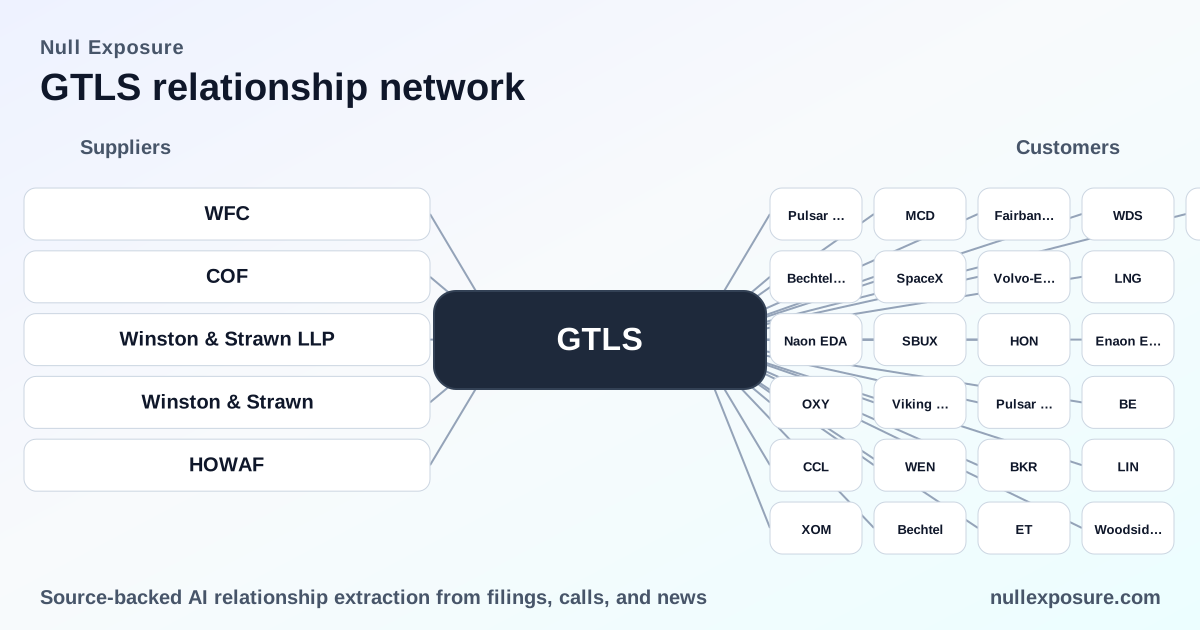
Chart Industries (GTLS): supplier relationships, advisors and what they signal for investors
Chart Industries manufactures and sells engineered equipment for industrial gases and power markets and monetizes through equipment sales, aftermarket services and long-term project contracts tied to LNG, hydrogen and cryogenic solutions. Recent advisory mandates and strategic partnerships are consistent with a company in active deal-making and selective portfolio pruning, while its contracting posture mixes long-term property commitments with shorter supply arrangements. For a structured view of Chart’s counterparties and how they affect execution risk, see the supplier and advisor map at https://nullexposure.com/.
Executive read: why counterparties matter now
Chart’s visible counterparties fall into two categories: financial and legal advisers engaged around M&A and divestitures, and industrial partners supporting hydrogen and cryogenic product development. The advisor engagements signal active corporate transactions that materially affect capital allocation and shareholder optionality; industrial partners reflect an execution path into growth markets. Both groups are critical to near-term valuation dynamics — advisers drive deal certainty and timing; industrial partners drive product bundling and aftermarket revenue retention.
If you are evaluating GTLS supplier relationships for exposure or partnership risk, track the counsel and bank roster closely: they signal both strategic direction and transaction readiness. For a full supplier map and relationship analysis, visit https://nullexposure.com/.
What Chart’s contract signals mean in practice
Company filings and disclosed excerpts show a dual contracting posture. Chart has lease commitments with maturities stretching to September 2042, which establishes long-term fixed overhead and operational footprints that are difficult to scale down quickly as demand cycles. Concurrently, Chart uses shorter one-to-three year supplier terms for certain inputs and services, which allows agility in cost management but increases vendor churn risk during tight supply environments.
Other operating-model signals:
- Buyer posture: Chart records material rental expense under operating leases — $26.2, $21.1 and $16.9 for 2024–2022 in the excerpts — underscoring the company’s role as a large-scale lessee and active purchaser of logistics and facilities services.
- Relationship maturity: Filings indicate Chart maintains long-term vendor relationships with raw-material suppliers while also carrying active lease liabilities ($95.5 and $86.4 in the cited figures), pointing to a mix of durable supplier ties and ongoing contract renewals.
These signals combine into a profile of a manufacturer with high fixed-location commitment (capital and lease intensity) and operational flexibility in supply sourcing — a balance that supports heavy project work but can stress margins during revenue contractions.
For a deeper supplier graph and to monitor changes to this roster, go to https://nullexposure.com/.
Relationship roster: who is working with Chart (each item from the record)
Below are every relationship found in the results, with a concise plain-English summary and the public source.
Wells Fargo Securities, LLC (via Latham & Watkins)
Latham & Watkins disclosed that it represents Wells Fargo Securities, LLC as lead financial advisor to Chart in a transaction context, indicating Wells Fargo Securities’ role as the primary investment bank supporting strategic M&A work. (Latham & Watkins news release, June 2025 — https://www.lw.com/en/news/2025/06/latham-watkins-advises-on-chart-industries-merger-with-flowserve)
Capital One Securities, Inc.
Capital One Securities served as exclusive financial advisor to Chart on the divestiture of American Fan to Fairbanks Morse Defense, signaling use of sell‑side advisory to execute portfolio rationalization. (ADVFN report on the divestiture, FY2026 — https://br.advfn.com/bolsa-de-valores/nyse/GTLS/share-news/92385759/chart-industries-divests-american-fan-to-fairbanks-morse-defense)
Winston & Strawn LLP (legal counsel on divestiture)
Winston & Strawn acted as legal counsel to Chart on the American Fan divestiture, reflecting external legal support for transaction documentation and regulatory clearance tasks. (ADVFN report on the divestiture, FY2026 — https://br.advfn.com/bolsa-de-valores/nyse/GTLS/share-news/92385759/chart-industries-divests-american-fan-to-fairbanks-morse-defense)
Wells Fargo (financial adviser in M&A coverage)
Independent coverage notes Wells Fargo serving as financial adviser to Chart in a proposed acquisition by Baker Hughes, confirming Wells Fargo’s repeat role across strategic sale processes. (LNGIndustry coverage of Baker Hughes transaction, 30 July 2025 — https://www.lngindustry.com/liquid-natural-gas/30072025/baker-hughes-to-acquire-chart-industries/)
Winston & Strawn (legal adviser in M&A coverage)
Separately reported in M&A context, Winston & Strawn is serving as legal adviser to Chart for the same Baker Hughes acquisition discussions, reinforcing its standing as Chart’s external transaction counsel. (LNGIndustry coverage of Baker Hughes transaction, 30 July 2025 — https://www.lngindustry.com/liquid-natural-gas/30072025/baker-hughes-to-acquire-chart-industries/)
Howden (industrial collaboration on hydrogen solutions)
Howden collaborated with Chart on integrated solutions for the hydrogen industry prior to an acquisition, indicating Chart’s strategy of partnering with pump/blower specialists to accelerate hydrogen product offerings. (Energy Connects interview, September 2023 — https://www.energyconnects.com/opinion/interviews/2023/september/unlocking-high-growth-potential-with-strategic-acquisition-and-expansions/)
Investment implications: concentration, criticality and risks
- Advisory concentration: Wells Fargo and Capital One handling major mandates signals reliance on tier‑one and regional investment banks to execute sale and divestiture strategies; successful execution will materially affect free cash flow and strategic optionality.
- Legal continuity: Winston & Strawn’s presence across transactions reduces execution friction but increases exposure to single-counsel dependency for complex regulatory and antitrust work.
- Executional criticality of industrial partners: Partnerships like the Howden collaboration are highly strategic for Chart’s hydrogen positioning, affecting future revenue streams from an emerging end market.
- Contracting mix: The company-level combination of long-term lease commitments and shorter supplier terms creates operational leverage — positive in upcycles, negative in downturns — and explains why investors should treat both real estate liabilities and supplier negotiation timelines as valuation drivers.
What investors should watch next
- Monitor formal deal announcements and advisor fee disclosures for timing and certainty around any sale or merger.
- Track filings related to lease liabilities and rental expense for changes in fixed-cost structure that affect margin resilience.
- Watch continued industrial partnerships and product integrations as leading indicators of hydrogen and LNG aftermarket capture.
For a live, queryable map of Chart’s counterparties and related signals, visit https://nullexposure.com/.
Bottom line
Chart Industries’ current relationship set tells a coherent story: active capital‑markets work backed by repeat financial and legal advisers, paired with industrial partners that deepen product-market access. The company’s contracting posture — long-term lease commitments plus shorter operational contracts — creates both strategic stability and cyclical margin sensitivity. Investors should treat adviser rosters and partnership announcements as leading indicators of corporate action and revenue mix change.
Explore the full supplier and advisor profile at https://nullexposure.com/ for ongoing monitoring and deal‑level context.