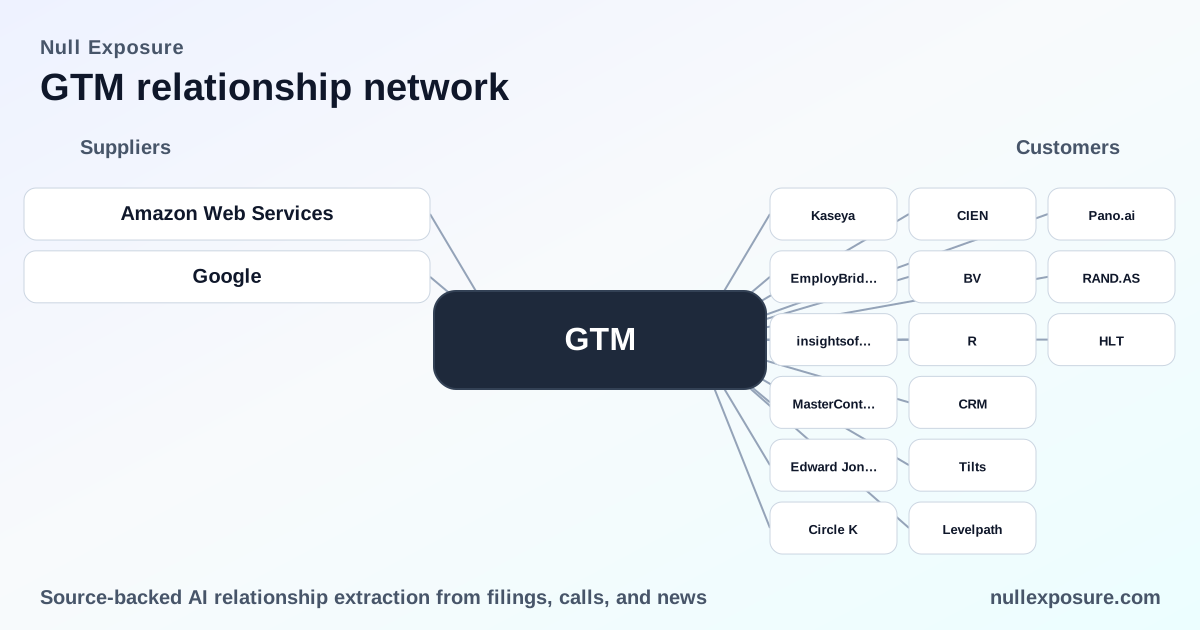
ZoomInfo (GTM) — how cloud relationships shape the go‑to‑market engine
ZoomInfo monetizes a subscription, SaaS platform that sells go‑to‑market intelligence and engagement tools to sales, marketing, operations and recruiting teams. The company operates a cloud‑hosted, high‑availability platform and recognizes recurring revenue from multi‑period contracts; its cost base includes sizable third‑party cloud and software hosting arrangements that are integral to service delivery. For investors, the operating leverage of recurring revenue paired with outsized cloud spend creates both a scalable margin opportunity and a concentration risk around hyperscaler availability and pricing.
Explore supplier risk profiles and more at https://nullexposure.com/.
Thesis in one paragraph: predictable revenue, outsourced infrastructure
ZoomInfo’s business model is classic SaaS: customers sign subscriptions for data, workflow and engagement products, generating predictable, recurring revenue while the company outsources the heavy lifting of compute, storage and global delivery to third‑party cloud providers. This outsourcing reduces capital intensity and speeds time‑to‑market, but it places critical operational dependency on a small set of infrastructure suppliers and on multi‑year contractual commitments that affect cash flow profiles.
What ZoomInfo buys from the cloud winners
ZoomInfo’s 2025 annual filing states the company runs its infrastructure in third‑party data centers hosted by leading cloud providers. That arrangement indicates a service provider relationship—ZoomInfo does not operate bespoke data centers and relies on public cloud regional footprints for scalability, redundancy, and geographic reach. According to the 2025 Form 10‑K, the company’s outstanding non‑cancelable purchase obligations “mainly relate to third‑party cloud hosting and software‑as‑a‑service arrangements,” which aligns commercial operating model and vendor selection with standard SaaS practices (Form 10‑K, FY2025).
Relationship breakdown: what the 10‑K says, provider by provider
Amazon Web Services — a core hosting location
ZoomInfo states that its infrastructure "operates out of third‑party data centers hosted by...Amazon Web Services." In plain terms, AWS provides core cloud hosting for ZoomInfo’s production and/or supporting systems, making it a critical infrastructure supplier for uptime and latency. (Source: Company Form 10‑K, FY2025.)
Google — an additional hosting anchor
The filing also names Google as a host for third‑party data centers supporting ZoomInfo’s infrastructure, indicating multi‑hyperscaler hosting rather than single‑vendor lock‑in. This arrangement gives ZoomInfo geographic and vendor redundancy while keeping operations dependent on external cloud ecosystems. (Source: Company Form 10‑K, FY2025.)
Company‑level constraints that shape supplier exposure
ZoomInfo’s disclosures reveal several operating constraints that are material to any evaluation of supplier risk and contract strategy:
- Subscription contracting posture and non‑cancelable obligations. The 10‑K reports outstanding non‑cancelable purchase obligations that “mainly relate to third‑party cloud hosting and software‑as‑a‑service arrangements,” indicating commitments that extend beyond a single quarter and affect cash outflows and flexibility (Form 10‑K, FY2025).
- Service provider role is explicit. The company explicitly uses third‑party data centers hosted by Google and Amazon Web Services, which confirms that these relationships are operationally critical rather than peripheral (Form 10‑K, FY2025).
- Spend scale sits in the middle band. The filing lists a total of $77.3 million of such non‑cancelable purchase obligations as of December 31, 2025, placing cloud and SaaS commitments in a meaningful but not outsized spend band relative to ZoomInfo’s revenue base (Form 10‑K, FY2025).
These constraints translate to a clear operational portrait: high criticality infrastructure sourced through subscription-style, multi‑period contracts with meaningful committed spend.
What that means for investors and operators
The combination of recurring revenues and outsourced hosting creates a favorable unit economics story—lower capital expenditure and rapid scaling—while concentrating operational risk in a small number of suppliers. Key investor implications:
- Margin sensitivity to cloud pricing. With committed cloud and SaaS spend, sustained price increases from hyperscalers or unfavorable contract renewals would compress operating margins more rapidly than for companies running on proprietary data centers.
- Availability and latency risk. Outages or regional disruptions at AWS or Google could have outsized impact on service delivery and customer retention given the centrality of those providers to ZoomInfo’s stack.
- Negotiation leverage and scale benefits. ZoomInfo’s revenue base and purchase scale should provide negotiation leverage, particularly as it diversifies across multiple providers, but the current disclosure of $77.3 million in commitments shows there is still material near‑term locked‑in spend.
If you want a structured supplier risk assessment tied to these dynamics, start here: https://nullexposure.com/.
Practical red flags and monitoring KPIs
Investors should monitor three vectors in quarterly filings and earnings calls:
- Renewal and contract terms with cloud suppliers reported in procurement disclosures or MD&A commentary.
- Quarterly trends in gross margin and hosting cost of revenue, which will signal pricing pressure or scale benefits.
- Any material incidents tied to AWS or Google regions, and the company’s remediation framework for multi‑region resilience.
Also watch for cadence in the company’s purchase obligation tables; movement in the non‑cancelable commitments line will be an early signal of rising supplier concentration or expanded multi‑year commitments.
Final takeaways and next steps
ZoomInfo runs a standard SaaS operating model: recurring revenue, outsourced infrastructure, and material non‑cancelable commitments to cloud and SaaS suppliers. The FY2025 disclosures name AWS and Google as hosting partners and quantify outstanding commitments at $77.3 million, creating a balance of scalable economics and vendor concentration risk. For investors, the critical questions are whether ZoomInfo can extract margin through scale and whether its multi‑hyperscaler approach sufficiently mitigates single‑vendor outages and pricing risk.
To assess supplier risk in your portfolio or for deeper due diligence on GTM’s exposures, visit https://nullexposure.com/ for supplier mapping and risk scoring. Make that supplier view part of your investment checklist before the next earnings cycle.