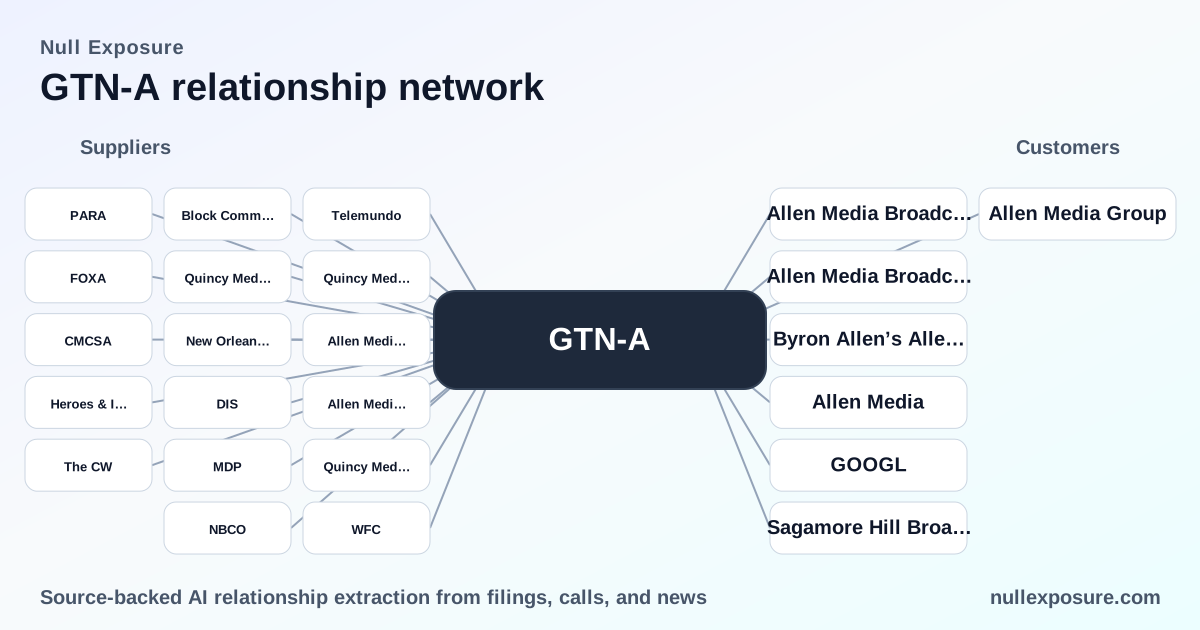
Gray Television (GTN-A): How supplier relationships underpin cash flow and valuation
Gray Television owns and operates local television stations and digital assets across the United States and monetizes primarily through advertising sales, retransmission consent fees, political and live sports rights, and affiliate/network carriage economics. The company negotiates long‑dated affiliation and programming arrangements that allocate advertising inventory and often include variable, usage‑linked fee components; Gray then leverages local distribution and premium live content to extract advertising and retransmission revenue. For investors, the key question is how those third‑party partnerships — network affiliates, content sellers and financial advisors — create durable revenue while concentrating operational and negotiation risk.
Discover more supplier relationship intelligence at https://nullexposure.com/.
How Gray’s commercial plumbing is organized — the operating model in plain English
Gray’s operating model is a classic local broadcaster arbitrage: secure programming and network affiliations, sell advertising and carriage, and manage station consolidation through M&A. Two company‑level signals are particularly material:
- Programming contracts contain usage‑based economics. Public excerpts indicate programming agreements include variable fee components such as revenue sharing or per‑subscriber rates, which links Gray’s cost base to viewership and distributor payments.
- Networks act as service providers that supply programming in exchange for a significant share of advertising time, reinforcing the importance of negotiated inventory splits for Gray’s top and bottom line.
Those signals shape four practical investor constraints:
- Contracting posture: Gray negotiates multi‑year affiliation renewals — renewals materially affect predictability of programming supply and sold inventory. Recent renewals extend into 2028 and beyond, showing a bias to medium‑term stability.
- Concentration vs. diversification: Gray’s footprint spans ABC, NBC, CBS, Fox, Telemundo and niche multicast partners, which reduces single‑network concentration but keeps exposure to aggregate national ad cycles.
- Criticality: Affiliations and premium local sports deals are critical — losing a network or rights package would meaningfully impair advertising inventory and local viewership.
- Maturity: Relationships are mature and operationally integrated, with recurring renewals and active portfolio reshaping via acquisitions and divestitures.
Key drivers to watch: affiliate renewal cadence, retransmission negotiations, and local sports rights. For ongoing supplier intelligence and deal tracking, visit https://nullexposure.com/.
The partner roll call investors should track
Below I cover every relationship surfaced in public materials and headlines. Each entry is a concise business takeaway and a source note.
Telemundo
Gray renewed and expanded its Telemundo portfolio to cover 47 markets, reaching roughly 1.6 million Spanish‑speaking households, enhancing Hispanic audience reach and local ad inventory. This was disclosed in Gray’s 2025 Q4 earnings call (reported March 2026).
Quincy Media / Quincy Media, Inc.
Gray acquired Quincy Media as part of a larger consolidation and subsequently divested certain stations; press from 2021 records the Quincy transaction and subsequent divestitures tied to regulatory approvals. A Deadline report in April 2021 documented Gray’s Quincy deal and later divestiture sales to Allen Media.
Allen Media Group / Allen Media Group, Inc.
Gray purchased and sold stations with Allen Media in a sequence of transactions: Allen acquired seven divestiture stations from Gray for $380 million in 2021, and later Gray purchased ten stations from Allen for $171 million in 2025, reflecting active portfolio reshaping between the two companies. Coverage appears across Deadline (April 2021), Yahoo Finance (2025) and Variety (2025).
Wells Fargo Securities, LLC
Wells Fargo served as financial advisor to Gray during that period of M&A and divestiture activity, indicating the use of large investment banking relationships to execute portfolio transactions. This engagement was noted in Gray press releases and GlobeNewswire coverage from 2021.
Block Communications, Inc.
Gray agreed to acquire four stations from Block Communications for $80 million in 2025, demonstrating continued inorganic growth through smaller‑scale station purchases; this was reported by regional outlets in August 2025.
New Orleans Pelicans
Gray announced a partnership to broadcast Gulf Coast Sports & Entertainment Network content, including 75 of 82 New Orleans Pelicans regular‑season games, expanding local live sports inventory and subscriber appeal; local coverage documented this move in October 2024.
The Walt Disney Company / ABC
Gray renewed affiliation agreements for all ABC‑affiliated stations across 25 markets through December 31, 2028, locking in core network programming and the associated advertising inventory and retransmission economics; Gray’s press release on GlobeNewswire in December 2024 summarizes this arrangement.
Meredith Corporation
Regulatory conditions tied to Gray’s acquisitions forced divestitures such as WJRT to satisfy approvals from the Meredith Corporation transaction era, a fact referenced in coverage discussing the Meredith Local Media Group sale and related regulatory steps.
NBC
Gray renewed its NBC affiliation agreements covering 54 NBC markets for an additional three years (disclosed in Gray’s 2025 Q4 earnings call), securing a core piece of network programming critical to local ratings and national ad pulls; additional coverage of NBC renewals was reported into FY2026.
CBS
CBS relationships figure into Gray’s station inventory and advertising mix; TVNewsCheck commentary on Gray’s FY2025 revenue noted the impact of network content scheduling (e.g., Super Bowl placements) on core advertising revenue and channel economics.
ABC (transactional listing)
As part of the Quincy transaction and station portfolio changes, several ABC‑affiliated stations were included in Gray’s acquisitions, as documented in the Quincy acquisition disclosure in early 2021 local coverage.
FOX
Fox network carriage influences Gray’s ad mix and core advertising revenue; press commentary in FY2025 quantified year‑over‑year impacts linked to network event scheduling across Fox channels.
Heroes & Icons
Gray acquired multicast or niche affiliates such as Heroes & Icons (for example WSJV in South Bend) as part of Quincy Media purchases, reflecting Gray’s strategy to capture secondary and multicast value in smaller DMAs (local transaction reporting, 2021).
The CW
Gray’s Quincy transaction also transported CW affiliations into Gray’s portfolio (e.g., WISE in Fort Wayne), adding additional ancillary programming inventory across certain markets (local reporting, 2021).
(Several of the above relationships appear across multiple press items and filings; I consolidated them into discrete partner summaries while preserving source context.)
What investors should infer from this partnership map
- Revenue sensitivity to network economics and event scheduling is real. Gray’s ad revenue swings tracked to where marquee events air (Super Bowl on CBS vs Fox) and calendar oddities (e.g., Leap Day), making national network placements a short‑term revenue swing factor.
- Contract economics are a hybrid of fixed and usage‑linked costs. Programming agreements with variable fee components mean Gray’s margins flex with subscriber and distributor outcomes; that structure can buffer downside in low viewership periods but also reduce upside if ad markets rebound.
- M&A is a persistent growth lever and governance risk. Gray uses transactions to reshape scale and DMA mix; financial advisors like Wells Fargo underscore the strategic and capital market complexity of these deals.
- Local sports and multicast assets are strategic margin enhancers. Deals like the Pelicans partnership convert local rights into premium viewership and retransmission leverage.
If you want a tailored supplier‑risk dashboard or a deeper read on Gray’s affiliation economics, order targeted research at https://nullexposure.com/.
How to position exposure and next steps
- Monitor upcoming affiliation renewal expirations and retransmission consent cycles — these are value inflection points for both revenue and cost.
- Track M&A headlines and divestiture activity as indicators of balance‑sheet and strategic direction; transaction counterparties are useful leading signals.
- For operational diligence, prioritize local sports rights renewals, network inventory splits, and the structure of usage‑based programming fees.
For ongoing supplier monitoring and to download the full relationship history and source links, visit https://nullexposure.com/.