Guggenheim Active Allocation Fund (GUG): Supplier map, counterparty risks, and what investors should price in
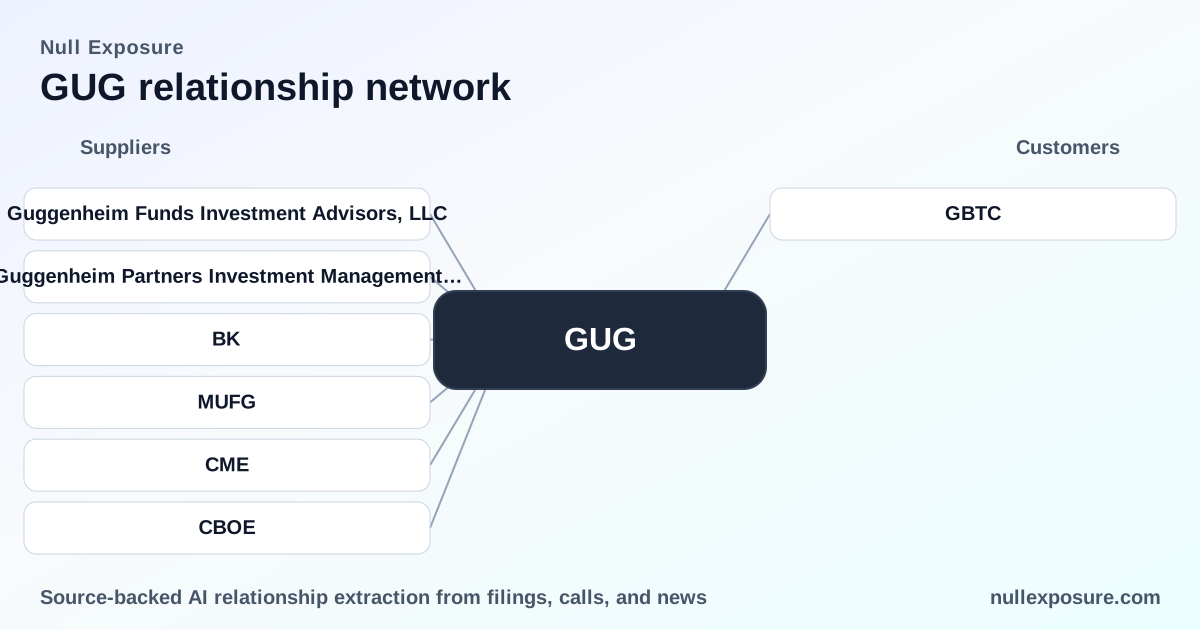
The Guggenheim Active Allocation Fund (GUG) is a dynamically managed closed-end allocation vehicle that generates returns and fee income through active asset allocation and externalized management services. The fund outsources portfolio management, sub‑advisory responsibilities, and back‑office administration to established financial firms, and monetizes primarily through management and advisory fee arrangements embedded in the fund’s expense structure. For investors evaluating exposure to GUG, the supplier network — advisers, sub‑advisers, administrators and trading venues — defines both operational resilience and concentration risk. Visit the research hub for ongoing supplier intelligence: https://nullexposure.com/
How GUG actually operates and where the economics flow
GUG runs a flexible allocation mandate that shifts between equity and fixed income strategies under active oversight. Investment decisions are concentrated in appointed adviser and sub‑adviser firms, while day‑to‑day fund accounting, pricing and administration are outsourced to third parties. The fund’s economics come from management and advisory fees charged to shareholders and the operational leverage produced by delegating execution and administration to large service providers.
That outsourced posture reduces internal operating overhead but creates counterparty concentration and operational dependency: vendors that provide advisory, sub‑advisory, custody, and administration services are essential to fund functioning and valuation transparency. For continual updates on issuer relationships and counterparty risk, see https://nullexposure.com/.
Supplier relationships investors must know
Below are the fund’s named counterparties from the record set, each followed by a concise plain‑English note and a source reference.
Guggenheim Funds Investment Advisors, LLC (GFIA)
GFIA serves as the Investment Adviser to GUG (and related Guggenheim closed‑end funds GBAB and GOF), handling primary portfolio oversight and fiduciary responsibilities for the fund. According to multiple fund distribution notices published via GlobeNewswire and replicated on Yahoo Finance (FY2025–FY2026), GFIA is the adviser designated for GUG.
Guggenheim Partners Investment Management, LLC (GPIM)
GPIM is listed as the Investment Sub‑Adviser for GUG, executing strategy under GFIA’s advisory mandate and providing additional portfolio management resources. This sub‑advisory role is documented across GlobeNewswire releases and Yahoo Finance investor notices (FY2025–FY2026).
The Bank of New York Mellon (BNY Mellon)
On December 15, 2025, GUG entered a new Fund Administration and Accounting Agreement with BNY Mellon to perform administration, bookkeeping, accounting, and pricing functions for the fund, shifting those duties to BNY Mellon. The Globe and Mail (TipRanks coverage) and other outlets reported this contractual change (FY2025).
MUFG Investor Services
Prior administrative agreements with MUFG Investor Services were terminated as part of the transition to new administrators, with reports indicating no additional termination fees were incurred. This termination is referenced in coverage of the administrative transition (The Globe and Mail / TipRanks, FY2025).
Chicago Mercantile Exchange (CME)
Regulatory filings referenced in Blockworks (FY2021) show the fund may seek exposure to cryptocurrency via cash‑settled derivatives traded on venues such as the CME; that operational choice implies execution and clearing relationships tied to CME liquidity and contract availability.
Cboe Global Markets
Same as CME: filings indicate the fund may utilize cash‑settled derivatives traded on Cboe to obtain certain exposures, linking the fund’s potential derivative program to Cboe liquidity and contract specifications (Blockworks, FY2021).
What the supplier map signals about GUG’s business model
With no explicit constraints reported, the relationship structure nevertheless reveals clear company‑level signals:
- Contracting posture: GUG operates a light internal operations model and relies on contractual delegation for both investment and administrative functions. Outsourcing to GFIA/GPIM for portfolio decisions and BNY Mellon for administration signals a deliberate preference for large‑scale third‑party providers over in‑house capabilities.
- Concentration: The fund’s critical functions are concentrated in a small set of counterparties (GFIA, GPIM, BNY Mellon). That concentration creates single‑point operational risk; a disruption at any of these suppliers would materially affect fund operations or reporting cadence.
- Criticality: Advisers (GFIA/GPIM) and the administrator (BNY Mellon) are mission‑critical — their continuity and contractual terms determine governance, NAV calculation, and investor reporting.
- Maturity and institutional footprint: GUG lists a market capitalization of roughly $504 million and ~32.98 million shares outstanding, with institutional ownership at ~32.75%, suggesting a mid‑sized closed‑end fund with meaningful institutional investor interest (company filings, latest quarter May 31, 2025).
Operational and market risks investors should price
- Vendor concentration risk: Heavy reliance on a few advisers and a single administrator amplifies operational vulnerability and raises bargaining leverage for those providers.
- Execution and liquidity risk tied to trading venues: If the fund uses cash‑settled crypto derivatives as filings indicate, liquidity and basis risk on CME and Cboe become relevant to returns and cash management.
- Transition risk: The move from MUFG to BNY Mellon (and termination provisions reported) is operationally normal but creates near‑term integration and reconciliation risk that investors should monitor, particularly around NAV timing and pricing integrity.
Key watch items:
- Timely NAV production and any administrative error filings after the BNY transition.
- Contractual term details and fee schedules for GFIA and GPIM if disclosed in future filings.
- Any formal adoption of cryptocurrency derivative strategies and the governance disclosures around them.
For deeper supplier profiles and to monitor change‑events in real time, consult our platform: https://nullexposure.com/
Investment implications and actions for portfolio managers
GUG’s structure is attractive for investors who prefer a leveraged operational model supported by large institutional suppliers, but the same structure imposes concentration and operational risk that must be priced into allocations. Active managers should treat adviser and administrator continuity as part of their due diligence checklist and require clear disclosure on any derivative use.
If you allocate to GUG:
- Confirm the adviser/sub‑adviser fee arrangements and recent performance attribution to their activity.
- Monitor NAV timeliness and audit or service notices following the BNY Mellon onboarding.
- Watch governance disclosures on derivative use for directional risk to portfolio beta.
For a consolidated view of supplier risk and to subscribe to alerts on GUG counterparty events, visit https://nullexposure.com/ — get supplier‑level intelligence and change notifications tailored to institutional workflows.
Overall, GUG’s outsourced model trades operating leverage for counterparty dependence; investors should reward the fee discipline and manager skill set while actively monitoring the critical supplier relationships named above.