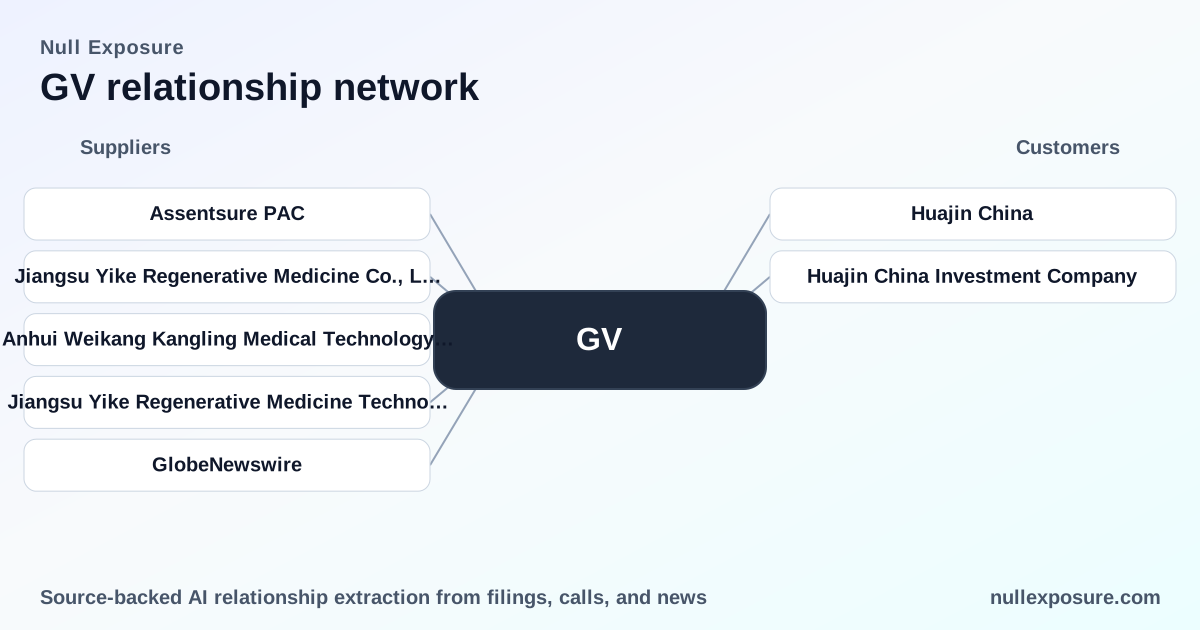
GV (Visionary Holdings) — Supplier map and what it means for investors
Visionary Holdings has transitioned from an education/utility profile into a premium medical-aesthetics operator that monetizes through licensed technologies, joint-venture clinical centers, and sale of high-margin procedural services. The company’s go‑forward model is partner-heavy: it sources proprietary regenerative and delivery technologies from specialized Chinese device and biologics firms, contracts auditors for standing financial assurance, and plans to convert real estate into a branded North American health center. Revenue derives from services, licensing and clinic operations rather than traditional product manufacturing. For a structured supplier risk view and transaction-ready research, visit https://nullexposure.com/.
Executive snapshot — what the supplier set tells investors
Visionary is a small-cap, early-stage pivot with revenue of roughly $5.0M TTM and negative EBITDA. The supplier list shows an explicit strategy to buy or license advanced regenerative technologies and to de-risk market entry through partnerships and a North American joint venture. Key investors should read this as a capital‑intensive scaling play that is heavily dependent on third-party IP and partner execution.
- Concentration and criticality: A small number of named collaborators supply core technology and clinic buildout capability; these relationships are operationally critical.
- Contracting posture: The company has signaled strategic collaborations and a JV structure rather than outright acquisition, implying licensing and revenue‑share economics.
- Maturity: These partnerships are recent and development-focused (FY2025–FY2026), placing the model in early commercialization phase.
- Transparency: Public commentary is primarily press releases summarized by news services; few formal financial metrics are tied to partner contracts in filings.
Learn how this supplier intelligence affects valuation and counterparty risk at https://nullexposure.com/.
Relationship roll call — who supplies what (plain-English, sourced)
Assentsure PAC — auditor reappointment (FY2025–FY2026)
Assentsure PAC has been reappointed as Visionary’s auditor for the 2025–2026 fiscal years, establishing continuity in the company’s financial oversight as it executes its strategic pivot. According to a QuiverQuant posting summarizing the company announcement (March 9, 2026), this is a governance action that supports reporting continuity.
Jiangsu Yike Regenerative Medicine Technology Co., Ltd. — core regenerative tech supplier and global R&D partner (FY2025–FY2026)
Visionary integrated Jiangsu Yike’s proprietary regenerative technologies into a suite of personalized anti‑aging and cellular rejuvenation solutions (stem cell therapy, NK cell revitalization, AI health assessment, nano‑delivery systems) and signed a cooperation agreement to jointly develop and market medical aesthetics products globally. Sources: a Yahoo Finance release on March 9, 2026 reporting the technology integration, and QuiverQuant/FinancialContent coverage of a FY2025 cooperation agreement and FY2026 collaboration statement.
Anhui Weikang Kangling Medical Technology Co., Ltd. — joint-venture clinical buildout partner (FY2025–FY2026)
Visionary announced a joint venture with Anhui Weikang Kangling to construct an “Anti‑Aging High‑End Medical Aesthetics and Health Center” on company property in Toronto as part of its North American clinical footprint plan, and described strategic collaborations to access product resources and proprietary technologies. These details are reported in FinancialContent (December 30, 2025) and reiterated in the company’s corrected annual report summary covered by QuiverQuant (March 9, 2026).
GlobeNewswire (press distribution) — press release syndication noted as AI summary (FY2026)
One of the items in the public record is an AI‑generated summary of a GlobeNewswire press release describing Visionary’s strategic plans; this indicates the company’s use of broad press distribution to disseminate its pivot messaging and that some coverage may be automated. QuiverQuant flagged this characterization in its March 2026 aggregation.
What the supplier mix implies for operations and valuation
The supplier set is strategic and high‑dependency: regenerative IP and a JV partner are the linchpins of the new business model. For investors that translates to three concrete structural dynamics:
- Execution risk concentrated in a few counterparties. With core therapeutic modalities and clinic buildout tied to Jiangsu Yike and Anhui Weikang, operational execution and intellectual‑property access are single points of failure for revenue realization.
- Revenue upside but high working capital and regulatory sensitivity. Licensing and clinic operations can generate attractive margins, yet they require capital to build clinical capacity, obtain regulatory clearances, and scale patient throughput.
- Governance continuity is being preserved. Reappointing Assentsure PAC as auditor signals an effort to maintain reporting credibility during a material business model transition.
These are not peripheral vendor relationships — they are the strategic supply chain for the company’s new revenue engine.
Constraints and company-level signals
There were no supplier‑specific contractual constraints disclosed in the relationships data set provided. As a company-level signal, the absence of explicit constraint excerpts suggests limited public disclosure of commercial terms, exclusivity, payment milestones or IP transfer details, which increases the importance of direct diligence on contract terms and regulatory authorizations before assuming revenue certainty.
Investment implications and risk checklist
- Upside thesis: If partnerships successfully translate to proprietary clinic offerings and licensing deals, a small revenue base can scale rapidly given the high per‑procedure economics in premium aesthetics.
- Downside thesis: Execution hinges on partner performance, regulatory approvals, and capital availability; current indicators show negative EBITDA and a small institutional ownership base, which can amplify volatility.
- Catalysts to monitor: contract filings, JV agreements, within‑jurisdiction regulatory approvals, first‑quarter clinic metrics, and any amendments to auditor or partner arrangements.
For focused supplier and counterparty due diligence tools that accelerate this process, see https://nullexposure.com/.
Final read — where investors should focus
Visionary’s strategy is clear: leverage third‑party regenerative IP and a branded clinical channel to create a premium medical‑aesthetics revenue stream. That approach offers asymmetric upside if partners deliver and initial clinics establish pricing power, but the company’s small scale, negative margins, and concentration of supplier risk create real execution hazards. Prioritize verification of contract terms with Jiangsu Yike and Anhui Weikang, confirmation of clinical compliance steps, and continued governance signals from the auditor engagement.
If you need a tailored supplier risk brief or counterparty verification package for GV, start here: https://nullexposure.com/.