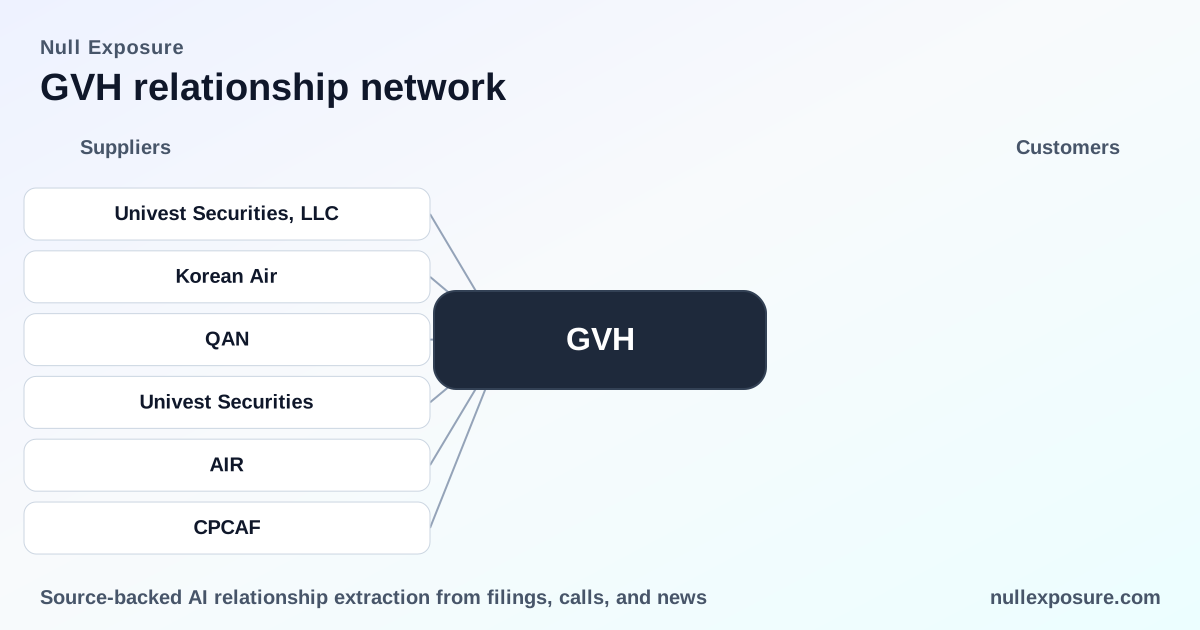
GVH supplier relationships: financing partners and carrier network that power cross‑border logistics
Globavend Holdings Limited (GVH) operates as an integrated cross‑border logistics and air freight forwarder serving Hong Kong, Australia and New Zealand; the company monetizes by arranging freight movement, leveraging carrier partnerships, and by raising capital through equity placements to fund growth in e‑commerce logistics. For investors evaluating supplier risk and counterparty exposure, the observable relationships cluster into two functional groups: capital markets/placement agents that supply liquidity and airline carriers that provide the operational lift for freight. Learn more about GVH supplier intelligence at https://nullexposure.com/.
Capital partners that underwrite growth financing
Univest Securities — repeated placement agent role
Univest Securities has been the principal placement agent on multiple GVH equity transactions across FY2025–FY2026, including acting as sole placement agent for a June 26, 2025 public offering and for later registered direct offerings that closed in late 2025 and early 2026. According to GlobeNewswire (June 26, 2025) and follow‑on notices, Univest executed at least one $14–$15 million placement and later managed a $1.4 million registered direct close that sold shares at $1.60 each to improve liquidity for GVH’s e‑commerce logistics operations. (GlobeNewswire, June 2025; secondary press reporting Dec 2025–Jan 2026.)
Carrier partners that provide freight capacity and market access
Air New Zealand — capacity and IATA accreditation link
GVH is an IATA‑accredited cargo agent with documented ties to Air New Zealand, indicating operational access to the carrier’s Pacific routes and associated capacity pools critical to GVH’s Australia/New Zealand trade flows. This relationship is described in press materials outlining GVH’s carrier network. (ABN Newswire press release; FY2024 disclosures cited in regional press.)
Cathay Pacific — gateway to Hong Kong flows
Cathay Pacific is listed among the “top air freight carriers” with which GVH maintains strong ties, positioning GVH to route Asian e‑commerce inventory through Hong Kong gateways and leverage Cathay’s long‑haul freighter and belly capacity. (ABN Newswire press release; FY2024 commentary.)
Qantas (QAN) — domestic/regional lift across Australia
Qantas is explicitly noted as a partner carrier, giving GVH domestic and short‑haul regional lift within Australia and direct connections into outbound international transits. The carrier affiliation was disclosed in the company’s public notices describing its carrier relationships. (ABN Newswire press release; FY2024.)
Korean Air — additional transpacific capacity
Korean Air is named among the major carriers tied to GVH, providing another source of transpacific and intra‑Asia capacity that supports cross‑border routing options for customers. This expands GVH’s ability to source lift beyond a single airline group. (ABN Newswire press release; FY2024.)
What the relationship map reveals about GVH’s operating model
GVH’s supplier footprint shows two concentrated but complementary dependency vectors:
-
Financing dependence on placement agents: Repeated use of Univest Securities for multiple equity raises indicates a contracting posture that favors equity financing arranged through a single trusted placement partner rather than diversified capital sources. That creates execution efficiency but concentrates placement risk and dealer negotiation leverage with one intermediary. (GlobeNewswire; related press 2025–2026.)
-
Operational reliance on major global carriers: Listing Air New Zealand, Cathay Pacific, Qantas and Korean Air as principal carrier partners signals critical dependency on established airlines for capacity, but also operational resilience through multiple carrier relationships rather than a single provider. Carrier ties are critical to GVH’s revenue model: freight forwarding margins and on‑time performance depend on these suppliers’ schedules and yield management. (ABN Newswire; FY2024.)
-
Maturity and scale signals: Public filings and reported financings show GVH actively raising capital to scale e‑commerce logistics, consistent with a growth posture rather than a fully mature, self‑funding operation. Financial metrics (Revenue TTM ≈ $23.6M, modest profit margins) corroborate a company in the scaling phase that uses external capital to expand throughput and liquidity.
Risk and concentration takeaways investors should track
- Capital access is fungible but concentrated. Univest’s repeated placement role accelerates raises but centralizes execution risk; watch for changes in placement terms or alternative capital channels as indicators of financing flexibility. (GlobeNewswire; market reports 2025–2026.)
- Operational criticality of carriers. Airline scheduling or capacity shocks at Air New Zealand, Qantas, Cathay Pacific or Korean Air would have immediate operational impact; however, having multiple carrier relationships provides operational redundancy. (ABN Newswire commentary, FY2024.)
- Execution sensitivity during growth financing. The company’s public offerings and registered direct transactions are direct levers on liquidity and working capital; pricing and uptake on those transactions are leading indicators of market appetite for GVH equity. (Press notices June 2025–Jan 2026.)
For a focused supplier risk brief and ongoing monitoring of these relationships, see the GVH supplier dossier at https://nullexposure.com/.
Company‑level signal on contractual constraints
No supplier‑level contractual constraints were reported in the collected relationship signals. This absence is itself a company‑level signal: publicly observable data emphasize carrier affiliations and placement agent activity, but do not disclose long‑term exclusive supply contracts, anchor customer covenants, or supplier security interests. Investors should treat supplier exposure as operational (capacity agreements) and financing‑driven rather than as legally encumbered by disclosed contractor constraints.
How to use this in your investment checklist
- Confirm current placement agent arrangements and any exclusivity period with Univest before assuming future equity access. (GlobeNewswire and press filings, 2025–2026.)
- Monitor carrier capacity announcements from Air New Zealand, Cathay Pacific, Qantas and Korean Air for schedule or capacity changes that would affect GVH routing economics. (Carrier notices and regional trade press, FY2024–ongoing.)
- Track follow‑on offers and registered direct closings as real‑time liquidity signals; pricing levels in those raises reflect market valuation and capital stress or strength. (Public offering notices June–Dec 2025; Jan 2026 closing announcements.)
If you want a tailored supplier risk scorecard or a deeper counterparty exposure map for GVH, begin with a high‑quality supplier intelligence briefing at https://nullexposure.com/ — we provide the transactional and relationship context investors need.
Final read: the bottom line for operators and investors
GVH’s business is funded and enabled by two types of suppliers: capital providers (notably Univest Securities) and major airline carriers (Air New Zealand, Cathay Pacific, Qantas, Korean Air). That structure supports rapid scale in e‑commerce logistics but concentrates financing execution and operational lift into a finite set of partners. Investors should prioritize monitoring placement activity and carrier capacity schedules as the most direct predictors of GVH’s near‑term liquidity and operational performance. For ongoing intelligence on these relationships and how they move GVH’s risk profile, visit https://nullexposure.com/.