GWH (ESS Tech Inc): supplier relationships that shape near-term liquidity and execution
ESS Tech Inc (ticker GWH) designs and sells iron flow battery systems to utilities and commercial customers, monetizing through system sales, service agreements, and intellectual property transfers. The company funds operations through capital raises, placement agents and strategic lender relationships while supplementing product roadmap and IP via selective acquisitions; those activities determine supplier dependency, balance-sheet flexibility and execution risk for operators and investors. For a rapid supplier-risk read and relationship map, visit NullExposure.
How this company sources capital, counsel and IP — a quick strategic read
ESS operates a capital-intensive, hardware-driven business model where external professional services, placement agents, and credit providers directly affect near-term liquidity and the pace of revenue recognition. Capital relationships and counsel are not ancillary: they are critical levers that determine whether ESS can convert backlog and IP into scalable deployments. That dynamic is essential when valuing operations that remain loss-making on the latest trailing figures (Revenue TTM $1.583M; Diluted EPS -$5.05; Market Cap ~$39.8M). Learn more at NullExposure.
The supplier and partner roster, and what each relationship actually means
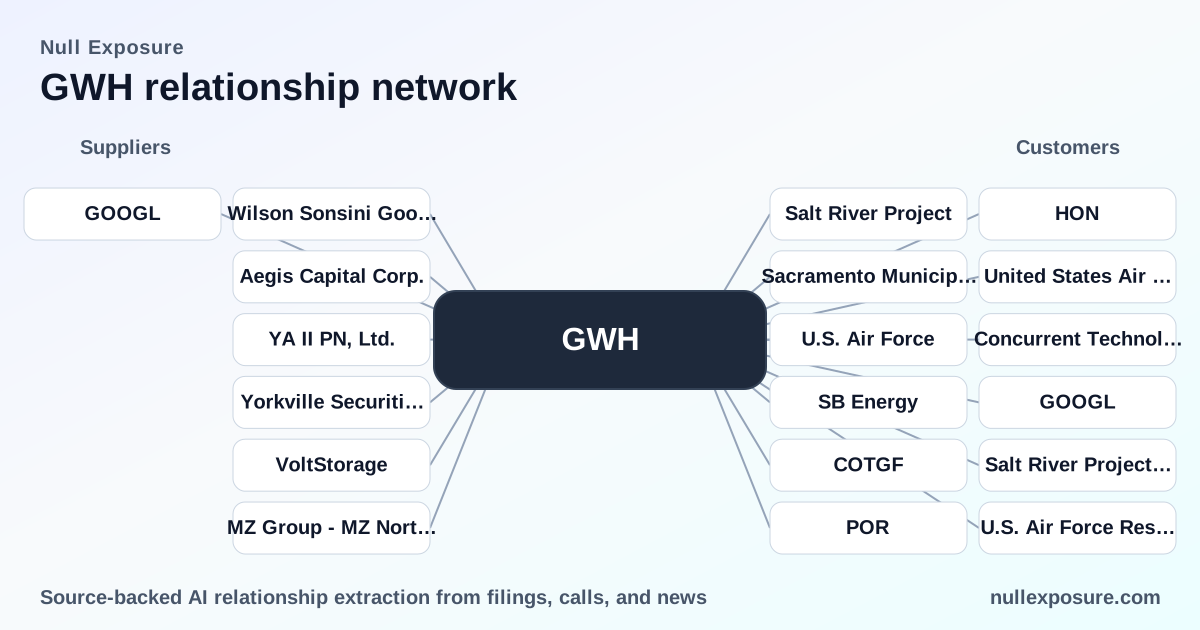
Below are the discrete counterparties surfaced in public reporting and press coverage. Each entry is a concise, plain-English description with a direct source reference.
-
Wilson Sonsini Goodrich & Rosati, P.C. — The firm is acting as legal counsel to ESS for recent corporate transactions, providing governance and transactional support that underpins capital raises and securities work in FY2026. Source: Yahoo Finance press release, FY2026 (https://finance.yahoo.com/news/ess-tech-inc-announces-15-133000417.html).
-
Aegis Capital Corp. — Aegis serves as the exclusive placement agent on ESS’s offering, managing distribution and underwriting execution that affects the company’s ability to access public capital markets in FY2026. Source: Yahoo Finance press release, FY2026 (https://finance.yahoo.com/news/ess-tech-inc-announces-15-133000417.html).
-
YA II PN, Ltd. (Yorkville Advisors fund) — Yorkville’s fund is identified as a new lender participating in a financing transaction, providing alternative credit capital that supplements equity raises and enhances short-term liquidity in FY2025. Source: MarketScreener report, FY2025 (https://www.marketscreener.com/news/ess-tech-inc-announced-that-it-expects-to-receive-40-million-in-funding-ce7d5aded881fe2c).
-
Yorkville Securities, LLC — An affiliate of Yorkville is named as the potential sales agreement counterparty for a contingent tranche, linking secured-lender financing to an equity sales mechanism that can unlock additional draws under the facility in FY2025. Source: MarketScreener report, FY2025 (https://www.marketscreener.com/news/ess-tech-inc-announced-that-it-expects-to-receive-40-million-in-funding-ce7d5aded881fe2c).
-
VoltStorage — ESS acquired VoltStorage’s intellectual property and assets in February 2026, an inorganic move to broaden its iron-based battery IP and accelerate product development rather than develop those technologies solely in-house. Source: InsiderMonkey earnings-call coverage, FY2026 (https://www.insidermonkey.com/blog/ess-tech-inc-nysegwh-q4-2025-earnings-call-transcript-1711770/).
-
MZ Group - MZ North America — MZ Group is named in corporate materials as the investor relations/communications firm supporting ESS, a relationship that shapes market messaging and investor access in FY2026. Source: Yahoo Finance press release, FY2026 (https://finance.yahoo.com/news/ess-tech-inc-announces-15-133000417.html).
-
Google (Alphabet) — Market commentary and analyst notes reference collaboration with Google on projects that reduce ESS’s project execution cost burden and provide validation from a major tech partner; this was cited in analyst coverage around FY2025. Source: TimothySykes summary referencing Roth Capital commentary, FY2025 (https://www.timothysykes.com/news/ess-tech-inc.gwh-news-2025_10_17/).
What the relationship map implies about operations and contracting
The pattern of relationships produces several actionable operating-model signals for investors and operators:
-
Contracting posture — transaction-heavy and externally mediated. ESS relies on placement agents, lenders and external counsel to deliver capital and execute financings; corporate outcomes are therefore tightly coupled to the effectiveness of these external parties rather than being purely internal financing decisions.
-
Concentration and criticality — financing and IP partners are critical. A small set of financial counterparties (Yorkville, Aegis) and the acquisition of VoltStorage IP indicate concentration of critical functions (capital and technology) outside the company. That increases counterparty risk if any single partner changes posture.
-
Supplier maturity and role diversity. Relationships span professional services, placement agencies, non-bank lenders and acquired technology—a mix of mature financial service providers and smaller IP positions, rather than a deep-tier manufacturing supply chain network.
-
Spend and procurement posture. Company-level disclosures show unfulfilled noncancellable purchase commitments of $0.2M at year-end 2024, implying smaller per-counterparty spend magnitude and a lower committed manufacturing spend band (evidence consistent with a $100k–$1M spend band signal).
These are company-level constraints drawn from public excerpts and filings, not attributions to any single counterparty.
Investment implications: how to weigh upside against execution risk
-
Capital access drives short-term survival. With negative EBITDA and low trailing revenue, the company’s runway and ability to scale deployments depend on the successful execution of the Aegis placement, Yorkville draws, and ongoing lender support. The counsel role of Wilson Sonsini reduces transactional legal execution risk.
-
IP acquisition de-risks product roadmap but requires integration. The VoltStorage purchase is a strategic accelerator of iron-salt battery IP; integration success will determine whether this is value-accretive or an expense absorption on the P&L.
-
Market validation is meaningful but not definitive. References to Google collaboration provide positive signal for project-level cost sharing and validation, but an investor should treat such mentions as project-level support rather than recurring revenue guarantees.
-
Key takeaways: capital relationships are the primary operational lever, IP acquisitions alter R&D trajectory, and procurement commitments remain modest, limiting heavy manufacturing lock-in for now.
For a deeper supplier-risk score and counterparty monitoring, check NullExposure for the complete supplier map and alerting options.
Closing guidance for investors and operators
Operational diligence should focus on the near-term financing calendar, the conditional nature of Yorkville tranches, and post-acquisition integration milestones for VoltStorage IP. If you are evaluating supplier risk or preparing to transact with ESS, prioritize legal and financing contingency planning given the company’s capital structure and reliance on placement agents and non-bank lenders. For real-time monitoring and supplier-level insights, visit NullExposure.
Key relationships and their roles are documented in the public filings and press materials linked above; use those sources to validate progress against financing milestones and integration timelines before sizing exposure.