Gyre Therapeutics — supplier relationships and what they mean for investors
Gyre Therapeutics operates as a development-stage biopharmaceutical company that monetizes through a mix of product sales, in‑licensing and acquisition-driven pipeline builds, milestone / royalty obligations, and capital‑markets financings. The company’s business model combines proprietary R&D with targeted acquisitions and licensing deals to accelerate commercialization (ETUARY is already approved in the PRC), while using third‑party manufacturers and capital markets partners to scale development and fund operations.
For an investor-grade supplier risk profile and continuous monitoring, see https://nullexposure.com/ — the overview and signals there map directly to counterparty concentration and contract structure.
How Gyre’s operating model drives supplier choices
Gyre is structured to lean on external expertise across three axes: capital markets, legal and transaction advice, and outsourced development / manufacturing. That triage reduces fixed overhead while concentrating operational risk in a small set of third parties. The constraints in company filings show a deliberate mix of contract tenors — long‑term leases and licensing commitments coexist with short‑term procurement and service contracts — which creates both stability (fixed facilities and multi‑year licensing liabilities) and flexibility (shorter procurement cycles and service engagements).
Key operational characteristics investors must treat as structural signals:
- Contracting posture: a hybrid model — substantial long‑term lease obligations for offices and PRC facilities alongside numerous short‑term purchase commitments and service arrangements. This supports scaled manufacturing in APAC while keeping headcount and fixed costs modest in the U.S.
- Concentration and geography: the supplier footprint is APAC‑heavy, with manufacturing and many operational leases in mainland China, creating geopolitical, regulatory and FX vectors for supply disruption or cost volatility.
- Criticality and materiality: some supplier relationships are critical and material (manufacturing, licensing and CMOs), while much of the spend is mid‑range ($100k–$10m) — enough to move timelines if interrupted but not uniformly catastrophic per contract.
- Maturity: relationships are a mix of active and developing, with the company reporting a small number of stable suppliers alongside active deals and ATM financing programs.
If you evaluate counterparties as part of diligence, Gyre’s profile rewards focused scrutiny of manufacturing and licensing counterparties and the legal/advisory firms that steer transactions. More on supplier signal mapping at https://nullexposure.com/.
Who Gyre is working with now — the relationships in the record
Below are the supplier and advisor relationships captured in recent public releases and news items. Each entry is a plain‑English summary with the cited source.
-
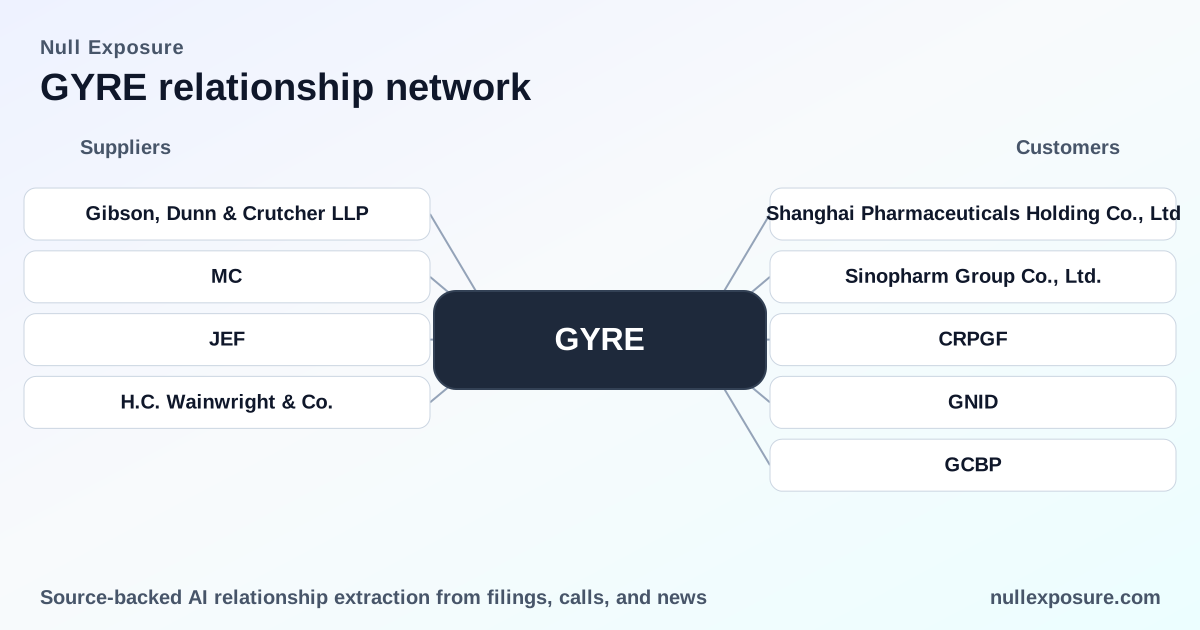
Gibson, Dunn & Crutcher LLP — Gyre’s legal counsel. The company engaged Gibson Dunn as outside legal counsel in connection with its announced acquisition activity and corporate transactions. According to the GlobeNewswire release (March 2, 2026) and a Yahoo Finance repost (March 10, 2026), Gibson Dunn is identified as Gyre’s legal counsel on the Cullgen acquisition announcement.
Source: GlobeNewswire press release (Mar 2, 2026) and Yahoo Finance coverage (Mar 10, 2026). -
Moelis & Company LLC — financial advisor to Gyre’s special committee. Moelis is acting as the special committee’s financial advisor related to the company’s acquisition activity, providing independent transaction advice during the review of the deal. This role was disclosed in both GlobeNewswire and Yahoo Finance coverage of Gyre’s acquisition agreement (March 2026).
Source: GlobeNewswire press release (Mar 2, 2026) and Yahoo Finance coverage (Mar 10, 2026). -
Jefferies — lead book‑running manager for an equity offering. Jefferies served as the lead book‑runner on a 2,555,555 share offering priced at $9.00 per share under Gyre’s ATM and placement activity, supporting the company’s near‑term liquidity and capital plan (reported March 2026).
Source: Yahoo Finance coverage of Gyre’s offering (Mar 10, 2026). -
H.C. Wainwright & Co. — co‑manager on the equity offering. H.C. Wainwright participated as a co‑manager alongside Jefferies on the same share offering that raised capital for Gyre’s operations and pipeline development (reported March 2026).
Source: Yahoo Finance coverage of Gyre’s offering (Mar 10, 2026).
What these relationships imply for operational resilience
The mix of legal, advisory and capital markets partners is consistent with a company executing bolt‑on transactions and frequent capital raises. That structure provides transactional horsepower but concentrates short‑term operational risk in a handful of critical service providers (CMOs, licensing partners and key advisors). The constraints in public filings reinforce this picture: Gyre holds multi‑year licensing obligations, longer leases for facilities, and active reliance on third‑party manufacturers — all of which amplify the importance of counterparties that can perform to GMP and regulatory standards.
Investors should weigh three practical signals:
- Regulatory and geographic exposure: heavy APAC manufacturing and numerous PRC leases imply governance and FX risk that is not easily hedged.
- Commercial milestones and contingent payments: licensing and transfer agreements create future cash outflows tied to approvals and launches, locking future economics to counterparties’ performance and regulatory timing.
- Capital‑markets dependency: ATM programs and managed equity offerings (Jefferies, H.C. Wainwright) are an explicit part of the funding model, so market access and advisor execution quality directly affect runway.
If you want a supplier‑level risk heatmap tied to these exact signals, explore the analytical tools at https://nullexposure.com/.
Risk watchlist and near‑term catalysts
For active investors and operators, focus on:
- Manufacturing continuity: any interruption at key CMOs would materially delay clinical programs and commercial supply.
- Regulatory milestones tied to licensing payments: approvals trigger milestone payouts and change cash flow profiles; track application filings and inspection calendars closely.
- Capital access and dilution risk: the ATM and recent placements are cash lifelines; continued use of these programs will determine dilution and runway.
Conclusion — where supplier risk affects value
Gyre’s supplier landscape is intentionally lean and transaction‑oriented: the company outsources manufacturing and relies on specialized legal and financial advisors to execute strategic deals, while holding licensor/licensee obligations that convert scientific progress into commercial value. That model supports faster go‑to‑market for prioritized assets, but it concentrates operational and regulatory exposure in a small set of critical counterparties — an important consideration for valuation and scenario planning.
For targeted supplier diligence, counterparty scoring, and continuous monitoring to inform investment decisions, visit https://nullexposure.com/ — the platform organizes these exact signals into investable risk profiles.