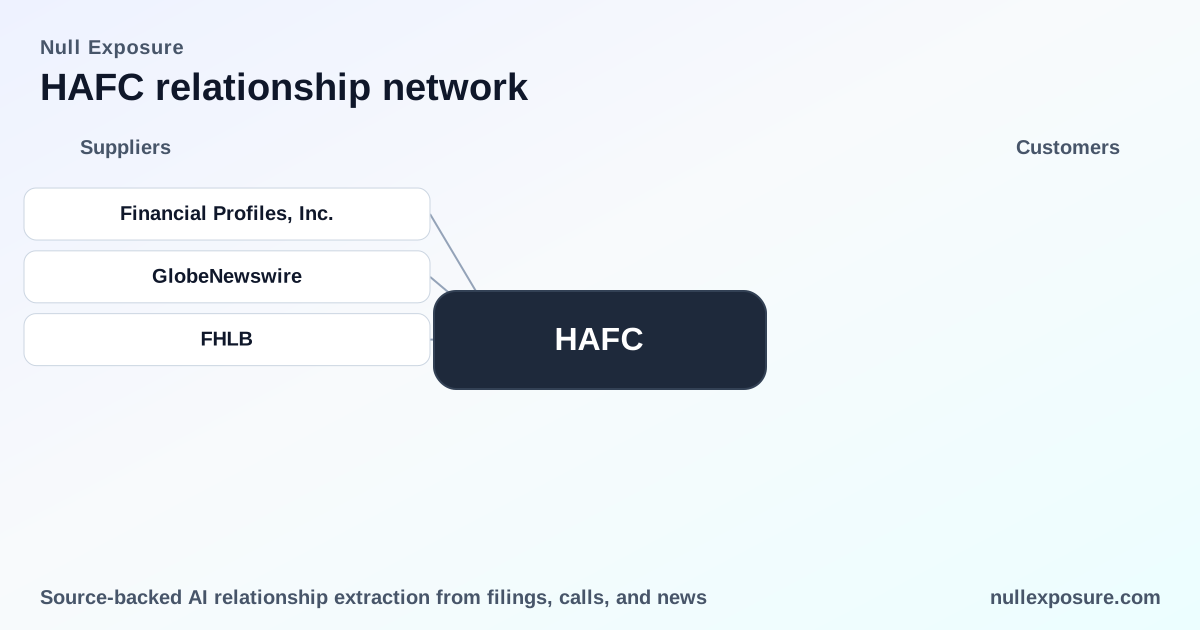
Hanmi Financial (HAFC): supplier footprint and what investors should underwrite
Hanmi Financial Corporation (NASDAQ: HAFC) operates as the holding company for Hanmi Bank, monetizing through traditional regional-bank channels: net interest income from a $2.4bn+ loan book, fee income, and returns on a large securities portfolio, with capital returned to shareholders via regular dividends. The company’s supplier profile is dominated by banking-system counterparties (Federal Home Loan Bank, Federal Reserve facilities), large third‑party service providers for data processing and security, and retained investor‑relations support — a mix that creates both operational dependency and balance-sheet optionality for liquidity management. For a closer look at how these relationships affect counterparty and operational risk, see the NullExposure hub: https://nullexposure.com/.
Quick read: what the supplier picture means for investors
Hanmi is a regional bank holding company with material exposure to government‑backed funding channels and large vendor services. Key balance‑sheet cues: $905.8m in available‑for‑sale securities, FHLB advances of $262.5m (down from $325.0m), and meaningful ongoing spend on data processing and occupancy (each in the tens of millions). The business model mixes long‑dated commitments — leases, subordinated notes (2031 notes of $110m) — with active liquidity management through wholesale borrowings. This creates a vendor and funding posture that is partly long‑term (leases, subordinated debt, multi‑year FHLB advances) and partly operationally active (third‑party IT/security contracts and software licenses).
For rapid access to the underlying signals used here, visit https://nullexposure.com/.
The relationships disclosed in recent filings and press — itemized
Below I cover each relationship returned in the supplier scan. Each entry is a plain‑English, investor‑oriented summary with an explicit source reference.
Financial Profiles, Inc. — investor relations support (news item)
Hanmi lists Financial Profiles, Inc. (contacts: Lisa Fortuna and Romolo Santarosa) as the external investor‑relations contact used to distribute dividend announcements and earnings communication, indicating outsourced IR support for market communications (investor contact details appeared in a Yahoo Finance feed on March 10, 2026: https://finance.yahoo.com/news/hanmi-financial-increases-cash-dividend-130000230.html).
GlobeNewswire — corporate press release channel (quarterly dividend)
A GlobeNewswire release dated January 29, 2026 announced a $0.28 per‑share cash dividend for Q1 2026, up 4% from the prior quarter, confirming the board’s distribution policy and the importance of consistent market communication channels (press release available via GlobeNewswire; reported in the market on Jan 29, 2026: https://finance.yahoo.com/news/hanmi-financial-increases-cash-dividend-130000230.html).
Financial Profiles, Inc. — IR role reiterated in earnings coverage
Independent coverage of Hanmi’s Q4 2025 highlights repeats that investor relations are coordinated by CFO Romolo Santarosa together with Financial Profiles, Inc., underscoring a stable outsourcing relationship for investor messaging and support (reported in an earnings highlights piece, published March 10, 2026: https://intellectia.ai/news/stock/hanmi-financial-reports-q4-2025-earnings-highlights).
FHLB (Federal Home Loan Bank of San Francisco) — wholesale funding and capital stock
Hanmi is a member of the FHLB of San Francisco and uses FHLB advances as a primary wholesale funding source; filings show outstanding advances of $262.5m at Dec 31, 2024 and explicit reductions of advances as deposits grew (referenced in trading and SEC report summaries noting a $62.5m reduction and deposit‑driven paydowns; see trading commentary referencing the 10‑K: https://www.tradingview.com/news/tradingview:e783c2bd36424:0-hanmi-financial-corp-sec-10-k-report/).
Operating constraints and what they say about vendor risk
Hanmi’s supplier and funding profile produces a set of practical constraints for investors and counterparties:
-
Contracting posture: Hanmi carries long‑term obligations — operating leases with weighted average remaining terms over six years and subordinated notes maturing in 2031 — which obligate capital and sourcing continuity over the medium term. The company also selectively uses short‑term leases and short‑dated FHLB tranches; the balance sheet therefore blends multi‑year commitments with rolling short‑term funding. These are company‑level signals drawn from the filings.
-
Concentration and criticality: The FHLB relationship is functionally critical. Filings show material FHLB advances and required FHLB stock ownership; the Bank’s dividend stream is the primary source of the holding company’s distributable cash, so wholesale funding channels and bank profitability are central to the company’s ability to service suppliers and pay dividends (FHLB details are linked explicitly in the FHLB relationship disclosure above).
-
Maturity and spend profile: Vendor spend skews high in a few categories — securities and funding positioning (>$100m), data processing (
$14.9m) and occupancy/leases ($17.8m). That split implies both strategic, large counterparties (cloud, core banking vendors, and FHLB/Fed facilities) and a number of mid‑sized professional services relationships supporting loan systems and cybersecurity. These are company‑level signals inferred from reported expense lines and pledged collateral amounts. -
Service provider dependency: Filings repeatedly call out dependence on third‑party IT and security providers, valuation and appraisal vendors, and audit/consulting firms (Crowe LLP is the auditor cited). This creates operational concentration risk: replacement of large national vendors could be time‑consuming and costly, with potential regulatory consequences. This is a company‑level signal; where the FHLB is named, the funding dependency is explicitly tied to that relationship.
Investor implications and checklist
Hanmi’s supplier profile presents a nuanced risk/reward tradeoff for investors and counterparties:
-
Upside: Strong profitability metrics (near 30% profit margin in the latest TTM data), a growing dividend, and active deleveraging of FHLB advances (deposit growth used to pay borrowings) all support thesis for resilient cash generation. The GlobeNewswire dividend announcement confirms a management posture of shareholder distributions.
-
Risks for counterparties: Funding concentration with FHLB and dependence on bank dividends make Hanmi sensitive to banking‑sector stress or changes in regulatory insurance premiums. Vendor continuity risk is material where services are provided by large, difficult‑to‑replace suppliers.
-
Due diligence checklist for operators and suppliers:
- Confirm contract term lengths and renewal options for any proposed IT or lease agreement (Hanmi’s existing leases have multi‑year remaining terms).
- Price contingent on the counterparty role: providers of security/processing services should structure SLAs and incident remediation clauses given Hanmi’s third‑party reliance.
- For funding or treasury counterparties, evaluate the bank’s pledged collateral and FHLB membership commitments.
If you want a consolidated supplier risk scorecard and supplier‑by‑supplier breakdown for Hanmi, start here: https://nullexposure.com/.
Bottom line and next steps
Hanmi presents a stable, actively managed balance‑sheet profile with a clear mix of long‑term commitments (leases, subordinated notes, FHLB advances) and continuing reliance on third‑party providers for mission‑critical IT, valuations and audit services. For investors and vendor managers, the key themes are funding concentration, vendor continuity, and the material role of the bank dividend stream in supporting parent company cash distributions.
To review Hanmi’s supplier relationships across multiple sources and to download a pragmatic supplier risk checklist, visit https://nullexposure.com/. For bespoke vendor diligence or to commission a tailored supplier map for HAFC, head to https://nullexposure.com/ and request a project.