Hafnia Limited (HAFN): supplier relationships and what they mean for investors
Hafnia Limited operates and monetizes a modern fleet of oil product tankers by earning freight revenue from spot and time-charter employment, extracting margin on vessel operations, and recycling capital through sale and newbuilding cycles. The company generates cash through cargo carriage, leverages long-term relationships for fleet renewal, and returns cash via a meaningful dividend yield—making supplier and partner dynamics a direct driver of fleet availability, cost of renewal, and strategic optionality. For a concise view of supplier exposures and strategic counterparties, review Hafnia’s profile at https://nullexposure.com/.
How Hafnia gets paid, and why suppliers matter
Hafnia’s P&L is fundamentally shipping economics: revenue per available days rises and falls with freight markets, while vessel availability and fuel technology determine operating costs and future competitiveness. On the balance sheet Hafnia is sizable—market capitalization roughly $3.64bn, revenue $2.22bn, EBITDA ~$466m, and a dividend yield around 5.5%—so supplier choices (shipyards, JV partners, capital counterparties) have immediate impact on capital expenditure, fleet composition, and cost curves.
Operationally Hafnia pursues a mixed charter strategy (spot/time) and a disciplined newbuilding program to access fuel-flexible vessels; this makes long-term shipyard partners and niche JV counterparts critical rather than peripheral. The company’s recent public filings and press coverage show an emphasis on dual-fuel and methanol-capable newbuilds, signaling a strategic commitment to emissions-forward tonnage and longer-term competitiveness.
For primary research and continuous monitoring of counterparties, see Hafnia’s supplier and partner signals at https://nullexposure.com/.
Supplier and partner relationships you need on your radar
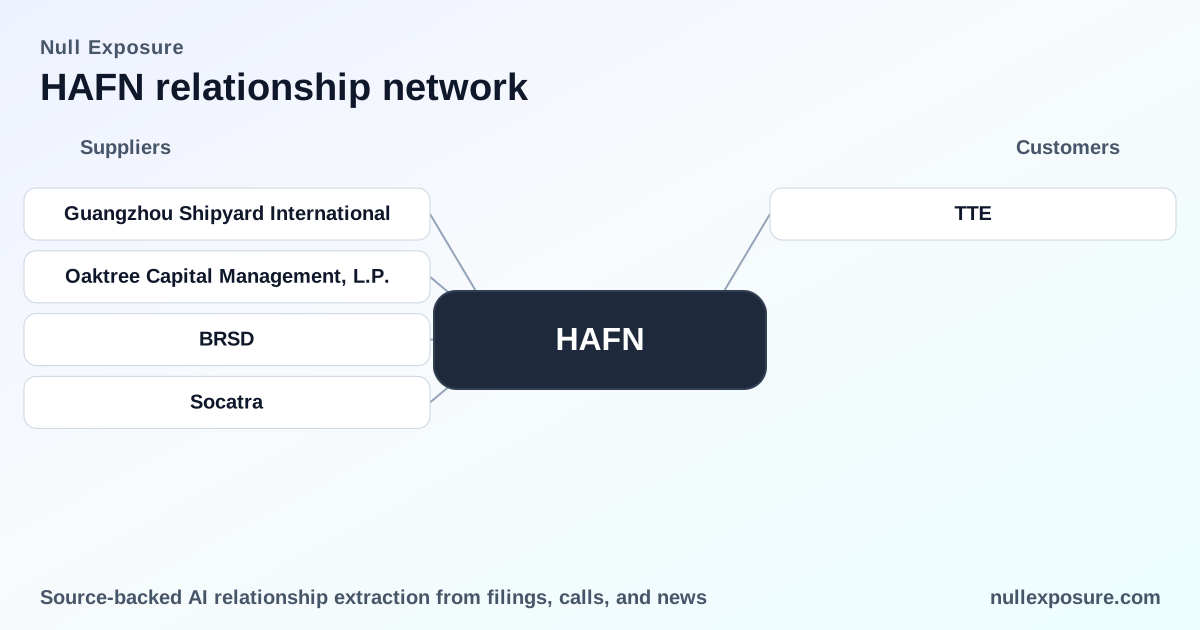
Below are the named relationships surfaced in recent coverage; each one is material for different reasons—newbuilding delivery, joint-venture development, or strategic equity transactions.
Guangzhou Shipyard International — long-term newbuilding partner
Hafnia has a long-standing newbuilding relationship with Guangzhou Shipyard International, delivering a steady cadence of product tankers as part of the ECOMAR program; the relationship dates back over a decade and supports Hafnia’s fleet modernization and dual-fuel conversion goals (MarineLink, Mar 2026: https://www.marinelink.com/news/hafnia-socatra-delivery-fourth-methanol-535001).
BRS (BRSD) — repeat builder and delivery collaborator
BRS has worked alongside Hafnia and Guangzhou on newbuild series, with 24 vessels delivered to Hafnia since 2013, underscoring a concentrated sourcing pattern for new tonnage that reduces procurement friction but elevates single-supplier exposure (MarineLink, Mar 2026: https://www.marinelink.com/news/hafnia-socatra-delivery-fourth-methanol-535001).
Socatra — joint-venture partner on green-capable MR tankers
Hafnia completed the final ship in a JV-developed series with France’s Socatra, delivering dual-fuel MR tankers and advancing Hafnia’s emissions-capable fleet; the JV model accelerates green-technology adoption while sharing development risk (Splash247, Mar 2026: https://splash247.com/hafnia-lines-up-sales-of-10-ageing-tankers/).
Oaktree Capital Management, L.P. — counterparty in strategic equity acquisition
Hafnia completed the acquisition of approximately 14.1 million A shares in TORM plc through a share purchase agreement with Oaktree and affiliates—this transaction is a strategic market positioning play and reflects Hafnia’s use of acquisitions to consolidate exposure in product tanker markets (Reuters/TradingView, Dec 22, 2025: https://www.tradingview.com/news/reuters.com,2025-12-22:newsml_ObiNx2CWa:0-hafnia-limited-hafnia-completes-acquisition-of-13-97-of-torm/).
What the relationship map implies for risk, concentration, and execution
Hafnia’s operating model shows several clear structural characteristics:
- Contracting posture: Hafnia relies on repeat, long-term relationships with shipyards and JV partners to manage newbuilding schedules and technical specification (especially for dual-fuel vessels). That posture improves build predictability and specification alignment but locks Hafnia into concentrated supplier channels for critical capex.
- Concentration: The record of 24 vessel deliveries from Guangzhou/BRS since 2013 indicates a concentrated procurement base. Concentration reduces bid friction and increases bargaining leverage over quality/price, yet it also exposes Hafnia to single-supplier delays or industrial disruptions.
- Criticality: Shipyards and JV partners are mission-critical because fleet renewal timing and fuel-technology adoption determine future cash generation and regulatory compliance. Delays or capability gaps at these partners immediately affect vessels on hire and capital deployment.
- Maturity: The decade-plus duration of relationships with Guangzhou and BRS reflects operational maturity and execution history; long-tenured relationships reduce integration risk for complex newbuild specifications such as methanol-capable engines.
- Company-level signal on constraints: There are no formal supplier constraint entries recorded in the reviewed coverage—this is a company-level signal that public reporting and press coverage do not reflect contractual supply restrictions or named limitations in the sampled data.
What investors should watch next
Hafnia’s supplier network creates a trade-off: predictable access to specialized newbuilds versus supplier concentration risk. Monitor these indicators closely:
- Delivery execution and timing from Guangzhou/BRS and Socatra for the ECOMAR series—slippage will compress available days and revenue.
- Integration and value capture from the TORM share acquisition—whether it translates into operational synergies or simply portfolio consolidation.
- Charter market direction versus fleet growth—shipyard-backed growth during weak rates can be margin-dilutive if utilization falls.
- Financial resilience metrics: EBITDA roughly $466m, revenue $2.22bn, trailing P/E ~11.9, forward P/E ~8.3, and a dividend yield ~5.5%; these frame valuation and payout sustainability.
For deeper counterparty profiling and to track how supplier relationships affect fleet economics over time, visit https://nullexposure.com/.
Final view and recommended diligence steps
Hafnia is a company that converts supplier relationships directly into fleet capability and market exposure. The most material exposures are shipyard and JV continuity (Guangzhou, BRS, Socatra) and strategic capital relationships (Oaktree/TORM transaction). Investors should:
- Confirm newbuilding delivery schedules and slip risk with shipyard partners.
- Evaluate how JV-built dual-fuel tonnage influences future fuel cost and charter competitiveness.
- Assess the strategic rationale and integration plan for the TORM stake and any downstream consolidation.
For ongoing monitoring of supplier signals and partner disclosures, return to the Hafnia supplier profile at https://nullexposure.com/. For a broader set of counterparty insights that contextualize these relationships, explore https://nullexposure.com/ for comparative supplier intelligence.
Bold takeaway: Hafnia’s long-term shipyard and JV partnerships are a strategic asset that underpins fleet modernization—but they also concentrate operational risk; investors should treat delivery execution and the company’s M&A moves as primary valuation drivers.