Hain Celestial: supplier relationships, strategic advisers and the operating constraints that matter to investors
Hain Celestial manufactures, markets and sells organic and natural consumer packaged goods across North America, the U.K. and other international markets, monetizing through retail and foodservice distribution of branded foods and beverages. The company’s core economics are driven by branded sales, co-manufacturer sourcing and distribution scale; a recent portfolio review and the announced sale of the North American snacks business have accelerated a repositioning that is being executed with external advisers. For direct access to ongoing supplier and counterparty intelligence, visit the NullExposure homepage: https://nullexposure.com/.
Market snapshot and catalyst Hain’s trailing twelve‑month revenue is approximately $1.506 billion with EBITDA of $93.8 million; the equity market capitalization is roughly $60.4 million, and the company reported a loss per share of -$6.03 in the latest metrics. These figures frame the urgency behind the strategic review initiated in mid‑2025 and the February–March 2026 transactions that target material portfolio change. Management has engaged external advisers to navigate the sale process and to extract value from its brand and supply chain footprint.
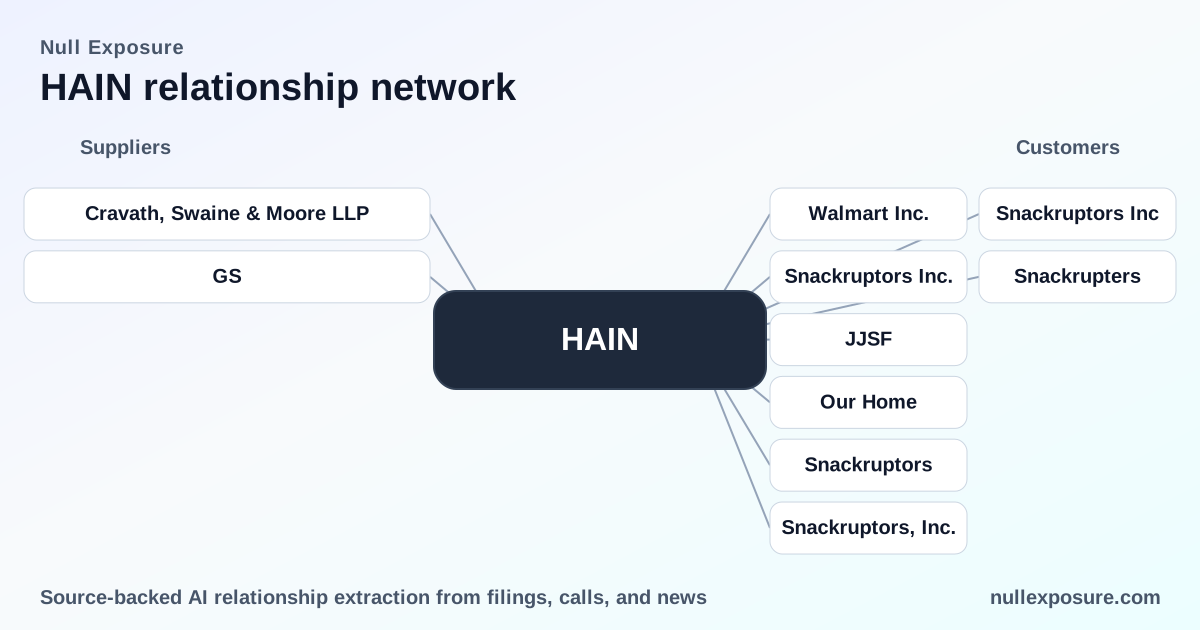
Who is advising Hain — and why those relationships matter Hain’s adviser roster in the recent strategic activity is small but consequential. These are the exact counterparties reported in public sources.
Goldman Sachs & Co. LLC — financial advisor Goldman Sachs is serving as Hain’s financial advisor for the strategic review and the sale of the North American snacks business, a mandate that began with the portfolio review launched in May 2025 and continued into the early‑2026 divestiture process. Prepared Foods and BakingBusiness reported Goldman’s advisory role on March 10, 2026; industry coverage in ESMMagazine also notes Goldman’s involvement in the May 2025 strategic review. (Prepared Foods, March 10, 2026; BakingBusiness, March 10, 2026; ESMMagazine, March 10, 2026.)
Cravath, Swaine & Moore LLP — legal counsel Cravath is listed as Hain’s legal counsel on the North American transaction and the broader strategic review, providing the legal architecture for sale agreements and related corporate actions. Prepared Foods and SahmCapital cited Cravath’s role in coverage of the February–March 2026 activity. (Prepared Foods, March 10, 2026; SahmCapital press release, February 2, 2026.)
Operating model constraints that define supplier risk Hain’s supplier and counterparty profile reflects a mid‑market branded foods operator that runs a hybrid model: company‑owned manufacturing plus heavy reliance on third‑party co‑manufacturers and outsourced services. The following company‑level signals summarize the structural constraints that investors and operators must factor into any diligence.
- Contracting posture: a mix of long‑term and short‑term obligations. The company carries long‑term leases and term loans with material maturities into late 2026, while short‑term borrowings and near‑term lease liabilities also appear in filings — a capital structure that compresses near‑term refinancing risk and operational flexibility. (Company filings and credit agreement amendments described through FY2025 disclosures.)
- Concentration and criticality: co‑manufacturers are material to production. Approximately 36% of 2025 sales were produced by independent contract manufacturers, and specific co‑packers can represent the sole source for particular brands; this creates operational concentration and substitution risk that is material to revenue delivery. (FY2025 operating disclosures.)
- Geographic footprint: truly global but focused on NA and EMEA. Procurement, manufacturing and regulatory compliance span North America and Western Europe, with currency hedging programs and cross‑border operating leases that add FX and regulatory complexity to supplier relationships. (Supply chain and hedging disclosures.)
- Roles and sourcing model: manufacturing, distribution and outsourced services dominate. The company relies on co‑packers, third‑party distributors, certifications (organic, Non‑GMO, kosher) and managed service providers for IT and supply chain functions — a layered dependency that increases both operational and compliance exposure.
- Spend profile: a wide spend band range. Contract footprints include large credit facilities and derivative notional amounts in the hundreds of millions alongside discrete capital and procurement spend in the $100k–$1m range, indicating a mix of strategic large‑ticket counterparty commitments and many mid‑sized supplier relationships. (Credit facility summaries and derivative notional amounts as reported in FY2025 materials.)
- Relationship maturity and activity: long-standing and active. Suppliers are generally mature, long‑term partners with active contracts and regular auditing of co‑manufacturers for quality and safety standards.
Investment implications: what this means for risk and upside The combination of material reliance on co‑manufacturers and depressed equity market capitalization relative to revenue signals both operational fragility and potential upside if portfolio rationalization succeeds. The sale of a large North American snack platform reduces scale but also reduces complexity and may improve margins if proceeds are used to de‑lever or reinvest in higher‑margin brands.
Key investor takeaways:
- Refinancing pressure is imminent. Term loans and the revolver have meaningful maturities that compress liquidity options into late 2026, elevating strategic urgency. (Credit agreement amendments and borrowing summaries.)
- Supply concentration is a primary operational risk. Loss of a co‑manufacturer for a branded SKU can constrain shelf supply and push margin erosion; existing audit and certification programs are necessary mitigants but not full substitutes for diversification.
- Advisers signal a decisive strategic pivot. Engagement of Goldman Sachs and Cravath for a portfolio review and transaction execution signals management’s intent to accelerate portfolio simplification and value extraction.
What investors and operators should do next
- For investors: validate how sale proceeds will be allocated between debt reduction and brand investment, and stress‑test liquidity under a worst‑case supplier disruption scenario.
- For operators and procurement teams: prioritize alternative co‑packer qualification, accelerate supplier dual‑sourcing for high‑dependency SKUs, and confirm third‑party certification continuity.
For ongoing monitoring of Hain’s supplier posture and counterparty changes, visit the NullExposure homepage: https://nullexposure.com/.
Final view and action checklist Hain Celestial is executing a high‑stakes repositioning where legal and financial advisers play an outsized role in shaping outcome. The combination of material co‑packer reliance, near‑term financing maturities, and active portfolio divestitures creates both near‑term downside and a pathway to long‑term simplification if executed cleanly. Operators should treat supplier continuity as mission‑critical through the next 12 months; investors should watch cash allocation from any sale and refinancing steps as the principal drivers of equity recovery.
If you want structured supplier intelligence and transaction tracking for Hain Celestial and its counterparties, start here: https://nullexposure.com/.