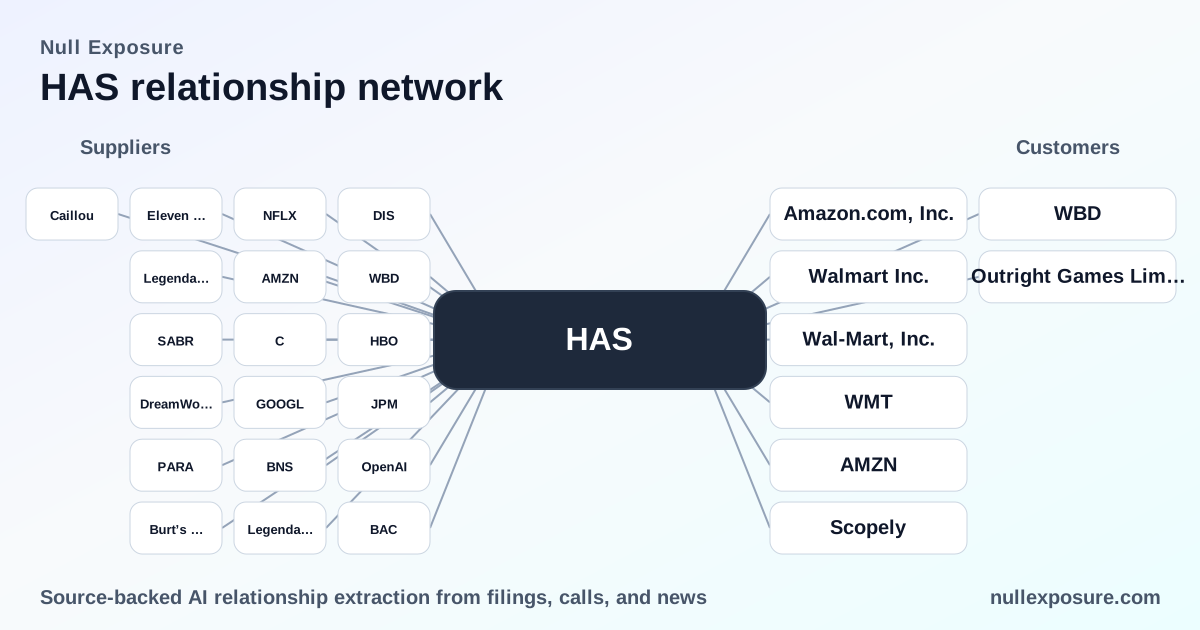
Hasbro (HAS) Supplier & Licensing Map — What investors need to know
Hasbro monetizes a hybrid business model built on three durable cash engines: licensed entertainment IP, third‑party manufacturing and distribution, and recurring finance facilities that smooth seasonal working capital. The company converts popular film, TV and gaming franchises into toys, games and digital products under long‑term license agreements, outsources most production to Far East manufacturers while using supplier finance and commercial paper to optimize cash flow, and leverages capital markets and bank facilities to fund strategic content and transformation spend.
For a fast, consolidated view of Hasbro’s supplier and licensing footprint, visit the Null Exposure homepage: https://nullexposure.com/
How the operating model drives revenue and risk
Hasbro’s operating posture is license‑centric and supply‑chain dependent. Licensing generates high-margin, brand‑sensitive revenue but creates exposure to minimum guaranteed royalties and renewal cycles; manufacturing is largely outsourced to China, Vietnam, India and the U.S., which provides scale but concentrates operational risk in the Far East. Financing and treasury programs — a committed revolving credit facility, commercial paper program and periodic debt issuances — provide liquidity to manage seasonality and support content investment.
- Contracting posture: Heavy use of licensing contracts with royalty payments and minimum guarantees; a mix of long‑term debt instruments and short‑term commercial paper to manage seasonal working capital.
- Concentration: Manufacturing concentrated in the Far East (China, Vietnam, India) and sizable relationships with global banks and underwriters for financing.
- Criticality: Manufacturing and studio/content partnerships are critical to revenue; supply disruptions in holiday windows would materially affect results.
- Maturity: Contracts span short‑term operating supplier agreements (annual pricing) to long‑term licenses and debt instruments extending through the 2030s and 2040s.
Explore a consolidated supplier profile and analytics at Null Exposure: https://nullexposure.com/
The relationship ledger — partner‑by‑partner summaries
Below are every relationship cited in the collected results, with a concise plain‑English summary and the original source.
-
The Walt Disney Company (DIS) — Hasbro identifies Disney brands (Marvel, Star Wars, Disney Princess, Frozen, etc.) as core licensed offerings and expects a peak year with Disney in FY2026. Source: earnings call transcript reported on InsiderMonkey (Q4 2025 / Mar 10, 2026) — https://www.insidermonkey.com/blog/hasbro-inc-nasdaqhas-q4-2025-earnings-call-transcript-1693334/
-
Warner Brothers Discovery (WBD) — Hasbro announced it holds the primary toy license for the Harry Potter world tied to WBD’s HBO series, positioning the company to monetize a major franchise. Source: InsiderMonkey earnings call transcript (Mar 10, 2026) — https://www.insidermonkey.com/blog/hasbro-inc-nasdaqhas-q4-2025-earnings-call-transcript-1693334/
-
HBO — Hasbro disclosed a partnership with HBO and Craig Mazin on a Baldur’s Gate series, indicating direct content tie‑ins for product pipelines. Source: InsiderMonkey (Q4 2025 transcript, Mar 10, 2026) — https://www.insidermonkey.com/blog/hasbro-inc-nasdaqhas-q4-2025-earnings-call-transcript-1693334/
-
J.P. Morgan (JPM) — J.P. Morgan is listed among lead underwriters managing a Hasbro offering, signaling strong institutional support for the company’s financing. Source: Intellectia coverage of CEO comments on AI and financing (Mar 10, 2026) — https://intellectia.ai/news/stock/hasbro-ceo-discusses-ais-impact-on-toy-development
-
Marvel (Marvel Superheroes) (DIS) — Hasbro is launching a Magic collaboration with Marvel Superheroes, reinforcing Marvel IP as a revenue driver under Disney’s consumer products umbrella. Source: InsiderMonkey (Q4 2025 transcript, Mar 10, 2026) — https://www.insidermonkey.com/blog/hasbro-inc-nasdaqhas-q4-2025-earnings-call-transcript-1693334/
-
OpenAI — Hasbro stated partnerships with AI platforms, including OpenAI, to embed AI into development workflows, reflecting investment in product innovation and design efficiency. Source: InsiderMonkey (Q4 2025 transcript, Mar 10, 2026) — https://www.insidermonkey.com/blog/hasbro-inc-nasdaqhas-q4-2025-earnings-call-transcript-1693334/
-
BofA Securities / Bank of America, N.A. (BAC) — Bank of America is cited both as underwriter and as administrative agent in the amended revolving credit agreement, indicating a dual banking and capital markets role in Hasbro’s liquidity structure. Source: Intellectia and MarketScreener coverage (Mar 10, 2026) — https://intellectia.ai/news/stock/hasbro-ceo-discusses-ais-impact-on-toy-development and https://www.marketscreener.com/news/monness-crespi-hardt-adjusts-price-target-on-hasbro-to-120-from-90-maintains-buy-rating-ce7e5addde8bf024
-
Netflix (NFLX) — Hasbro announced licensing for Netflix’s KPop Demon Hunters, expanding entertainment tie‑ins to streaming originals. Source: PR via FinancialContent/BizWire reporting on Toy Fair (Feb 14, 2026) — https://markets.financialcontent.com/wral/article/bizwire-2026-2-14-hasbro-is-inspiring-a-lifetime-of-play-at-2026-toy-fair-with-premier-collaborations-entertainment-announcements-and-new-products
-
Warner Bros. Discovery Global Consumer Products — Listed specifically for Harry Potter licensing activity tied to Hasbro’s product pipeline showcased at Toy Fair. Source: BizWire/FinancialContent (Feb 14, 2026) — https://markets.financialcontent.com/wral/article/bizwire-2026-2-14-hasbro-is-inspiring-a-lifetime-of-play-at-2026-toy-fair-with-premier-collaborations-entertainment-announcements-and-new-products
-
Amazon MGM Studios (AMZN) — Hasbro has an announcement linking Voltron to Amazon MGM Studios, positioning another entertainment tie‑in for toy IP conversion. Source: BizWire and InsiderMonkey (Feb–Mar 2026) — https://markets.financialcontent.com/wral/article/bizwire-2026-2-14-hasbro-is-inspiring-a-lifetime-of-play-at-2026-toy-fair-with-premier-collaborations-entertainment-announcements-and-new-products and https://www.insidermonkey.com/blog/hasbro-inc-nasdaqhas-q4-2025-earnings-call-transcript-1693334/
-
Citigroup Global Markets (C) — Named as a managing underwriter on Hasbro’s offering, indicating broad bank syndicate support for capital raises. Source: Intellectia (Mar 10, 2026) — https://intellectia.ai/news/stock/hasbro-ceo-discusses-ais-impact-on-toy-development
-
Google (Google Gemini) (GOOGL) — Hasbro cited Google Gemini among AI partners to augment R&D and workflows. Source: InsiderMonkey (Q4 2025 transcript, Mar 10, 2026) — https://www.insidermonkey.com/blog/hasbro-inc-nasdaqhas-q4-2025-earnings-call-transcript-1693334/
-
Scotia Capital (BNS) — Listed as part of the underwriting syndicate for a Hasbro offering, reflecting international bank participation. Source: Intellectia (Mar 10, 2026) — https://intellectia.ai/news/stock/hasbro-ceo-discusses-ais-impact-on-toy-development
-
Disney Consumer Products (Marvel and Star Wars) (DIS) — Hasbro cited new PLAY‑DOH campaigns and entertainment‑inspired product lines tied to Disney Consumer Products brands. Source: BizWire/FinancialContent (Feb 14, 2026) — https://markets.financialcontent.com/wral/article/bizwire-2026-2-14-hasbro-is-inspiring-a-lifetime-of-play-at-2026-toy-fair-with-premier-collaborations-entertainment-announcements-and-new-products
-
Legendary Entertainment / Legendary Pictures — Hasbro announced agreements with Legendary for Street Fighter, indicating franchise-based product plans. Source: BizWire and InsiderMonkey (Feb–Mar 2026) — https://markets.financialcontent.com/wral/article/bizwire-2026-2-14-hasbro-is-inspiring-a-lifetime-of-play-at-2026-toy-fair-with-premier-collaborations-entertainment-announcements-and-new-products and https://www.insidermonkey.com/blog/hasbro-inc-nasdaqhas-q4-2025-earnings-call-transcript-1693334/
-
Eleven Labs — Listed as an AI partner alongside Google and OpenAI for embedding AI into workflows, likely for content, sound or production tasks. Source: InsiderMonkey (Q4 2025 transcript, Mar 10, 2026) — https://www.insidermonkey.com/blog/hasbro-inc-nasdaqhas-q4-2025-earnings-call-transcript-1693334/
-
Sabre (SABR) — Hasbro referenced a joint venture announced with Sabre on a game, showing third‑party digital / platform collaboration. Source: InsiderMonkey (Q4 2025 transcript, Mar 10, 2026) — https://www.insidermonkey.com/blog/hasbro-inc-nasdaqhas-q4-2025-earnings-call-transcript-1693334/
-
DreamWorks — DreamWorks IP (Trolls) is named among brands sold under partner brands, contributing licensed product sales. Source: MarketScreener coverage (Mar 10, 2026) — https://www.marketscreener.com/news/monness-crespi-hardt-adjusts-price-target-on-hasbro-to-120-from-90-maintains-buy-rating-ce7e5addde8bf024
-
Nickelodeon (PARA) — Hasbro announced a Magic: The Gathering crossover with Teenage Mutant Ninja Turtles, a Nickelodeon property, strengthening collectible card game tie‑ins. Source: BizWire/FinancialContent (Feb 14, 2026) — https://markets.financialcontent.com/wral/article/bizwire-2026-2-14-hasbro-is-inspiring-a-lifetime-of-play-at-2026-toy-fair-with-premier-collaborations-entertainment-announcements-and-new-products
-
Burt’s Bees Baby — Hasbro launched a co‑brand collection with Burt’s Bees Baby for soft dolls and sleepwear, illustrating non‑entertainment brand licensing. Source: BizWire/FinancialContent (Feb 14, 2026) — https://markets.financialcontent.com/wral/article/bizwire-2026-2-14-hasbro-is-inspiring-a-lifetime-of-play-at-2026-toy-fair-with-premier-collaborations-entertainment-announcements-and-new-products
-
Caillou — Management referenced Caillou as a partner that performed strongly through 2024/early 2025, showing the company tracks brand lifecycle performance. Source: InsiderMonkey (Q4 2025 transcript, Mar 10, 2026) — https://www.insidermonkey.com/blog/hasbro-inc-nasdaqhas-q4-2025-earnings-call-transcript-1693334/
Implications for investors and operators
- Revenue composition is heavily dependent on licensed IP performance; royalty structures and minimum guaranteed payments are central to profitability. Company filings show licensing is material to gross margins and requires careful renewals and hit content to pay off guarantees.
- Supply chain risk is concentrated in APAC manufacturing; operational disruptions in the holiday quarter would have outsized impact on seasonal revenue.
- Liquidity profile is robust but active: committed revolver, commercial paper capacity and repeated use of bank underwriters support both opportunistic content investment and working capital needs.
- Technology partnerships (AI platforms, digital game partners) are an explicit operating leverage play intended to reduce development cycles and create new monetizable digital IP.
For a single‑page supplier risk dashboard and to map these relationships to Hasbro’s contracts and spend bands, go to https://nullexposure.com/
Final take
Hasbro’s strategy is a classic entertainment‑to‑consumer conversion: acquire or license high‑value IP, outsource production at scale, and finance the timing mismatch between content investment and retail seasonality. Investors should monitor renewal timing on marquee licenses, APAC manufacturing capacity ahead of the holiday season, and the company’s use of capital markets for strategic content funding.
Actionable next steps: review Hasbro’s FY2025/2026 filings alongside the partner list above and get the supplier exposure dashboard at Null Exposure: https://nullexposure.com/