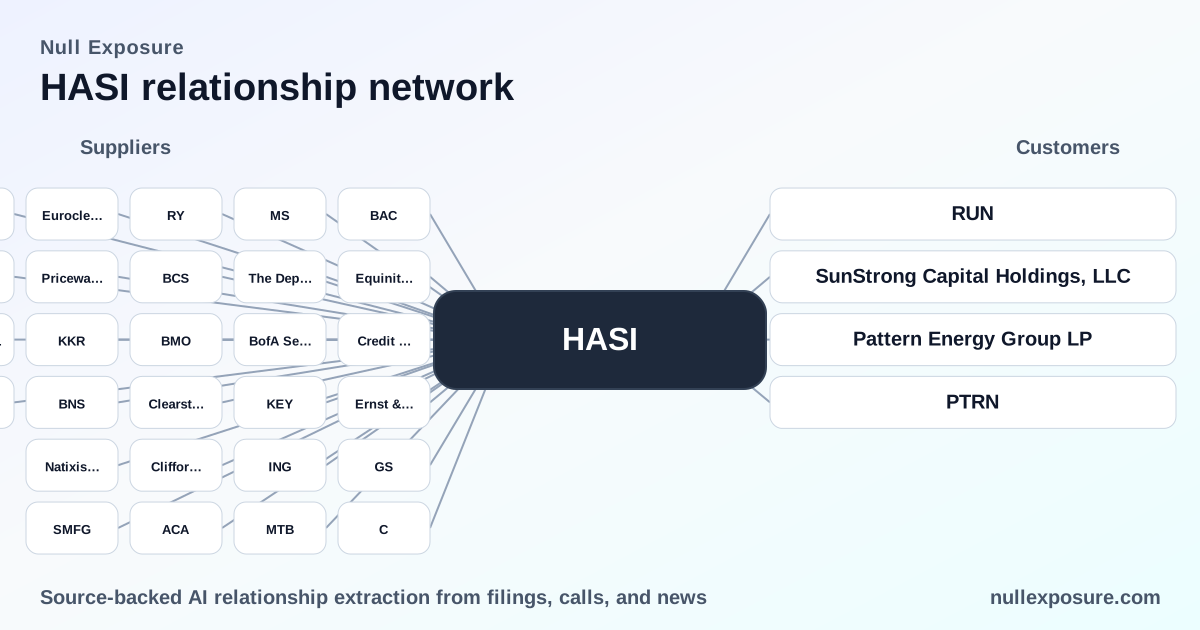
Hannon Armstrong (HASI) supplier map: what counterparties power its financing engine
Hannon Armstrong is a capital provider to energy efficiency, renewable energy and sustainable infrastructure projects; it monetizes by originating and financing assets, earning interest and fees on loans and securities, and extracting asset-management and structuring fees through co-invest vehicles and securitizations. Its core business is financial intermediation: sourcing climate assets, funding them through a combination of short‑ and long‑term debt and equity, and managing cash yield for shareholders and partners. For a full supplier and counterparty view, visit https://nullexposure.com/.
How HASI contracts, funds and runs projects — the operating model in plain English
HASI uses a layered financing strategy that blends short‑term liquidity tools (commercial paper and revolvers) with long‑dated unsecured and secured notes and bank facilities to match its portfolio of long‑lived assets. Corporate filings show a persistent mix of long‑term debt and long-term leases, substantial use of revolving credit and commercial paper for working liquidity, and active interest‑rate hedging programs. The company relies heavily on large banks and capital markets partners for underwriting, letters of credit and syndicated facilities, and on third‑party service providers for transfer agent, custody, audit and legal services — which makes counterparty performance and market access operationally and financially material.
- Contracting posture: A mix of long‑term (senior notes, term loans, long leases) and short‑term (commercial paper, revolvers) arrangements provides optionality but creates refinancing exposure if credit markets tighten.
- Concentration and criticality: Key banks provide letters of credit and underwrite debt; these relationships are material to liquidity and securitization capacity and therefore operationally critical.
- Maturity profile and staging: The company actively manages both active and pipeline financings, with many relationships in an active underwriting or servicing stage.
- Geography: Operations are North America‑centric for project exposure, while capital markets and settlement use global clearing networks.
Explore the supplier network and underlying documents at https://nullexposure.com/ to validate counterparties and exposures.
Contract and counterparty constraints that drive risk and opportunity
HASI’s public documents disclose constraints and features investors must factor into any supplier assessment. Company‑level signals include:
- A dual funding strategy: long‑dated senior notes and term loans coexist with short‑dated commercial paper supported by a Bank of America direct‑pay letter of credit — this structure improves short‑term funding access but concentrates contingent liquidity dependence.
- Heavy use of large financial institutions as underwriters, lenders and hedging counterparties, implying both scale benefits and counterparty concentration risk.
- Extensive reliance on third‑party service providers (transfer agent, auditors, valuation and IT/security providers), making vendor operational resilience important.
- Materiality: Several constraints explicitly flag that inability to refinance or lender actions could be critical to liquidity and distributions.
These characteristics make counterparty diligence a frontline risk management task for investors and operators evaluating HASI.
Counterparty map: each named supplier and what they do for HASI
Below are every counterparty referenced in the latest supplier results and a one‑line summary with source context.
- Bank of America, N.A.: Provides a $125 million direct‑pay letter of credit supporting HASI’s credit‑enhanced commercial paper program, underpinning short‑term funding capacity (HASI SEC prospectus, March 2026).
- BofA Securities, Inc.: Acts as a joint book‑running manager on HASI’s $400 million green senior unsecured notes offering (NationalToday, Feb 28, 2026; SEC prospectus, March 2026).
- Equiniti Trust Company, LLC: Serves as HASI’s transfer agent, handling shareholder recordkeeping and distributions (HASI SEC prospectus, March 2026).
- Credit Agricole Securities (USA) Inc.: Served as a joint book‑running manager/underwriter on recent note offerings (NationalToday, Feb 28, 2026; SEC prospectus, March 2026).
- Goldman Sachs & Co. LLC: Listed as a joint book‑running manager and underwriter representative for HASI’s debt issuance (NationalToday, Feb 28, 2026; SEC prospectus, March 2026).
- Citigroup / Citigroup Global Markets Inc.: Included among book‑running managers and assigned underwriter allocations for the note offering (HASI SEC prospectus, March 2026).
- Morgan Stanley / Morgan Stanley & Co. LLC: Participated as joint book‑running manager and underwriter in the offering group (HASI SEC prospectus, March 2026).
- The Depository Trust Company (DTC): Vehicle for book‑entry delivery of HASI’s notes, enabling settlement into global custody networks (HASI SEC prospectus, March 2026).
- KeyBanc Capital Markets / KeyBanc Capital Markets Inc.: Listed as a co‑manager and underwriter with allocated principal amounts in the notes syndicate (HASI SEC prospectus, March 2026).
- ING Financial Markets LLC / ING: Assigned underwriter principal amounts and listed among the syndicate members (HASI SEC prospectus, March 2026).
- M&T Securities / M&T Securities, Inc.: Acts as a co‑manager and underwriter with a specific principal allocation in the offering (HASI SEC prospectus, March 2026).
- RBC Capital Markets / RBC Capital Markets, LLC: Included as an underwriter with assigned principal amounts in the syndicate (HASI SEC prospectus, March 2026).
- Barclays / Barclays Capital Inc.: Appears as a book‑running manager and underwriter in the debt issuance syndicate (HASI SEC prospectus, March 2026).
- BMO Capital Markets / BMO Capital Markets Corp.: Included among book‑running managers and underwriters on the offering (HASI SEC prospectus, March 2026).
- Clearstream Banking S.A.: Part of the international settlement chain for the notes, via DTC delivery to Clearstream (HASI SEC prospectus, March 2026).
- Clifford Chance US LLP: Acts as legal counsel for certain HASI legal matters referenced in the prospectus (HASI SEC prospectus, March 2026).
- Euroclear Bank S.A./N.V.: Operator of the Euroclear system used for international custody and settlement of HASI’s book‑entry notes (HASI SEC prospectus, March 2026).
- PricewaterhouseCoopers LLP: Provided an independent auditors’ report relied upon for a consolidated subsidiary financial statement incorporated by reference (HASI SEC prospectus, March 2026).
- KKR: Partner on CCH1 co‑investment vehicle, referenced by management as a contributor to profitability and access to a new bond market segment (HASI Q4 2025 earnings call).
- Scotiabank / Scotia Capital (USA) Inc.: Listed among the book‑running managers and underwriters in the syndicate (HASI SEC prospectus, March 2026).
- Natixis / Natixis Securities Americas LLC: Served as an underwriter with a defined principal allocation in the offering (HASI SEC prospectus, March 2026).
- Credit Agricole CIB: Named as a joint book‑running manager in the underwriting syndicate (HASI SEC prospectus, March 2026).
- SMBC Nikko Securities America, Inc. / SMBC Nikko: Included among representatives of underwriters and syndicate members (HASI SEC prospectus, March 2026).
- Rabo Securities USA, Inc. / Rabo Securities: Participated as an underwriter representative in the financing syndicate (HASI SEC prospectus, March 2026).
(The above list covers every named counterparty in the most recent supplier results and the filings informing them.)
What this counterparty list means for investors and operators
Key takeaway: HASI’s financing model is bank‑and‑capital‑markets centric. The company’s ability to sell notes, maintain a commercial paper program supported by Bank of America, and execute syndicated facilities depends on deep, active relationships with the largest global banks and capital markets houses. That creates both resilience (scale, liquidity access) and concentration risk (letter‑of‑credit dependence, underwriting market access). Operationally, third‑party service providers — transfer agent, auditors, legal counsel, clearing systems — are functionally critical to issuance and settlement.
If you are evaluating HASI for investment or counterparty risk, prioritize (1) the stability of its bank LC providers and syndicate relationships, (2) the maturity ladder of short‑term vs long‑term debt, and (3) the operational readiness of its service providers.
For a mapped, document‑linked view of these relationships and to download the underlying source filings, visit https://nullexposure.com/.
Final read: actionable lens for diligence
HASI operates as a market‑native financier of climate assets; its supplier map is dominated by major banks, global custodians and professional service firms that together sustain issuance, liquidity and compliance. Assess concentration in LC and underwriting roles, track hedging counterparty collateral arrangements, and validate third‑party operational resilience when sizing exposure. For access to the primary documents and an interactive supplier breakdown, go to https://nullexposure.com/.