Huntington Bancshares (HBANL) — supplier relationships and operating constraints investors must price in
Huntington Bancshares is a regional bank holding company headquartered in Columbus, Ohio, that monetizes through traditional commercial and consumer banking activities, mortgage origination and servicing, and wholesale funding and capital markets operations. The company generates fee income from advisory and trading activities, net interest income from loans and securities, and relies on a mix of stable retail deposits plus diversified wholesale funding to finance asset growth. For a focused view on counterparty and supplier risk across Huntington’s ecosystem, review our platform at https://nullexposure.com/.
Why supplier relationships matter for a bank like Huntington
Huntington’s business model is capital- and operations-intensive: lending, payments, ATM networks, third‑party data processing, and capital markets counterparties are all essential to day‑to‑day earnings. The firm reported revenue of about $7.69 billion TTM and an operating margin near 40%, underscoring that operations and funding cost controls directly affect profitability and dividend capacity. Huntington’s balance sheet also includes substantial long‑term debt and wholesale funding, which means supplier and counterparty disruptions can have immediate funding and market access consequences.
Explore a deeper supplier map at https://nullexposure.com/ to see counterparty footprints and contract characteristics.
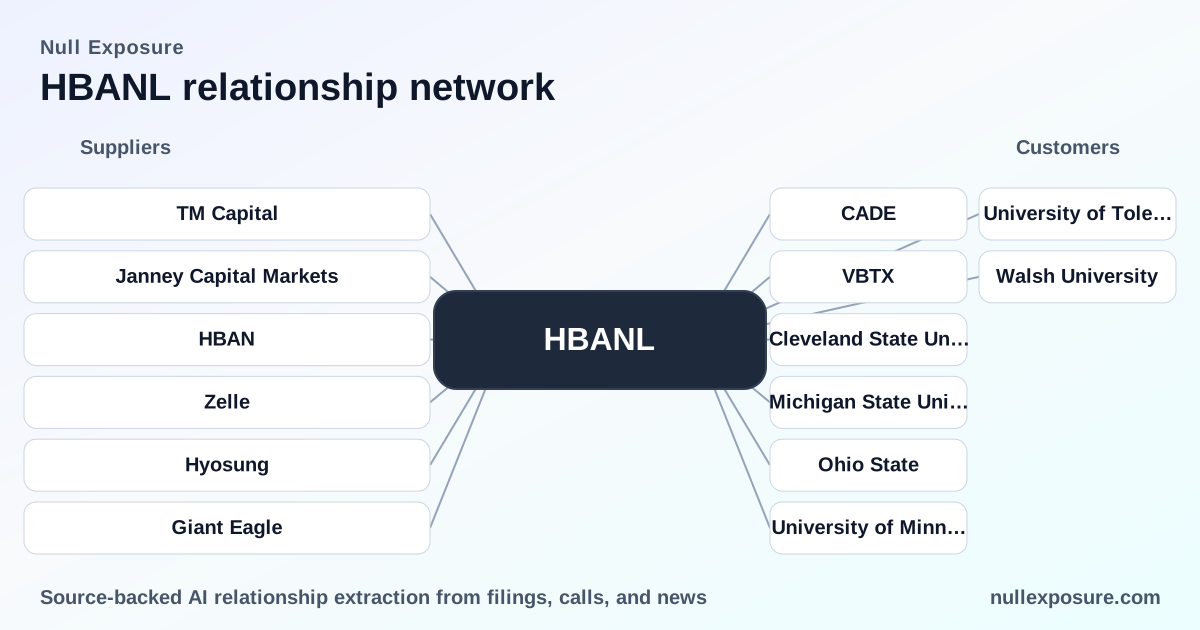
Direct supplier and partner relationships observed in our review
Below are the explicit relationships found in external filings and reporting, with a concise, plain‑English take for each.
TM Capital
Huntington said in its 2025 Q4 earnings call that the firm added TM Capital to expand its financial advisory capabilities and to broaden fixed‑income trading categories. (2025 Q4 earnings call disclosure.)
Janney Capital Markets
Also disclosed on the 2025 Q4 earnings call, Janney Capital Markets was added alongside TM Capital to increase Huntington’s advisory breadth and fixed‑income trading inventory. (2025 Q4 earnings call disclosure.)
Operation HOPE
Huntington’s small business lending rollout in 2020 included a requirement that new small businesses take training offered by Operation HOPE, with Huntington underwriting aspects of SBA loans and directing training at no charge to borrowers. (Freep report, October 2020.)
Detroit Regional Convention Facility Authority
The bank’s naming‑rights transition for the Detroit convention center was documented as part of a continuity arrangement with the Detroit Regional Convention Facility Authority, confirming Huntington’s public‑facing sponsorship and community engagement in Detroit post‑TCF transaction. (Detroit Urbanize, FY2021 coverage.)
Small Business Administration (SBA)
Huntington committed to cover SBA fees and underwrite SBA loans for existing businesses during its small‑loan program launch in 2020, establishing a direct operational relationship with the SBA as program facilitator. (Freep report, October 2020.)
Zelle
Huntington customers use Zelle inside the bank’s mobile wallet and online banking to send and receive person‑to‑person payments, reflecting an embedded payments network partnership rather than a core banking replacement. (The Penny Hoarder review, FY2021.)
Hyosung
Huntington announced an ATM network upgrade that will run on Hyosung MoniPlus2S software to deliver faster transactions and improved security, signaling hardware and software vendor reliance for customer touchpoints. (PR Newswire release, FY2020.)
Giant Eagle
Coverage from Crain’s Cleveland recorded Huntington’s plan to close 62 branches, many inside Giant Eagle grocery stores, illustrating a retail branch footprint negotiation with a major grocery partner and the operational effects of branch consolidation. (Crain’s Cleveland, FY2021.)
What the constraints tell investors about Huntington’s operating posture
The public evidence produces a clear set of company‑level signals about Huntington’s supplier model and risk profile:
- Contract mix: both short‑term and long‑term contracting are core to the model. Huntington uses short‑term borrowings and repurchase agreements for liquidity, while also carrying substantial long‑term debt and multi‑decade leases, so supply relationships span quick‑turn and multi‑year commitments.
- Funding concentration and materiality are meaningful. Wholesale funding totaled roughly $23.6 billion at year‑end 2024 and purchase commitments were $716 million, which positions several supplier and capital counterparties as material to cash‑flow and liquidity outcomes.
- Government counterparties are central. Huntington’s securities and pledged assets are heavily weighted to U.S. Treasury and agency instruments, and the bank maintains contingent borrowing access via the Federal Reserve and FHLB — making government relationships both liquidity anchors and regulatory constraints.
- Service providers are core and potentially critical. The company explicitly outsources data processing, cybersecurity assessments, and valuation work, and recognizes cyber and third‑party failures as a route to material operational loss. Service provider relationships are therefore both widespread and operationally critical.
- Geography is primarily North America with some global dependencies. Most securities and headquarters footprint are U.S.‑centric, although Huntington acknowledges offshore third‑party providers and global supply considerations for specific hardware or software.
- Spending posture is large‑scale in services and infrastructure. Reported line items like “outside data processing and other services” and purchase commitments indicate >$100 million spend bands and concentration in software, data, and physical branch infrastructure.
These constraints combine to create a supplier risk profile where operational continuity, vendor cyber posture, and liquidity counterparties are the highest-value monitoring targets for investors.
Explore supplier scoring and exposure heatmaps at https://nullexposure.com/ for portfolio‑level due diligence.
Investment implications: what to watch and next steps
- Operational risk drives earnings volatility. Given Huntington’s dependence on third‑party processors, ATM vendors, and payments rails, any systemic vendor outage or cyber event would directly affect customer service and earnings realization.
- Funding and rating sensitivity remain key. A downgrade could increase borrowing costs, trigger collateral demands, and reduce access to wholesale markets — all of which would pressure dividend capacity and growth plans.
- Localized retail footprint changes have strategic impact. Branch closings inside partners like Giant Eagle reduce fixed costs but concentrate reputational and deposit risks in remaining channels; investors should triangulate deposit trends against branch rationalization.
For asset managers and operations leaders evaluating HBANL supplier relationships, prioritize vendor cyber posture, contract term profiles, and the bank’s contingency liquidity lines when forming exposure limits.
If you need a customized supplier risk brief or exposure dashboard for Huntington, start here: https://nullexposure.com/. For a portfolio‑level audit of banking counterparties and third‑party concentration, get a tailored report via https://nullexposure.com/ — our team converts filings and press disclosures into actionable supplier signals.
Bottom line: Huntington runs a hybrid supplier model—large, material long‑term contracts coexist with essential short‑term funding and critical service providers—so active monitoring of vendor resilience and liquidity counterparties is mandatory for investors and operators.