Huntington Bancshares (HBANM) — supplier profile and operational constraints for investors
Huntington Bancshares is a Columbus, Ohio–based regional bank holding company that monetizes through interest income on loans and securities, fee income from retail and commercial banking services, and treasury/asset-liability management, supported by a branch network and scale in the Midwest. The firm runs a dual funding model—stable core deposits plus diversified wholesale funding—and invests heavily in third‑party technology and services to run operations at scale. For focused supplier-risk analysis and supplier relationship intelligence, visit https://nullexposure.com/.
Quick business snapshot and financial posture investors should track
Huntington is a regional bank with $123 billion in assets, 839 branches and 1,322 ATMs across seven Midwestern states, operating as a traditional deposit-taking and lending institution augmented by capital markets activities. Recent public financials show revenue of roughly $7.7 billion (TTM) and a profit margin near 28.7%, while trailing P/E is 28.6 and book value sits at $13.79 per share-equivalent metrics. The company runs active liquidity management, significant long‑term debt and lease obligations, and a material technology and services spend that scales with growth and regulatory compliance. These elements drive supplier decisions and contracting posture.
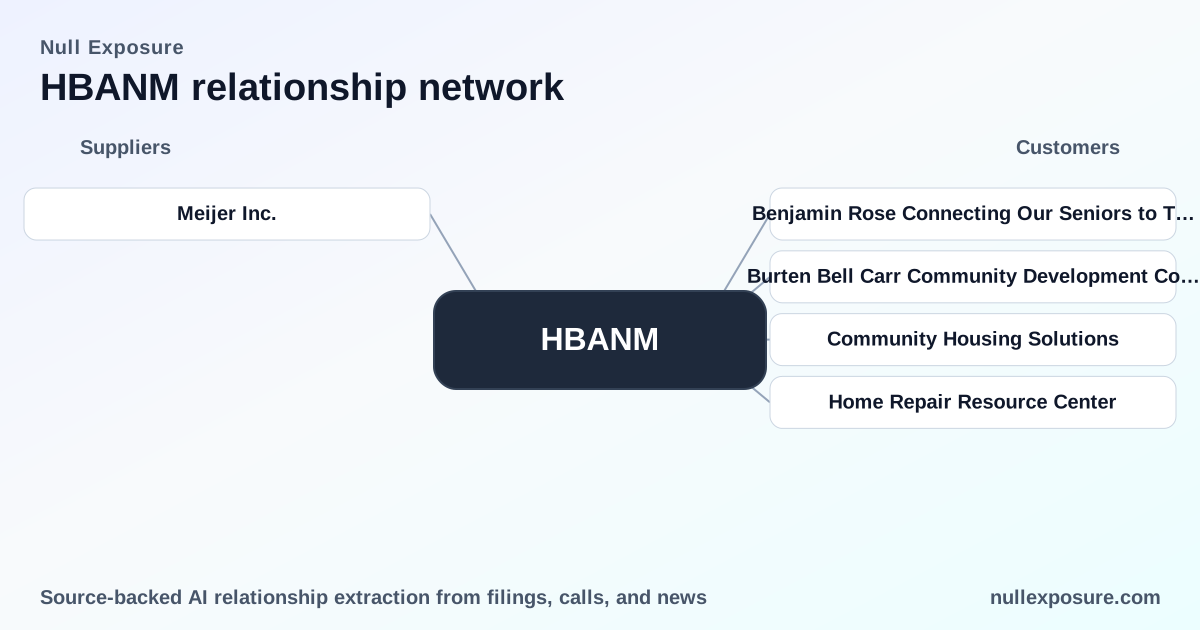
The supplier relationship revealed in the record: Meijer Inc.
Huntington has a long-standing retail branch partnership with Meijer. The bank originally signed a deal in 2012 to operate in‑store branches within Meijer supercenters; in March 2026 Huntington announced that it will close 97 in‑store branches at Meijer locations as part of the TCF acquisition integration. This change reduces Huntington’s in-store retail footprint and should be evaluated for local deposit and customer retention impacts. (Source: Crain’s Grand Rapids, March 10, 2026.)
How Huntington’s contracting and counterparty profile shapes supplier risk
The company-level evidence in public filings defines an operating model where supplier relationships are structured, significant, and often long-dated:
- Long-term commitments dominate capital structure and occupancy: Huntington reports material long‑term debt and subordinated instruments and holds long lease commitments for branches and offices extending years into the future. Those long-term obligations anchor funding needs and make supplier continuity a strategic priority (Company filings, FY2024).
- Short-term funding is an operational lever: The bank uses repurchase agreements, federal funds and short-term borrowings in active liquidity management; these short-term instruments are part of routine counterparty exposure and create sensitivity to market dislocations (Company filings, FY2024).
- Usage‑based regulatory levies influence cost exposure: The FDIC special assessment is calculated on uninsured deposits and therefore imposes variable cost tied to deposit metrics, not a fixed contract—this is a usage‑style charge that increases the effective cost of wholesale deposit instability (Regulatory disclosure, FY2024).
- Framework and collateral agreements underpin risk management: Huntington uses master netting and collateral agreements with broker‑dealers and banks for derivative and secured transactions, which standardizes exposures across large counterparties and reduces bilateral credit risk (Company filings, FY2024).
- Counterparty composition skews to government and high-quality institutions: Nearly all held-to-maturity securities are U.S. government or agency issues and Huntington maintains borrowing capacity at FHLB and FRB—this reduces credit risk on investment securities but concentrates exposure to U.S. sovereign and agency markets (Company filings, FY2024).
- Third‑party services are material and recurring: Technology, data processing and outsourced services are large and growing expense lines (outside data processing and other services rose to $665 million in the latest reporting), indicating significant dependency on external vendors for operations and cybersecurity testing (Company filings, FY2024).
These constraints collectively create a hybrid contracting posture: long-term capital and occupancy commitments combined with flexible short-term funding and usage-linked regulatory costs, plus a heavy reliance on third-party service providers for infrastructure and compliance functions.
For a deeper supplier mapping and supplier-level risk signals, see https://nullexposure.com/.
Operational implications: concentration, criticality and maturity
Huntington’s supplier risk profile is defined by a few clear, actionable signals:
- Concentration toward regulated and high-quality counterparties reduces credit risk but increases systemic exposure to U.S. government and agency markets; a sovereign stress event would be material to the balance sheet (Company filings, FY2024).
- Third-party services are critical: technology and data processing are essential to daily operations and control frameworks; vendor outages or cybersecurity incidents at key suppliers would have material operational and reputational impact (Company filings, FY2024).
- Contract maturity is mixed but leans long for capital and occupancy; this produces fixed cost obligations that cannot be easily scaled down in a downturn, creating sensitivity to deposit outflows and funding cost shocks (Company filings, FY2024).
- Spend magnitude is significant: public disclosures place vendor and service spend in high bands (>$100M), signaling that vendor performance and contract terms meaningfully affect margins and service continuity.
Key takeaways for investors and counterparties
-
Branch footprint adjustments—like the Meijer closures—are not isolated operational events; they have deposit, fee, and customer‑retention consequences that interact with liquidity management and wholesale funding needs. (Source: Crain’s Grand Rapids, March 10, 2026.)
-
Vendor reliance is strategic and material: technology and outsourced services represent a major cost and operational dependency; operational resilience and contract terms are central to credit and operational risk assessment (Company filings, FY2024).
-
Funding flexibility is essential: Huntington’s active use of short‑term wholesale funding, long-term debt, and secured borrowing capacity at FHLB/FRB is a core part of the business model and a lever investors should monitor via deposit flows and market access metrics (Company filings, FY2024).
-
Monitor three variables closely: deposit retention after branch consolidation, counterparty funding spreads, and any vendor-service interruptions that affect core banking systems.
If you are evaluating Huntington as a supplier or counterparty, or tracking supplier concentration across a financial-services portfolio, start with supplier-level exposure and contract maturity—NullExposure offers targeted supplier intelligence at scale: https://nullexposure.com/.
Actionable next steps for operators and investors
- Require visibility into vendor SLAs and termination rights for key technology and data-processing suppliers; stress-test vendor failure scenarios.
- Track branch-level deposit metrics in markets affected by branch closures (for example, Meijer locations) and compare deposit migration to nearby branches or digital channels.
- Maintain focus on liquidity buffers and access to secured borrowing facilities; use market indicators like repo and brokered deposit spreads as early warning.
For tailored supplier-risk intelligence and continuous monitoring of supplier changes, subscribe via https://nullexposure.com/.
Huntington’s profile is that of a large regional bank with constrained but diversified funding, material long-term commitments, and high dependence on third-party services—each of these factors should be elevated in any supplier-risk or counterparty assessment.