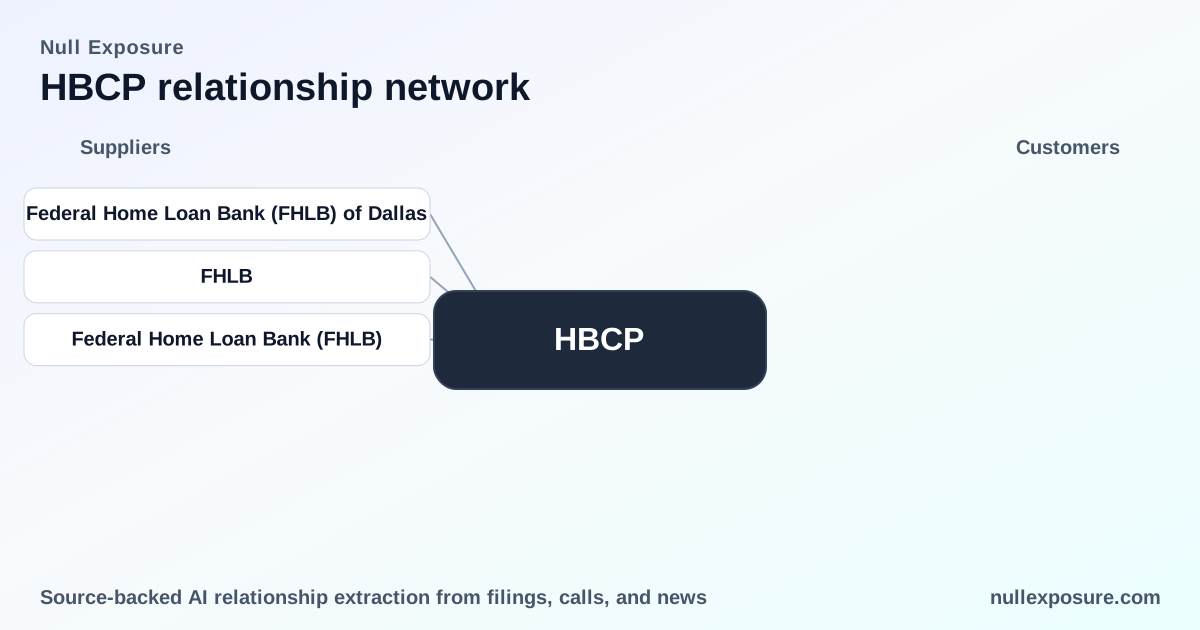
Home Bancorp (HBCP): The balance-sheet supplier map investors need
Home Bancorp, Inc. is a regional bank holding company that monetizes through net interest margin on loans and securities, fee income from deposit and servicing activity, and capital returns to shareholders. Its operating model relies on core customer deposits supplemented by significant advances and contingent liquidity from the Federal Home Loan Bank (FHLB) system, plus long‑dated subordinated debt and lease obligations that influence capital and funding flexibility. For a practical supply‑chain view of HBCP’s counterparties and contracts, this note lays out each recorded supplier relationship, explains the contractual characteristics investors should care about, and highlights where concentration and operational risk concentrate on the balance sheet. If you want a consolidated supplier risk view, visit https://nullexposure.com/ for a full supplier analysis toolkit.
How Home Bancorp makes, funds, and scales profitably
Home Bancorp runs a classic regional-bank economics model: take retail and commercial deposits, underwrite loans, hold and trade mortgage‑backed securities, and manage funding through FHLB advances and market debt. Profitability drivers are net interest income and controlled noninterest expense; capital returns come from dividends and subordinated notes that expand regulatory capital. Key financial signals: return on equity above 11% (trailing), a price‑to‑book just over 1x, and a concentrated funding relationship with the FHLB that can amplify liquidity upside or stress depending on deposit velocity.
- Operational dependencies include third‑party IT, data processing, and lease contracts for branches; cybersecurity and service‑provider continuity are core operational risks.
- Funding profile mixes stable deposits with both short‑term and long‑term FHLB advances and a $55 million subordinated note due 2032, implying both maturity ladder and covenant considerations.
Explore supplier exposure and enterprise counterparty mapping at https://nullexposure.com/.
The FHLB relationship — four press hits, one structural reality
Home Bancorp’s news flow records multiple references to the Federal Home Loan Bank (FHLB) across filings and press reports; all entries point to the same structural role: the FHLB is a central liquidity counterparty and collateralized lender for Home Bank.
- Federal Home Loan Bank (FHLB) of Dallas — Home Bancorp cites the FHLB of Dallas as a primary outside lender alongside deposits and loan repayments; the company lists FHLB advances as part of its principal funding sources. According to an Intellectia news item on March 10, 2026, the bank explicitly identifies FHLB borrowings as a contingent funding source. (Intellectia news, March 10, 2026).
- FHLB — Home Bancorp’s earnings call transcript notes deposit growth in 2025 reduced more expensive FHLB advances by $173 million, leaving only $3 million outstanding at quarter end, illustrating active balance‑sheet management to substitute deposits for FHLB borrowings. (Earnings call transcript published on InsiderMonkey, March 10, 2026).
- Federal Home Loan Bank (FHLB) — A company press release reporting fourth‑quarter 2025 results states average FHLB advances of $3.0 million in Q4 2025, down sharply from prior quarter levels due to paydowns. (Sahm Capital press release on Home Bancorp, January 27, 2026).
- Federal Home Loan Bank (FHLB) — A TradingView news summary emphasizes the bank’s strong deposit liquidity and substantial unused FHLB capacity available to support lending activity, underlining the FHLB as a liquidity backstop rather than a constant funding source. (TradingView news summary, March 10, 2026).
Key takeaway: the FHLB functions both as an active lender and a standby liquidity facility; Home Bancorp has materially reduced outstanding advances during 2025 while preserving large undrawn capacity.
All recorded supplier relationships (explicit results)
The public relationship items returned in news and filings all reference the FHLB in one form or another; below are the four items in the source results with concise, source‑anchored summaries.
-
The Intellectia article describes the FHLB of Dallas as one of Home Bank’s principal external funding sources alongside deposits and loan repayments. According to that March 10, 2026 news item, FHLB borrowing is an established component of the bank’s funding mix. (Intellectia news, March 10, 2026).
-
The InsiderMonkey earnings‑call transcript reports that deposit growth in 2025 allowed Home Bancorp to reduce FHLB advances by $173 million to $3 million at year end, signaling active liability management. (InsiderMonkey transcript, March 10, 2026).
-
A Sahm Capital press release covering Q4 2025 results notes average FHLB advances were $3.0 million in the fourth quarter—down 92% from the third quarter—driven by paydowns of FHLB advances. (Sahm Capital press release, January 27, 2026).
-
A TradingView news item highlighted Home Bancorp’s strong deposit liquidity and substantial unused FHLB borrowing capacity, framing the FHLB as contingency liquidity rather than a persistent funding cost center. (TradingView summary, March 10, 2026).
Contracting posture, concentration, and criticality — what the constraints tell investors
The company disclosures in our corpus reveal a set of actionable supplier‑model signals:
-
Contracting posture: mixture of long‑term and short‑term commitments. Home Bancorp carries long‑dated instruments (subordinated notes due 2032, long‑term FHLB advances, multi‑year lease obligations) alongside sizeable short‑term FHLB advances and short‑term liquidity programs. This dual posture creates predictable capital servicing needs while preserving tactical flexibility in short‑term funding markets. (Company filings, 2024–2025).
-
Concentration risk: material exposure to government and quasi‑government counterparties. The firm’s securities portfolio is heavily weighted to U.S. government agencies and agency MBS, and FHLB stands as a concentrated liquidity counterparty; these are company‑level signals from investment and funding disclosures. (2024 financial statements).
-
Criticality: FHLB is a critical counterparty. Several excerpts explicitly name FHLB advances and available capacity—this confirms the FHLB relationship is operationally critical to funding and lending capacity. (Long‑ and short‑term FHLB advances disclosures).
-
Maturity and spend profile: blended—large lines and meaningful mid‑term obligations. Spend and exposure bands show eight‑figure to 100‑million‑plus relationships with FHLB advances and a $55 million subordinated note, plus multi‑year lease liabilities that are active and materially sized. (Notes payable, lease schedules, FHLB advance tables).
-
Service‑provider dependency: material. The company repeatedly flags dependence on third‑party IT, data processing, and valuation/pricing services; failures could materially impact operations and regulatory standing. (Technology and third‑party risk disclosures).
Investment implications and risk checklist
For investors and operators evaluating supplier relationships with HBCP, prioritize these items:
- Liquidity optionality is strong but concentrated. Large undrawn FHLB capacity is a plus, but dependency on a single regional FHLB relationship concentrates funding risk.
- Interest‑rate and MBS mark‑to‑market exposures are government‑centric. Agency MBS unrealized losses influence capital and strategic choices; governance of securities valuation (third‑party pricing services) is operationally important.
- Operational resilience matters. Data processing and cybersecurity with third‑party providers are flagged as material; outsourcing arrangements are a potential single point of failure.
- Contract ladders are predictable. Long‑term subordinated notes and lease obligations create steady capital and cash‑flow claims—important when modeling dividend capacity and capital buffers.
If you want a supplier risk heatmap and contract‑level detail for portfolio allocation or counterparty due diligence, learn more at https://nullexposure.com/.
Final takeaway and actionable next steps
Home Bancorp combines stable retail deposit economics with contingent, sizable FHLB liquidity and a set of long‑dated capital and lease commitments that define its funding flexibility. For investors, the trade is clear: dividend and ROE history are supported by strong deposit behavior, but concentrated FHLB exposure and outsized third‑party operational dependencies require active monitoring.
For a deeper supplier‑by‑supplier analysis and to build counterparty scenarios for stress testing, visit https://nullexposure.com/ and request the supplier exposure pack tailored for regional financial institutions.