Harvard Bioscience (HBIO): supplier relationships, financing posture, and what operators should know
Harvard Bioscience designs, manufactures and distributes laboratory instruments and services that support drug discovery and preclinical research, monetizing through the sale of proprietary instruments, third‑party distribution agreements and recurring service and software support. Revenue relies on a hybrid model of manufactured products, third‑party distribution and periodic professional services, while balance‑sheet management is dominated by a concentrated debt package that shapes near‑term operations. For deeper supplier and counterparty intelligence for investment or operational diligence, visit Null Exposure.
Quick investor thesis
Harvard Bioscience operates as a manufacturing and distribution platform for life‑science research tools, with cash flow patterns tied to product cycles and capital expenditures for manufacturing and IT. The company finances growth and working capital largely through a secured credit facility and occasional capital actions (including a 1‑for‑10 reverse split in 2026), making lender covenants and refinancing the primary governance levers for supplier negotiations and capital allocation.
What the public relationships tell investors
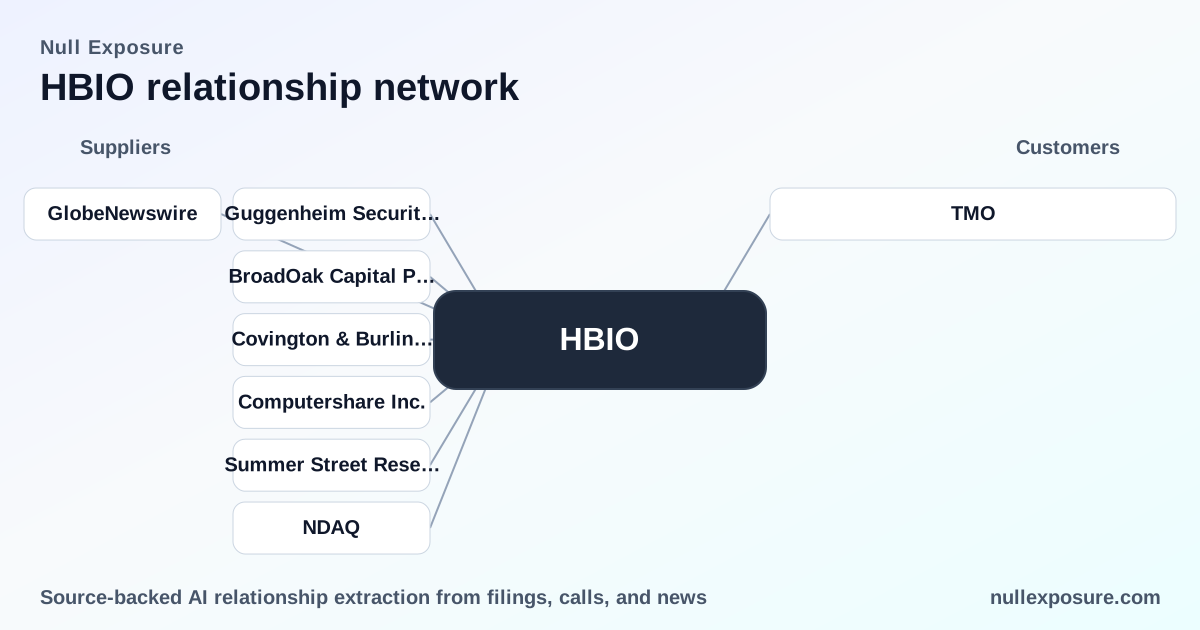
Below I catalogue every disclosed relationship from recent reporting and press releases, then extract implications for contracting posture, concentration and criticality.
Guggenheim Securities — financial advisor on refinancing
Guggenheim Securities served as lead financial advisor to Harvard Bioscience for the December 2025 debt refinancing package. According to a GlobeNewswire press release dated December 17, 2025, Guggenheim advised on the structure that reshaped the company’s credit profile.
BroadOak Capital Partners — $40 million life‑sciences credit facility
Harvard Bioscience entered into a $40 million term financing arrangement with BroadOak Capital Partners, comprised of three term loans funded on December 17, 2025, establishing BroadOak as a principal lender/financing partner for growth capital. The transaction was announced in the same GlobeNewswire release on December 17, 2025.
Covington & Burling LLP — legal counsel to Harvard Bioscience
Covington & Burling LLP acted as legal advisor to Harvard Bioscience on the refinancing, while Cooley LLP advised BroadOak, per the December 2025 GlobeNewswire announcement; this confirms outside counsel engagement for material credit and security arrangements.
Computershare Inc. — transfer agent handling reverse stock split logistics
Computershare is the transfer agent tasked with executing the company’s 1‑for‑10 reverse stock split, including conversion of physical certificates and cash‑in‑lieu payments; this instruction was distributed alongside the March 2026 split notice reported via QuiverQuant and GlobeNewswire.
The Nasdaq Capital Market — listing compliance driver for reverse split
The reverse split was explicitly executed to restore compliance with Nasdaq’s minimum bid price requirement for continued listing, as disclosed in the March 2026 company notice re‑distributed by QuiverQuant; compliance with exchange rules directly drove near‑term shareholder action.
Summer Street Research Partners — book‑running manager on an IPO filing (historical)
A 2012 GlobeNewswire release shows Summer Street Research Partners acted as sole book‑running manager for an IPO registration statement for a business unit, indicating historical use of specialized underwriting and capital‑markets relationships for divestitures or spin‑outs.
GlobeNewswire / press distribution — channel and content provenance
A March 2026 re‑distribution of the reverse split notice carried a disclaimer indicating the summary was AI‑generated; this highlights the use of third‑party news distribution platforms and downstream republishing in the company’s communications pipeline, as seen in QuiverQuant/GlobeNewswire reporting.
Operating model and contract posture — the constraints that matter
The public record of contracts and disclosures shows a mixed maturity and concentrated financing posture that defines operational flexibility.
- Contract maturity mix — long‑term and short‑term co‑exist. Harvard Bioscience maintains multi‑year non‑cancelable leases through 2030 and a multi‑year credit facility, while also operating short‑term arrangements (month‑to‑month leases and an interest rate swap maturing in December 2025). This produces a durable fixed‑cost base alongside discrete refinancing cliffs.
- Concentration of counterparty credit and covenant risk. The company’s obligations under the Credit Agreement are secured by substantially all assets and guaranteed by domestic subsidiaries; lenders exercise material control via covenants and waivers. The March 2025 amendment capped the revolving commitment and tightened margins, showing lender influence on liquidity and investment decisioning.
- Criticality of third‑party service providers. Harvard outsources material functions — legal, transfer agency, capital markets advisory and external cybersecurity and professional services — and flags these engagements as operationally significant. Service providers are essential for compliance, financing and corporate actions.
- Global and regional operating footprint raises supplier complexity. The company runs manufacturing and supplier relationships outside the U.S., with competitive labor markets in the U.S., England and Germany. Supply‑chain disruptions and geopolitically driven commodity volatility are described as material operational risks.
- Spend and scale profile. Fee payments to lenders and amendments fall in the mid‑to‑lower six‑figures, while outstanding borrowings are in the tens of millions — indicating both transactional supplier spend and large financing exposures that dominate the capital structure.
- Role diversity: buyer, seller, manufacturer, service consumer. Harvard acts as a manufacturer and distributor, procures from third parties (including sole‑source components in places), and regularly engages external service providers for audit, legal and treasury functions; this hybrid posture increases supplier management complexity and escalation points.
Key takeaway: the financing relationship is the single largest external control on operations; lenders and capital‑markets advisors shape liquidity, while cross‑border manufacturing and third‑party service dependencies create execution risk.
Visit Null Exposure for supplier risk scoring and counterparty monitoring if you need a rapid, investor‑grade readout on these dynamics.
Investment implications and tactical guidance
- For investors: priority monitoring should target covenant testing dates, lien structures and any additional amendments to the Credit Agreement. Refinancing events or covenant waivers materially change equity optionality.
- For operators and procurement teams: focus vendor continuity planning on sole‑source components and cross‑border suppliers, and ensure transfer‑agent and corporate‑action processes are well‑documented ahead of capital structure moves.
- For diligence teams: validate that legal and advisory retainers (e.g., Covington, Guggenheim) are transaction‑oriented rather than ongoing cost centers; advisory continuity reduces execution risk during refinancing windows.
If you want a customizable brief that maps these relationships to supplier concentration and cash‑flow sensitivity, get an actionable report at Null Exposure.
Final read: how to use this intelligence
Harvard Bioscience’s business combines manufactured product margins with distribution and service revenue, under a debt‑constrained capital structure that dictates near‑term strategy. Investors should treat financing events and exchange compliance actions as leading indicators of corporate flexibility; operators should prioritize supplier redundancy in manufacturing and strengthen controls around third‑party services. For tailored counterparty mapping and monitoring built for investor workflows, see Null Exposure.