HBNB: Supplier relationships, strategic levers, and investor implications
Hotel101 Global Holdings Corp. operates a branded budget-hotel platform headquartered in Singapore, developing, owning and operating Hotel101 properties and monetizing through hotel room revenues, asset ownership and development/management fees tied to new builds and franchise/management arrangements. The company scaled to a public listing pathway through advisory and legal engagements tied to a NASDAQ merger and pursues property-level growth by securing land partners for local developments. For investors focused on supplier concentration and execution risk, these supplier relationships are immediately material to near-term rollout and the firm’s path to revenue growth.
Explore structured supplier intelligence at https://nullexposure.com/ for deeper counterparty and concentration analysis.
Why supplier relationships determine the value path for Hotel101
Hotel101’s headline financials show a small revenue base (Revenue TTM $16.94 million) against a large market capitalization (approximately $1.87 billion), producing very high valuation multiples (Price/Sales 110.61, Price/Book 102.11). That valuation structure converts supplier execution into a core value driver: land owners, financial advisors and legal counsel directly affect the company’s ability to deliver new rooms, access capital, and defend transaction structures. High insider ownership (95%) and negligible institutional ownership (0.019%) also indicate a concentrated governance and contracting posture that centralizes vendor selection and negotiation. Taken together, supplier counterparties are not peripheral — they are central to execution and valuation realization.
Visit https://nullexposure.com/ for comparative supplier risk metrics and underwriting templates that map to asset-level delivery.
Direct supplier relationships disclosed in available records
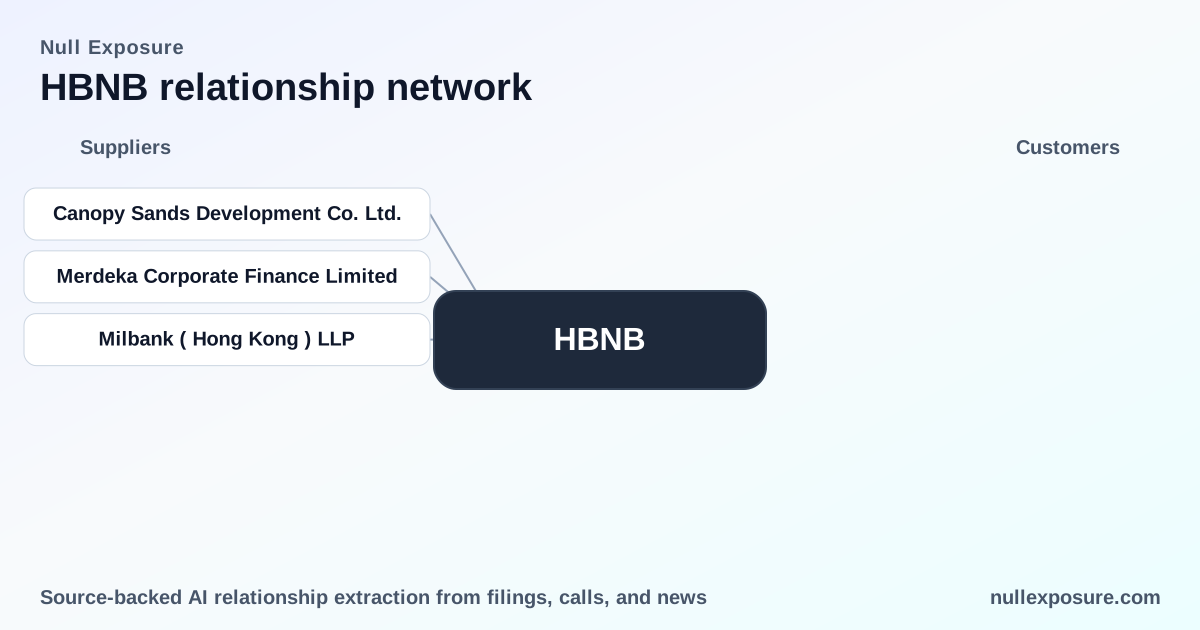
Canopy Sands Development Co. Ltd.: land access for two Cambodia hotels
Hotel101’s parent DoubleDragon Corp. agreed with Canopy Sands Development Co. Ltd. to develop two Hotel101 projects, with Canopy Sands providing prime land in Cambodia for development. This relationship is a strategic land partnership that reduces acquisition friction for two planned properties. Source: Manila Bulletin report on the agreement dated August 20, 2025 — https://mb.com.ph/2025/08/20/hotel101-to-build-2-hotels-in-cambodia-worth-63-billion.
Merdeka Corporate Finance Limited: financial adviser on the NASDAQ listing transaction
Merdeka Corporate Finance Limited served as financial advisor to Hotel101 Global Pte. Ltd. in the definitive merger agreement that took the company public via a SPAC-style transaction, supporting capital markets positioning and deal execution. Advisory relationships like this materially affect timing and structure of public capital access. Source: PR Newswire press release announcing the merger agreement (FY2024) — https://www.prnewswire.com/news-releases/hotel101-global-signs-definitive-merger-agreement-with-jvspac-acquisition-corporation-to-publicly-list-on-the-nasdaq-302110093.html.
Milbank (Hong Kong) LLP: legal counsel on the transaction
Milbank (Hong Kong) LLP acted as legal counsel to Hotel101 Global Pte. Ltd. during the merger and listing process, providing cross-border transaction and regulatory counsel relevant to the NASDAQ listing and related structuring. Established international counsel reduces execution risk on complex cross-jurisdictional deals. Source: Same PR Newswire press release (FY2024) — https://www.prnewswire.com/news-releases/hotel101-global-signs-definitive-merger-agreement-with-jvspac-acquisition-corporation-to-publicly-list-on-the-nasdaq-302110093.html.
What the supplier list tells investors about contracting posture and risk
The disclosed supplier set is focused and transaction-oriented: a land partner for two projects and professional advisors for the public listing. The data shows no broad network of operational vendors disclosed in the public results supplied here. Company-level signals and operating characteristics include:
- Contracting posture: centralized supplier selection under tight insider control, implied by 95% insider ownership; strategic vendor decisions will track closely with controlling shareholders’ priorities rather than broad institutional oversight.
- Concentration: visible supplier coverage is narrow — the firm depends on a small number of counterparties for key growth steps (land access, financial advisory, legal counsel), increasing single-counterparty execution risk for initial rollouts.
- Criticality: the listed counterparties are high-impact: land ownership dictates project feasibility, while financial and legal advisors determine access to capital markets and transactional defensibility.
- Maturity: financial indicators (negative EPS, -63.2% profit margin, substantial quarter-over-quarter revenue growth but small absolute revenues) indicate an early-growth operating profile in which supplier reliability and speed of delivery directly influence margin recovery and revenue scaling.
No supplier-specific contractual constraints were returned in the provided records, which itself is a signal: limited public disclosure of long-term supplier commitments increases the importance of diligence on counterparty terms and local development approvals.
Risks investors should prioritize
- Valuation vs. fundamentals: a large market capitalization and extreme valuation multiples leave little room for execution slippage; supplier failures or delays will compress expected upside rapidly.
- Concentration and single-point failure: reliance on a landowner for immediate expansion and a small set of advisors for capital access concentrates operational and financing risk.
- Governance and related-party dynamics: very high insider ownership increases the risk that supplier terms reflect controlling-party priorities rather than market rates; investors should check for related-party disclosures and contractual safeguards.
- Geographic and regulatory execution: cross-border development (e.g., Cambodia projects) requires robust local permitting and partner performance; legal counsel and local partner capability are therefore material.
If you want a supplier-focused diligence playbook tailored to hospitality rollouts, see detailed options at https://nullexposure.com/.
Bottom line: where supplier analysis moves valuation
For investors and operators, the disclosed supplier relationships show a focused, transaction-driven vendor set that is essential to early growth: land partners enable the physical product, while financial and legal advisors enable capital and public-market access. Given the company’s small revenue base, high valuation multiples, and concentrated ownership, supplier performance and contract terms are primary value determiners over the next 12–24 months. Investors should demand transparent contracts, confirm counterparty capacity for execution, and monitor any additional supplier dependencies as the company scales.
For integrated supplier risk reports and benchmarking for HBNB, visit https://nullexposure.com/ for subscriptions and bespoke analysis.