Horizon Bancorp (HBNC): supplier relationships that matter to investors
Horizon Bancorp operates as the bank holding company for Horizon Bank, monetizing through traditional regional banking activities: deposit gathering, commercial and consumer lending, fee income from services, and interest spread management across its investment and loan portfolios. Capital and liquidity management—especially borrowings, FHLB membership, and periodic equity raises—drive the company's strategic flexibility and directly influence investor outcomes. For investors and operators evaluating supplier exposure, the focus is on counterparties that underwrite equity placements, provide wholesale funding, and supply core services such as accounting, pricing and payments infrastructure. Learn more on the firm's footprint at the NullExposure homepage: https://nullexposure.com/.
Quick read: why supplier relationships matter for HBNC investors
Horizon runs a capital- and liquidity-intensive business. Supplier partners that act as underwriters, provide wholesale funding, or deliver mission‑critical infrastructure are economically and operationally material—they affect cost of capital, funding duration, and the ability to execute strategic balance-sheet moves. The firm shows a mix of short‑term funding (repurchase agreements, overnight liquidity) and long‑dated capital instruments (subordinated notes, secured borrowings through 2033–2043), so counterparty and contract maturity profiles matter for risk assessment and scenario planning.
Explore a research-grade supplier map at NullExposure: https://nullexposure.com/.
What the public record shows — every relationship in the results
Below I cover each relationship identified in the supplied results, with a concise plain-English summary and the reported source.
-
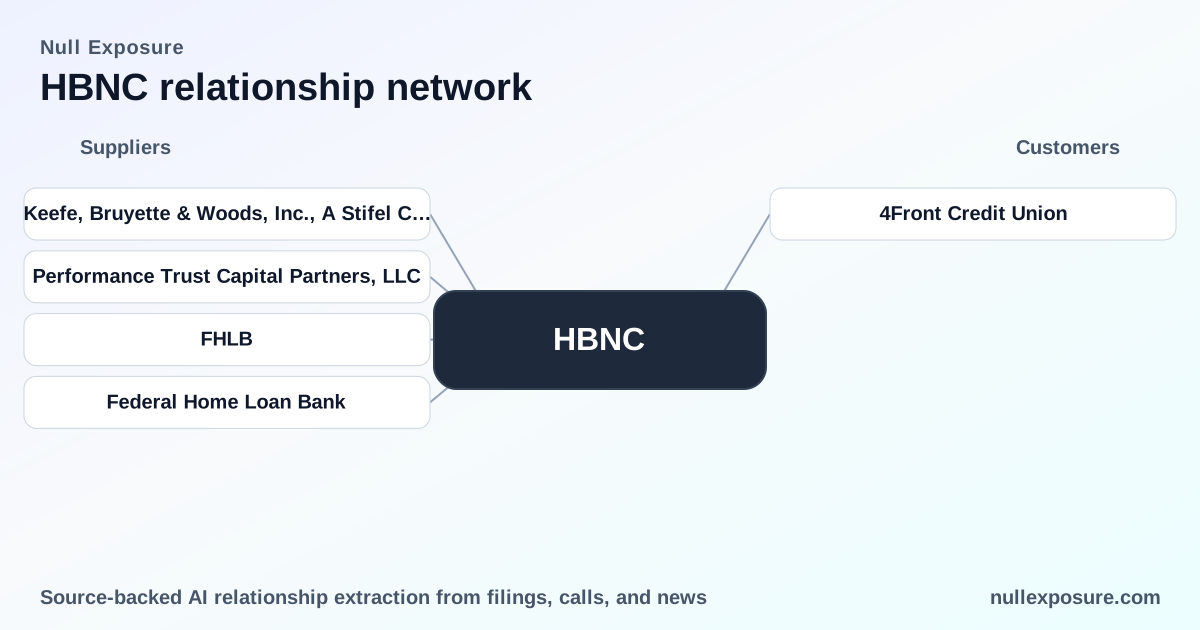
Keefe, Bruyette & Woods, Inc., A Stifel Company — Keefe Bruyette acted as a joint book‑running manager alongside Performance Trust for Horizon’s common stock offering, supporting Horizon’s equity raise activity in 2025. (Horizon press release / Globe and Mail, Aug 20, 2025 and closing notice Mar 10, 2026; source: Globe and Mail press release.)
-
Performance Trust Capital Partners, LLC — Performance Trust served as the co‑bookrunner on the same 2025 common stock offering, sharing underwriting responsibility for Horizon’s capital transaction. (Horizon press release / Globe and Mail, Aug 20, 2025 and Mar 10, 2026; source: Globe and Mail press release.)
-
FHLB (Federal Home Loan Bank) — Horizon used proceeds from securities sales to pre‑pay $700 million of puttable advances from the FHLB as part of a balance‑sheet restructuring disclosed in FY2025. That prepayment drove a one‑time prepayment penalty earlier reported and materially reduced advance balances. (Horizon restructuring press release / GlobeNewswire, Sep 15, 2025; SEC filing Project Olympia, FY2025.)
-
Federal Home Loan Bank (note on expense impact) — Horizon reported that the payoff of $700 million in FHLB advances generated a $12.7 million prepayment penalty affecting non‑interest expense during Q4 2025; the company flagged this as non‑recurring. (FY2026 results press release / GlobeNewswire, Jan 21, 2026.)
-
FHLB (credit commentary) — Independent commentary noted that Horizon used excess liquidity to pay down more FHLB advances than planned—reducing outstanding advance balances by over $300 million beyond initial guidance—underlining the FHLB relationship’s centrality to funding strategy. (KBRA publication, FY2025 commentary.)
-
Keefe, Bruyette & Woods (launch disclosure) — The earlier launch disclosure confirms Keefe Bruyette’s role as an active underwriter when Horizon announced its offering in August 2025. (Horizon press release / GlobeNewswire, Aug 20, 2025.)
-
Performance Trust Capital Partners (launch disclosure) — The initial offering announcement reiterates Performance Trust’s role as co‑bookrunner at the offering launch in August 2025. (Horizon press release / GlobeNewswire, Aug 20, 2025.)
-
FHLB (SEC filing) — Horizon’s SEC filing for its restructuring explicitly documents the use of securities sale proceeds to pre‑pay FHLB puttable advances as part of the executed plan in FY2025. (Horizon SEC filing Project Olympia, FY2025.)
Operating model constraints and what they signal for investors
Horizon’s public filings and press disclosures present a coherent set of operating constraints that shape supplier risk.
-
Contracting posture: mixed short‑ and long‑term exposure. Horizon runs short-term funding outlets (repurchase agreements and overnight liquidity) alongside long‑dated instruments (subordinated notes maturing into the 2030s and secured borrowings into the 2040s). This dual posture requires active ALM and counterparty diversity to avoid concentrated rollover risk.
-
Counterparty concentration and government exposure. A meaningful portion of Horizon’s investment and funding mix involves U.S. Treasuries, agency securities, and FHLB advances, creating a heavy government‑counterparty tilt that reduces credit risk but raises operational concentration on government-sponsored counterparties.
-
Critical service dependencies. Multiple third‑party providers supply essential infrastructure: investment management (Horizon Investments), accounting/audit (Forvis Mazars), pricing services for level‑2 securities, and payment and digital channels. Service provider failures would be materially disruptive.
-
Spend and scale signals. Liquidity movements and borrowings run in the hundreds of millions to billions, while external services and consultants are in the mid‑single‑digit millions—indicating supplier spend bands that range from mission‑critical large counterparties (FHLB, money‑center lines) to tactical external advisors.
-
Relationship lifecycle. Most supplier ties are active; limited terminations are documented (for example, a swap termination in May 2023). Horizon routinely refreshes held‑to‑maturity assessments and runs a third‑party risk program, consistent with an advanced maturity posture for vendor oversight.
Investment implications and risk checklist
- Capital flexibility is a strength: equity underwriting relationships (Keefe, Performance Trust) support opportunistic raises; the company executed a material equity offering in 2025 to fund repositioning.
- Funding concentration is the principal operational risk: membership and sizeable exposure to FHLB advances make the FHLB relationship both a strategic asset and a critical dependency—prepayments materially affect expense and liquidity metrics.
- Operational continuity relies on multiple service providers: auditors, pricing vendors, and technology/payment processors are material to daily operations; vendor management is therefore a value driver and a potential vulnerability.
See our supplier risk mapping and scenario tools at NullExposure: https://nullexposure.com/.
Conclusion — what to watch next
For investors and operators, monitor three levers: (1) FHLB advance levels and any future prepayment or re‑borrowing actions; (2) execution and pricing on any planned capital raises and the underwriting roster; (3) third‑party service continuity and expense trends. These variables will determine Horizon’s cost of funds, balance‑sheet durability, and the predictability of earnings as the company converts structural changes into recurring performance.
If you want a tailored supplier exposure brief or a comparative view across regional banks, visit NullExposure for curated research and supplier maps: https://nullexposure.com/.