HBR: How the new HBAR spot ETF changes the supplier map investors should watch
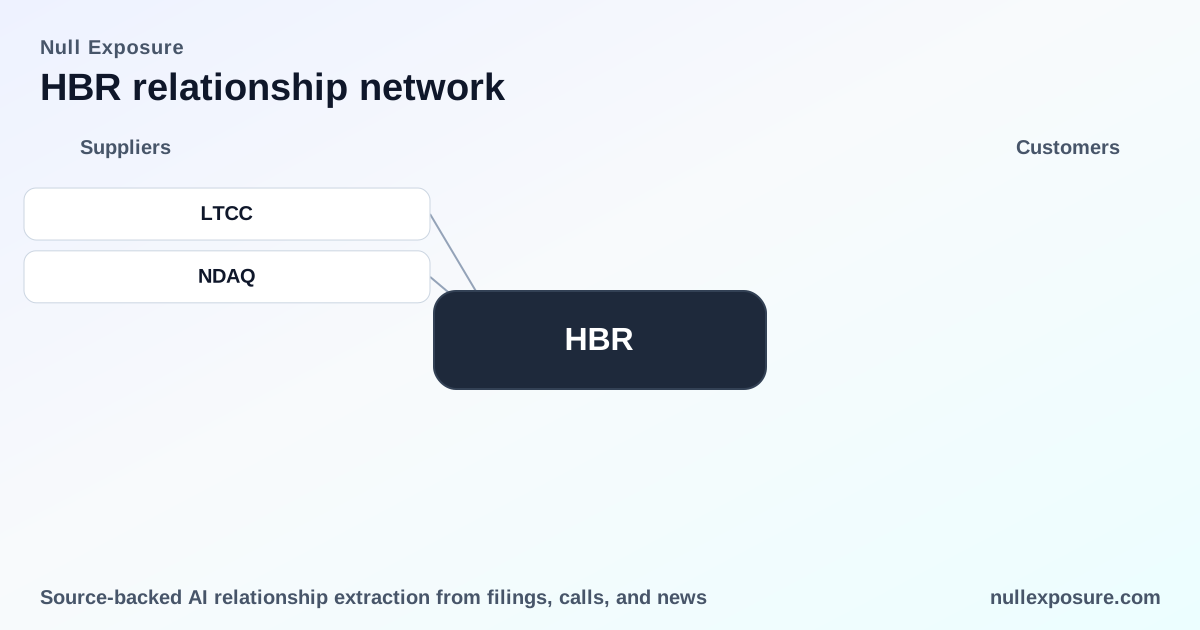
HBR trades as a U.S. spot HBAR exchange-traded product issued into a two-party supplier ecosystem: an ETF sponsor that designs and monetizes the fund through management and structural fees, and an exchange that provides distribution, secondary-market liquidity and listing infrastructure. Revenue flows do not accrue to a single entity labeled “HBR” — they flow to the ETF issuer and to market participants who capture spreads and execution revenue, while listing and trading occur on a public exchange that governs distribution and visibility.
For operators and investors evaluating counterparty exposure, HBR’s supplier footprint is compact and concentrated; understanding each supplier’s economic role is the priority. Learn more about our supplier analysis framework at https://nullexposure.com/.
One-line situational read: early product, narrow counterparty set
HBR is a newly listed product launched in FY2025 and therefore sits at the intersection of early-maturity product risk and high-visibility distribution. A concentrated supplier set increases execution and operational dependence, while the ETF wrapper channels most economic capture to the sponsor and to market-making counterparties that support creation/redemption. Review deeper supplier coverage and signals at https://nullexposure.com/ to benchmark this exposure.
The relationships you need to know
-
Canary Capital Group LLC — Canary is the ETF sponsor that issued the spot HBAR fund (ticker HBR) and a companion Litecoin fund; the issuer expanded the U.S. spot-crypto ETF roster beyond Bitcoin and Ethereum and executed the product launch in FY2025. Canary is the revenue originator for HBR: it structures the fund and collects manager and administrative economics. Source: Yahoo Finance coverage of the launch (reported March 10, 2026) describing Canary’s issuance of the HBAR and Litecoin spot ETFs.
-
Nasdaq — Nasdaq served as the listing venue for HBR when the fund began trading on Oct. 28 (FY2025), providing the exchange infrastructure and public market access; the listing day recorded zero net inflows on opening trading. Nasdaq supplies distribution and post-listing liquidity mechanisms that materially affect secondary-market pricing and accessibility. Source: Yahoo Finance reporting (March 10, 2026) noting Nasdaq listing and opening-day flow data.
What those supplier relationships imply about HBR’s operating model
With no additional supplier entries in the public relationship set, company-level signals describe an operating model shaped by concentration and early-stage maturity:
-
Contracting posture — sponsor-led: The ETF sponsor (a single issuer in the visible set) controls product design, fee schedule, and the legal contract that governs creation/redemption mechanics. For counterparties, negotiation leverage concentrates around the sponsor because it determines economic terms for the product.
-
Concentration — focused counterparty map: The results show a very narrow supplier list. Concentrated supplier relationships increase single-point operational risk — if the sponsor or the primary exchange has an operational or regulatory issue, HBR’s market functioning is disproportionately affected.
-
Criticality — exchange dependence for market access: Listing on a major exchange is critical for retail and institutional visibility; any exchange-level repricing of fees, delisting risk, or market structure changes would directly alter accessibility and liquidity for HBR.
-
Maturity — early lifecycle dynamics: The fund launched in FY2025, placing it in an early maturity bucket where initial trading behavior, maker/taker incentives, and client adoption drive near-term volatility in flows and spreads. Early-stage products require vigilant monitoring of flows, AP (authorized participant) engagement, and secondary-market depth.
-
Commercial economics — sponsor-controlled capture: While trading spreads and market-making capture a portion of transaction economics, the sponsor captures management and structural fees. Investors should prioritize clarity on fee schedules, authorized participant relationships, and the sponsor’s capital commitment to product support.
Risk and monitoring checklist for investors and operators
- Track sponsor disclosures and fee schedules for HBR; sponsor governance and fee economics determine who captures value and how sensitive revenue is to AUM growth.
- Monitor exchange trading depth and spread behavior; Nasdaq’s liquidity provision is central to execution quality.
- Identify authorized participants and market-makers supporting creation/redemption; absence of diverse APs signals higher liquidity risk.
- Watch regulatory headlines and exchange policy changes affecting spot-crypto ETFs, as those are system-level drivers for HBR’s market access.
- Keep an eye on early flows and opening-day mechanics: opening-day zero net inflows suggest discretionary liquidity patterns that can persist until AP and investor behavior stabilizes.
Midway read: if you want a clear supplier-risk profile for this and other ETF sponsors, see the detailed supplier intelligence we publish at https://nullexposure.com/.
Practical takeaways for portfolio and operations teams
- For portfolio managers: treat HBR as an issuer-concentrated exposure until the sponsor demonstrates sustained assets and a diverse AP ecosystem; size positions with liquidity and execution contingency plans in place.
- For operations and counterparty risk teams: validate settlement, creation/redemption counterparties, and exchange connectivity; operational resilience is the primary mitigant for a compact supplier set.
- For research and strategy: incorporate adoption curves for spot-crypto ETFs into scenario models — early adoption can create rapid AUM growth or sudden outflows depending on macro and regulatory signals.
Closing: what matters going forward
HBR’s supplier footprint is small but structurally important: a single issuer sets the economics while a major exchange supplies distribution. Concentration, early product maturity, and exchange dependence are the three structural themes that will determine HBR’s risk-return profile over the next 12–24 months. For investors and operators focused on supplier exposure and counterparty resilience, maintain active monitoring of sponsor disclosures, authorized participant involvement, and exchange liquidity metrics.
To get supplier-level signal scoring and continuous monitoring for HBR and comparable products, visit https://nullexposure.com/ and explore our supplier intelligence coverage.