HBT Financial: Supplier relationships, funding posture, and where risk concentrates
HBT Financial, the holding company for Heartland Bank and Trust Company and State Bank of Lincoln, operates as a regional commercial bank that monetizes through net interest margin, fee income from retail and commercial banking, and balance-sheet management including securities and wholesale funding. The company funds loan growth with a mix of deposits, held-to-maturity and available-for-sale securities, and committed borrowings from government-sponsored facilities, while generating recurring income from interest spread and non-interest services. For investors assessing supplier and counterparty risk, the most consequential relationships are funding counterparties and core third‑party service providers that underpin operations and regulatory compliance.
Explore deeper supplier intelligence at https://nullexposure.com/.
Quick read: the funding and vendor picture that matters to investors
HBT runs a conventional regional-bank model: deposit-funded core lending, supplemented by securities portfolios and FHLB/Fed access for liquidity. The balance-sheet mix shows sizable held-to-maturity agency and mortgage-backed holdings and an active, small-but-accessible drawing on Federal Home Loan Bank advances. Outsourced digital banking, card processing and valuation services are strategic to retail and operational continuity. These elements shape capital allocation, earnings sensitivity to rates, and operational resilience.
What the relationship data shows (all supplier relationships covered)
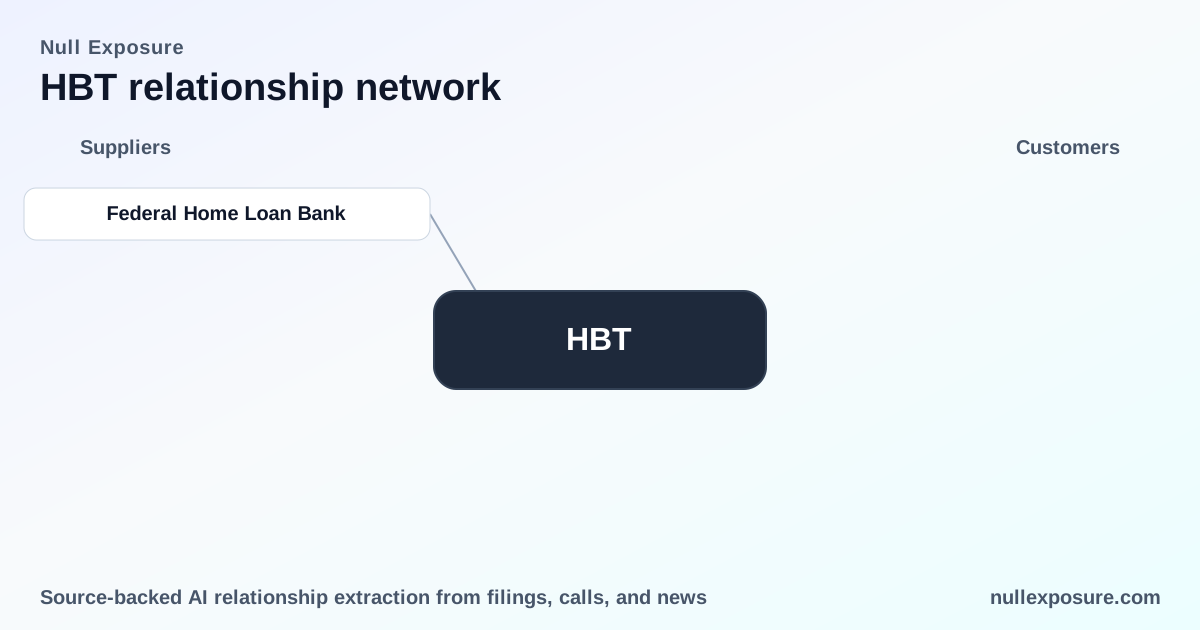
HBT’s supplier relationships in the source set are concentrated and dominated by a single, material counterparty: the Federal Home Loan Bank system.
- Federal Home Loan Bank: HBT has active borrowing capacity and outstanding advances with the FHLB, with $13.231 million outstanding and over $1.0 billion of additional available capacity as of December 31, 2024; FHLB advances carried a weighted average rate of 0.54% for that period, illustrating a low-cost supplemental liquidity channel. This position was also noted in HBT’s FY2025 quarterly results reported via GlobeNewswire in January 2026. (Source: company annual report as of Dec. 31, 2024; FY2025 / FY2026 results press release on GlobeNewswire, Jan. 26, 2026.)
This article covers every relationship listed in the supplied results. The single named supplier — the Federal Home Loan Bank — is described above with the supporting public references.
Why the FHLB relationship matters to investors
The FHLB relationship functions as both a backstop and a strategic instrument for funding management.
- Liquidity cushion: The FHLB provides committed borrowing capacity that dwarfs HBT’s current draws ($1.02 billion available vs. $13.2 million outstanding as of year-end 2024), giving management optionality to fund loan growth or respond to deposit outflows. (Source: 2024 annual report disclosures.)
- Maturity and tenor mix: HBT’s reporting highlights a mixture of long‑term and short‑term contractual exposures across its balance sheet — FHLB advances are recorded among borrowings with multi-year maturity windows elsewhere in the portfolio, while repurchase agreements act as daily sweep facilities. This combination creates a funding ladder that is flexible but requires active interest-rate and liquidity management. (Source: 2024 annual report.)
- Cost and margin sensitivity: The weighted average FHLB rate reported (0.54% at Dec. 31, 2024) is a low-cost lever to preserve net interest margin, particularly when loan demand or securities cash flows are cyclical. (Source: 2024 annual report.)
Operating model constraints and what they signal for supplier risk
HBT’s disclosures provide a set of company-level signals about contracting posture, concentration, criticality and maturity that are relevant for any supplier or investor evaluation.
- Contracting posture: HBT uses both long-term and short-term contracts. Long-term exposures are evident in derivative maturities stretching to 2035 and held-to-maturity securities positions that management intends to retain; short-term exposures exist in daily repurchase agreements used for day-to-day funding. These mixed tenors require active treasury management and hedging discipline. (Company filings as of Dec. 31, 2024.)
- Counterparty mix and geography: The bank’s counterparty set is government‑centric and U.S.-regional — large holdings of U.S. Treasury, government agency and agency mortgage-backed securities and membership in the FHLB system concentrate exposures in U.S. government‑backed credit and the Midwest banking ecosystem. This reduces credit risk but increases exposure to systemic market shocks. (Company annual report disclosures.)
- Materiality and criticality: Third-party service providers are functionally critical — core banking systems, card processing, and digital platforms are outsourced, and regulatory requirements increasingly demand stricter vendor oversight; HBT warns regulators could penalize inadequate third-party controls. At the same time, some supplier liabilities (e.g., certain lease and litigation items) are immaterial on a line-item basis. (Company annual report disclosures.)
- Relationship role and stage: The company acts as a buyer of vendor services and a customer/borrower of financial counterparties; relationships are active, with ongoing vendor reliance and active borrowings from the FHLB. (Company annual report disclosures.)
- Spend and concentration signals: Reported balances show concentrated potential spend and exposure bands — FHLB advance balances in the $10m–$100m range historically, available liquidity in the $100m–$1bn+ band, and regulatory/supervisory fees in the low‑hundreds of thousands — a profile consistent with a mid-sized regional bank that needs selective, scalable vendor partners. (Company annual report disclosures.)
Risk themes investors should watch
- Operational dependency on third-party platforms is a primary non-credit risk; interruptions in core banking or card processing would have material operational and regulatory consequences. (Company annual report.)
- Interest-rate hedge execution risk: HBT uses swaps and derivatives to manage rate exposure; ineffective hedging would directly compress earnings given the securities and loan mix. (Company annual report.)
- Liquidity concentration: Access to FHLB capacity is a key backstop; while ample on paper, reliance on wholesale facilities is a strategic choice that amplifies funding flexibility but also counterparty and market access risk under stress. (Company annual report.)
If you are evaluating counterparty risk or looking to benchmark vendor resilience, a targeted supplier map will surface dependencies across funding, core processing and valuation services — start that mapping now at https://nullexposure.com/.
Actionable takeaways for investors and operators
- FHLB is a strategic, low-cost liquidity partner for HBT; the outstanding advances are small versus capacity but materially relevant for contingency funding and rate management. (Company annual report; FY2025 press release.)
- Operational continuity hinges on a small set of third‑party vendors for digital banking and card processing; vendor oversight and contract terms are central to enterprise risk management. (Company annual report.)
- Balance-sheet composition — large held-to-maturity agency securities and derivatives with long maturities — drives sensitivity to interest rates and hedging effectiveness. (Company annual report.)
For a practical next step: map HBT’s external counterparty exposures against your risk tolerance and conduct focused diligence on FHLB terms, vendor redundancy, and hedging policy. Learn how to prioritize those inquiries at https://nullexposure.com/.
Closing view
HBT Financial combines a traditional deposit-and-securities-funded banking model with selective wholesale borrowing from the FHLB and outsourced operational infrastructure. This structure delivers predictable margin opportunities but concentrates risk in liquidity access and vendor reliability; investors should prioritize transparency on FHLB utilization, hedging effectiveness, and the contractual resilience of core service providers.