HCA Holdings: supplier relationships, operating posture and what investors should price in
HCA Healthcare is a large, for‑profit operator of hospitals and outpatient sites that monetizes scale through patient services, ancillary care and centralized support platforms. The company drives cash flow from admissions, outpatient procedures and integrated revenue‑cycle management while expanding via acquisitions and capital projects; HCA’s balance sheet reflects heavy long‑term leverage alongside a large ongoing capital program and recurring operating leases. For investors and vendor operators evaluating commercial exposure, HCA is both a high‑volume buyer and a strategically sophisticated operator that prizes measurable ROI, regulatory compliance and continuity of critical services.
Explore supplier intelligence and vendor risk for complex healthcare buyers at https://nullexposure.com/.
The commercial posture that matters for suppliers and investors
HCA’s supplier footprint is defined by a mix of long‑term and short‑term contracting, sizeable spend and operational criticality. The company couples long‑duration financing and lease obligations with a commercial paper facility for short liquidity needs, creating a buying counterparty that is credit‑capable but closely managed by covenant and capital priorities. This posture influences how suppliers price multi‑year digital transformations, hardware refresh cycles and staffing contracts.
Key operating signals:
- Contract mix: Heavy long‑term debt and leases signal preference for stable, multi‑year vendor relationships for facilities, equipment and enterprise systems. At the same time, a commercial paper program and variable lease/usage expenses indicate tactical short‑term procurement for working capital flexibility.
- Spend concentration: Planned capital expenditures of roughly $5.0–$5.5 billion in 2026 and a large debt base indicate project budgets in the $100M+ range for major initiatives, making HCA a high‑value buyer for infrastructure, enterprise software and medical hardware.
- Criticality and risk: Labor availability, cybersecurity and technology implementations (including AI) are identified as material and operationally critical to HCA’s performance; failure in these areas can meaningfully affect capacity and results.
- Segmentation of purchases: HCA buys across hardware, software and services, often through centralized programs and affiliates that provide national supply contracts and shared service platforms—this increases bargaining leverage for organized suppliers.
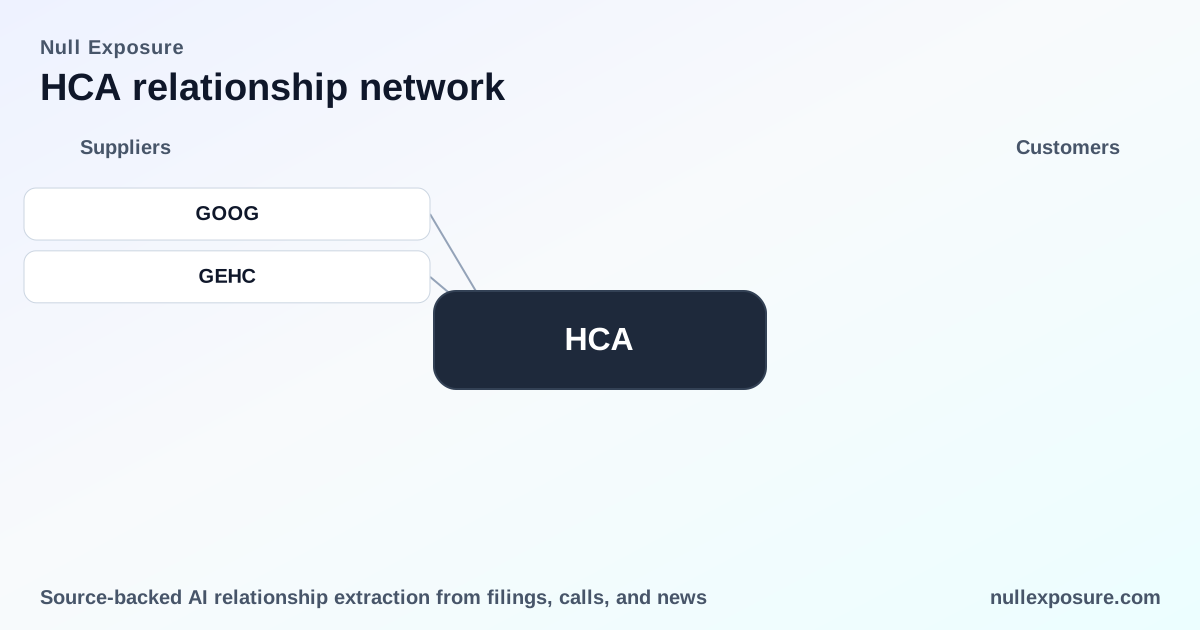
Supplier relationships reported: Google Cloud and GE Healthcare
Below are the supplier relationships flagged in public reporting and press coverage. Each entry is a plain‑English summary with a source reference.
Google Cloud — automating clinical documentation with generative AI
HCA is using a partnership with Google Cloud to deploy generative AI for clinical documentation workflows, targeting physician time savings of up to two hours per day and operational efficiency gains across charting and notes. According to a Finterra deep‑dive published on FinancialContent (Feb 17, 2026), the initiative is positioned as a broad automation play to reduce clinician administrative burden while integrating with HCA’s EHR efforts (https://markets.financialcontent.com/wral/article/finterra-2026-2-17-deep-dive-hca-healthcare-navigates-policy-shifts-and-market-volatility).
GE Healthcare — perinatal AI product collaboration (CareIntellect for Perinatal)
HCA and GE Healthcare have launched CareIntellect for Perinatal, an AI‑driven monitoring tool intended to detect fetal distress earlier than conventional monitors, reflecting HCA’s strategy of embedding advanced analytics into clinical workflows. The same FinancialContent report (Feb 17, 2026) describes this as part of a broader push into domain‑specific AI tools that address high‑value clinical pathways (https://markets.financialcontent.com/wral/article/finterra-2026-2-17-deep-dive-hca-healthcare-navigates-policy-shifts-and-market-volatility).
Constraints that shape HCA’s procurement and partner strategy
Treat these as company‑level operating signals that determine contract structuring, risk allocation and vendor selection:
- Long‑term commitments are dominant: HCA’s capital structure and lease profile—including senior notes with maturities out to 2055 and multi‑year operating leases—create a bias toward long‑term supplier relationships for capital equipment and enterprise systems. These partners must support multi‑year depreciation and uptime economics.
- Short‑term flexibility exists for working capital: A commercial paper program (up to $4.0 billion capacity) and variable debt components permit short‑term sourcing and temporary staffing contracts when operational demand spikes.
- Usage‑based and variable expense lines are material: HCA records meaningful variable lease and operating expense items, supporting contracts that include consumption pricing or flexible seat/usage models for software and services.
- High spend and centralized procurement: With planned multi‑billion capital investment and national supply contracts managed through affiliates, HCA is a strategic, high‑value buyer; suppliers should prepare for competitive RFPs and strict ROI proof points.
- Operational criticality: labor, IT and cybersecurity: HCA identifies staffing availability, technology implementation risk and security incidents as material; vendors offering staffing, managed services, cybersecurity or resilient SaaS should price in higher SLAs and robust compliance features.
- Regulatory scrutiny on AI and referral economics: State and federal rules around AI transparency and physician relationships are evolving and explicitly cited as business risks—partners must embed compliance controls and explain traceability.
- Vendor maturity signal: HCA’s long‑standing auditing relationship with Ernst & Young (since 1994) indicates preference for established, audited partners and mature contracting processes.
What this means for suppliers and investors — tactical takeaways
- For suppliers: Design contracts that combine guaranteed performance metrics with usage or volume‑based escalation; prioritize interoperability with major EHR platforms and articulate measurable clinician time‑savings and compliance controls. Demonstrable HIPAA, AI‑governance and cybersecurity capabilities are table stakes.
- For investors: Value HCA’s growth and cash generation against significant leverage and large capital commitments; upside from AI‑driven efficiency is real but contingent on successful, secure deployment at scale and regulatory clarity.
- Negotiation posture: Expect centralized procurement, long negotiation cycles and a preference for proven partners who can support nation‑wide rollouts and provide indemnities around compliance and uptime.
For deeper supplier scoring and counterparty exposure analysis, visit https://nullexposure.com/ and evaluate how enterprise buyers like HCA allocate risk across technology, equipment and services.
Final read: tradeoffs and investment signals
HCA is a strategic, high‑spend buyer that rewards measurable clinical and financial outcomes. Partnerships with Google Cloud and GE Healthcare show a deliberate pivot into AI‑enabled care pathways—an opportunity for vendors who can deliver validated ROI and enterprise‑grade security. At the same time, debt levels, regulatory complexity and labor constraints require suppliers and investors to price in execution risk and compliance costs.
If your firm is negotiating with HCA or you track supplier concentration in healthcare portfolios, start with risk‑adjusted SLAs, robust audit trails and a clear regulatory compliance plan. Learn more about vendor risk and supplier relationships at https://nullexposure.com/ — our platform consolidates counterparty signals that matter to buyers, operators and investors.