Hennessy Capital Acquisition Corp. IV (HCAC): a sponsor-driven SPAC whose value tracks successful capital formation and deal execution
Hennessy Capital Acquisition Corp. IV (HCAC) is a special-purpose acquisition company that raises cash in an IPO trust, pays sponsors and underwriters to assemble and execute a business combination, and ultimately monetizes through a successful merger or liquidation of the trust. Value for investors is driven not by operating cash flow but by capital formation, underwriting relationships, and the sponsor’s ability to source a compelling target and structure a transaction (PIPE, earnouts, sponsor promote). For research teams and operators assessing HCAC as a supplier counterparty, the relevant questions are execution capability, concentration of intermediary relationships, and timing risk. Learn more or revisit the issuer profile at https://nullexposure.com/.
Quick operating thesis: how HCAC makes money and where risk sits
HCAC’s balance sheet and economics are simple: cash sits in a trust following an IPO; a sponsor and underwriters are paid fees and a promote at combination; investors realize returns if the combination creates enterprise value above trust-per-share and transaction costs. Key commercial dependencies are external: the Nasdaq listing venue and the lead underwriter(s) who manage distribution, pricing, and execution. Institutional ownership (~53.6%) and modest insider stakes (1.77%) indicate a sponsor-forward capitalization with broad professional investor participation in the float. Market capitalization stands at approximately $727 million with roughly 29.8 million shares outstanding, so market dynamics and secondary liquidity are immediate value drivers for the stock.
Recent market signals that matter to sponsors and counterparties
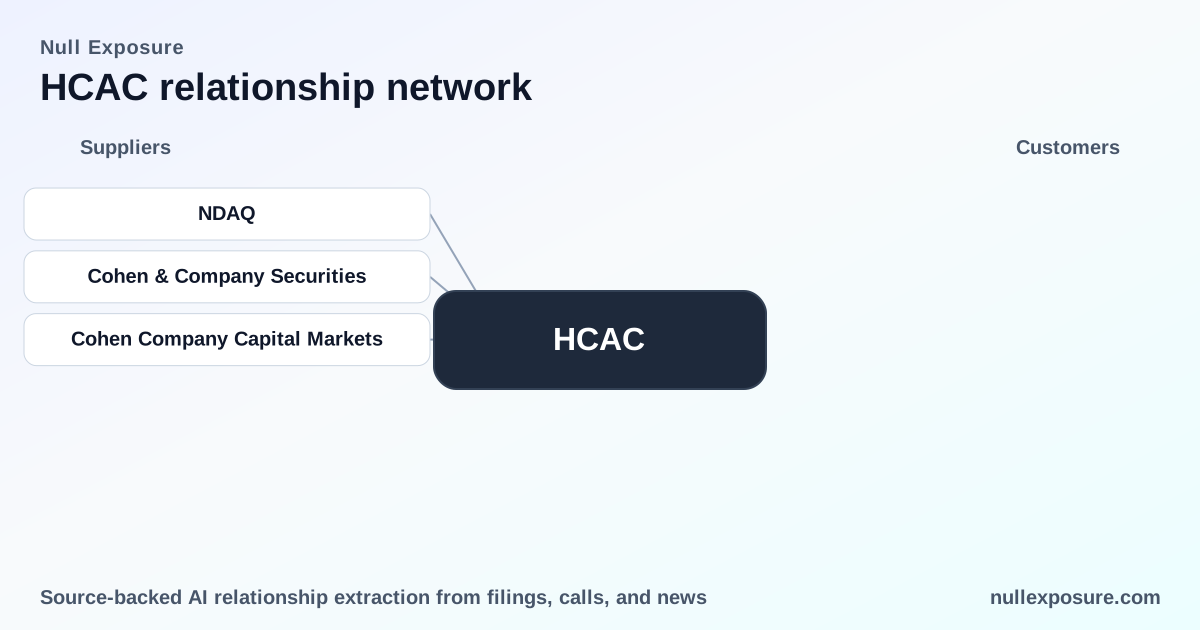
The public record for HCAC’s supplier relationships in FY2025 shows a tightly focused set of capital markets counterparties involved in the IPO and listing process. That concentration is a strategic characteristic — not an operational flaw — because SPACs depend on a small number of expert firms to clear SEC registration, underwriting, and listing requirements. Where those firms are reputable and experienced, execution risk reduces; where they are single points of failure, the reverse is true.
- According to a press release dated March 10, 2026, Hall Chadwick announced the successful completion of a US$207 million IPO of affiliate Hall Chadwick Acquisition Corp (Nasdaq: HCACU) on the Nasdaq Global Market, confirming the venue and deal size. (GetTheWordOut, 2026-03-10)
- Renaissance Capital’s IPO coverage noted the role of Cohen & Company Securities as the sole bookrunner on the offering filed in FY2025, which signals concentrated underwriting responsibility. (Renaissance Capital, FY2025)
- A secondary press account identified Cohen Company Capital Markets (a division of Cohen & Company Securities) as the lead book-running manager for the IPO, reinforcing the single-lead-manager structure for distribution and syndication. (GetTheWordOut, 2026-03-10)
Relationship roster: who HCAC is doing business with (concise summaries)
Nasdaq Global Market
Nasdaq served as the listing venue for the HCACU offering that raised US$207 million, providing primary-market distribution, regulatory listing standards, and post-listing liquidity. According to a company press release (GetTheWordOut, March 10, 2026), the IPO completed on the Nasdaq Global Market.
Cohen & Company Securities
Cohen & Company Securities acted as the sole bookrunner for the transaction, concentrating underwriting, pricing, and allocation functions with a single lead manager. Renaissance Capital’s IPO commentary (FY2025 coverage) lists Cohen & Company Securities as the deal’s bookrunner.
Cohen Company Capital Markets
Cohen Company Capital Markets, a division of Cohen & Company Securities, is cited as the lead book-running manager and was responsible for managing the syndicate and execution details of the IPO. That role is documented in the same March 10, 2026 press release describing the offering’s close (GetTheWordOut, 2026-03-10).
What these supplier relationships mean in practice
- Concentrated execution: HCAC’s capital-raising execution relied on a single underwriting franchise to manage the IPO and run the book. For investors this is efficient — a single accountable manager — but it creates a vendor concentration that elevates execution risk if that manager becomes unavailable or reputationally impaired.
- Venue certainty: A Nasdaq Global Market listing is a positive signal for secondary market access and institutional participation; it reduces distribution friction and supports price discovery.
- Sponsor economics dominate: As with all SPACs, sponsor promote, underwriting fees, and transaction-level economics determine investor outcomes more than any operating revenue at this stage. That makes the quality of the sponsor/underwriter partnership the primary commercial lever.
If you want a deeper read on issuer relationships and counterparty concentration, visit https://nullexposure.com/ for full supplier profiles and cross-issuer comparisons.
Operating and business-model constraints (company-level signals)
No explicit supplier constraints were documented in the relationship feed for HCAC, so the following are company-level operational signals derived from the SPAC model and the relationship set above:
- Contracting posture — transactional and time-limited. SPAC agreements with underwriters and listing venues are finite, event-driven contracts focused on IPO execution and post-closing obligations.
- Concentration — high dependence on a small number of financial intermediaries. The sole-bookrunner structure concentrates execution and syndication responsibilities.
- Criticality — elevated around deal execution windows. Relationships with underwriters and the exchange are strategically critical during registration, pricing, and the business-combination window; outside those windows their importance falls to administrative and compliance roles.
- Maturity — nascent issuer lifecycle. As a recently capitalized SPAC, HCAC’s maturity is early-stage; the firm’s commercial value proposition depends on successful transaction sourcing and execution rather than recurring operating revenues.
Investment implications and risk framing
For investors and counterparties evaluating HCAC as a supplier or counterparty, prioritize these items: the sponsor’s track record in sourcing priced deals, the underwriter’s ability to syndicate follow-on PIPE investors, and the contingency plans if a lead manager cannot perform. Underwriter concentration and the single-venue listing are efficiency strengths, but they are also single points of execution risk during the most valuable periods of the SPAC lifecycle.
A mid-cycle operational review should:
- Confirm underwriting agreements and fee schedules.
- Stress-test sponsor incentives against potential dilution scenarios.
- Verify timelines and milestones tied to the Nasdaq listing and regulatory deliverables.
If you require an operational map of HCAC’s counterparties and a comparative concentration analysis, explore the issuer hub at https://nullexposure.com/ for curated supplier intelligence.
Bottom line and next steps
HCAC is a classic SPAC: capitalization and underwriting relationships create the value runway; sponsor execution creates the realized returns. The most material supplier relationships for HCAC are its Nasdaq listing and its Cohen-led underwriting syndicate — both of which determine distribution, pricing, and ultimately whether investors achieve upside on a business combination. For buy-side teams and operators, diligence should focus on counterparty continuity, underwriter incentives, and the sponsor’s transaction pipeline.
For a full supplier risk assessment and comparable issuer analysis, visit https://nullexposure.com/ and download the expanded relationship dossier.