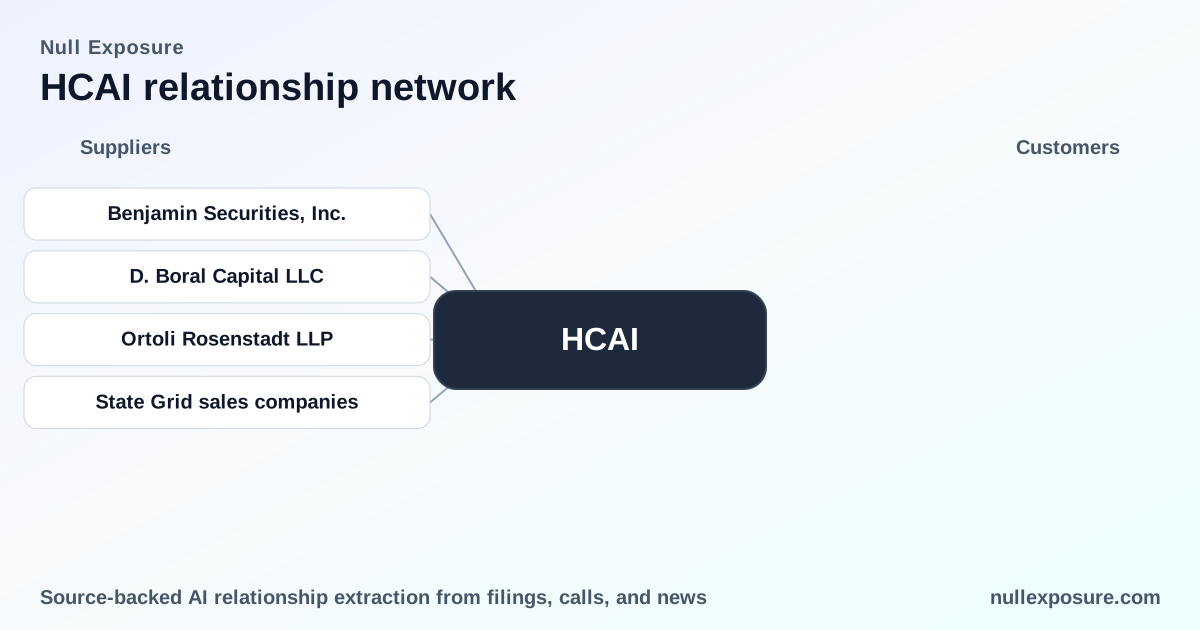
HCAI Supplier Map: What investors need to know about Huachen AI’s vendor footprint
Huachen AI Parking Management Technology Holding Co., Ltd (NASDAQ: HCAI) sells AI-driven parking hardware, software and increasingly integrated smart-city services — monetizing through product sales, recurring operations and maintenance contracts, and an emerging energy-arbitrage business that converts grid procurement into incremental margins. The company completed a market financing event tied to its Nasdaq listing and now runs a hybrid commercial model that mixes traditional equipment revenues with service-level and energy-retail economics. Investors should evaluate both capital-market counterparties and operational suppliers when sizing exposure to HCAI’s growth and execution risk.
For a concise supplier risk briefing and ongoing monitoring, visit https://nullexposure.com/.
Why the supplier list matters now
HCAI is small by market-cap and revenue but strategically positioned at the intersection of urban infrastructure and energy services. The vendor relationships uncovered in recent filings and press notices show two distinct clusters: (1) capital markets and legal partners that enabled the company’s U.S. listing, and (2) operational counterparties that power its smart-energy and parking offerings. Those clusters have different risk profiles — underwriters and counsel affect liquidity and disclosure readiness, while electricity providers determine margin capture for the green-power initiative.
Key takeaway: underwriting and counsel relationships indicate capital markets readiness; energy-supplier ties drive operating margins for the new arbitrage initiative.
Who HCAI is working with — the relationships that matter
Benjamin Securities, Inc.
Benjamin Securities acted as an underwriter for HCAI’s public offering that supported the company’s Nasdaq listing. This engagement is documented in the company’s press release announcing the closing of the initial public offering in February 2025. (Source: company press release reported on markets.financialcontent.com, Feb 2025.)
D. Boral Capital LLC
D. Boral Capital served as a joint bookrunner on HCAI’s IPO, a role that places the firm at the center of HCAI’s access to U.S. investor demand and aftermarket liquidity. The joint-bookrunner appointment is noted in the same February 2025 offering announcement. (Source: Access Newswire / markets.financialcontent reporting the Feb 2025 offering.)
Ortoli Rosenstadt LLP
Ortoli Rosenstadt LLP acted as U.S. securities counsel to HCAI during the offering process, supporting SEC and exchange requirements tied to the Nasdaq listing and disclosure package. The firm’s role is identified in HCAI’s IPO closing notices in early 2025. (Source: company announcement covered on markets.financialcontent.com and Access Newswire, Feb 2025.)
State Grid sales companies
HCAI sources renewable electricity from State Grid sales companies as part of a 4G smart energy management and green power arbitrage initiative, buying at bulk rates (reported at roughly RMB 0.6/kWh) and selling to commercial end users at higher prevailing rates (reported at roughly RMB 0.8/kWh) to capture incremental margin. The energy-procurement relationship is central to the new revenue stream described in HCAI’s FY2026 press disclosures. (Source: QuiverQuant and ChronicleJournal coverage of HCAI’s Feb 2026 initiative.)
What these relationships imply about operations and risk
HCAI’s supplier map communicates a hybrid maturity profile. On the capital side, the presence of underwriters and U.S. securities counsel demonstrates a finished capital-markets transaction and baseline compliance capability, which lowers near-term funding uncertainty relative to an unlisted peer. On the operating side, dependence on State Grid sales companies for bulk renewable procurement is material to margin formation for the energy arbitrage line — the program’s profitability is a direct function of procurement spreads and retail pricing.
Company-level signals drawn from HCAI’s public data reinforce this interpretation:
- Size and scale: Market capitalization (≈ $9.16M) and trailing revenue (~$19.2M) indicate a small-cap operation where single-supplier economics and contract wins can have outsized P&L impact.
- Margin sensitivity: Gross profit and operating margin metrics show positive operating leverage in product/service mix but limited absolute buffers; the company’s energy-arbitrage margins will be important to sustaining profitability.
- Concentration and ownership: A small shares float with ~60% institutional ownership suggests that liquidity is concentrated; events such as follow-on financings or operational setbacks could produce larger price moves.
- Growth profile: Recent quarterly revenue and earnings growth turned negative year-over-year, highlighting execution and demand challenges concurrent with the company’s product and service expansion.
Investor implication: underwriting and counsel relationships reduce execution risk on governance and disclosure; however, operational dependency on State Grid sales companies for energy supply increases exposure to regulatory or wholesale-price shifts in China’s electricity markets.
For a vendor-risk scorecard and ongoing alerts tailored to HCAI, see https://nullexposure.com/.
How to weigh counterparty exposure in valuation and operations
- Treat capital-market counterparties (underwriters, U.S. counsel) as one-time enablers of listing and liquidity; their presence supports investor access but does not replace sustained operating performance.
- Treat the State Grid relationship as an operational input with recurring margin implications; model energy-arbitrage assumptions explicitly when projecting future EBITDA.
- Account for small-cap idiosyncratic volatility driven by a thin float and concentrated institutional holdings; stress-test scenarios for both slower parking deployment and compressed energy spreads.
Bottom line: HCAI’s supplier footprint confirms the company is transitioning from pure parking solutions into wider smart-city and energy retail economics; that pivot enhances upside but concentrates execution risk on energy procurement and commercial pricing.
Final checklist for investors and operators
- Confirm contractual terms and duration with State Grid sales companies where possible, and stress-test the model across wholesale price scenarios. (Source: commercial launch disclosure, Feb 2026.)
- Review offering documents and counsel attestations provided at IPO close to validate disclosure completeness and contingent liabilities. (Source: IPO closing notices, Feb 2025.)
- Monitor institutional holdings and float dynamics for liquidity risk and potential block trades that could move the stock.
Explore an ongoing supplier-monitoring solution and download the HCAI supplier brief at https://nullexposure.com/ — or contact Null Exposure for a tailored counterparty risk assessment.
Conclusion: HCAI’s vendor list is short but consequential — underwriters and counsel delivered market access, while State Grid procurement underpins a new revenue stream that will define near-term margin performance. Investors should value the upside of energy-arbitrage against concentrated operational exposure and small-cap liquidity risk.