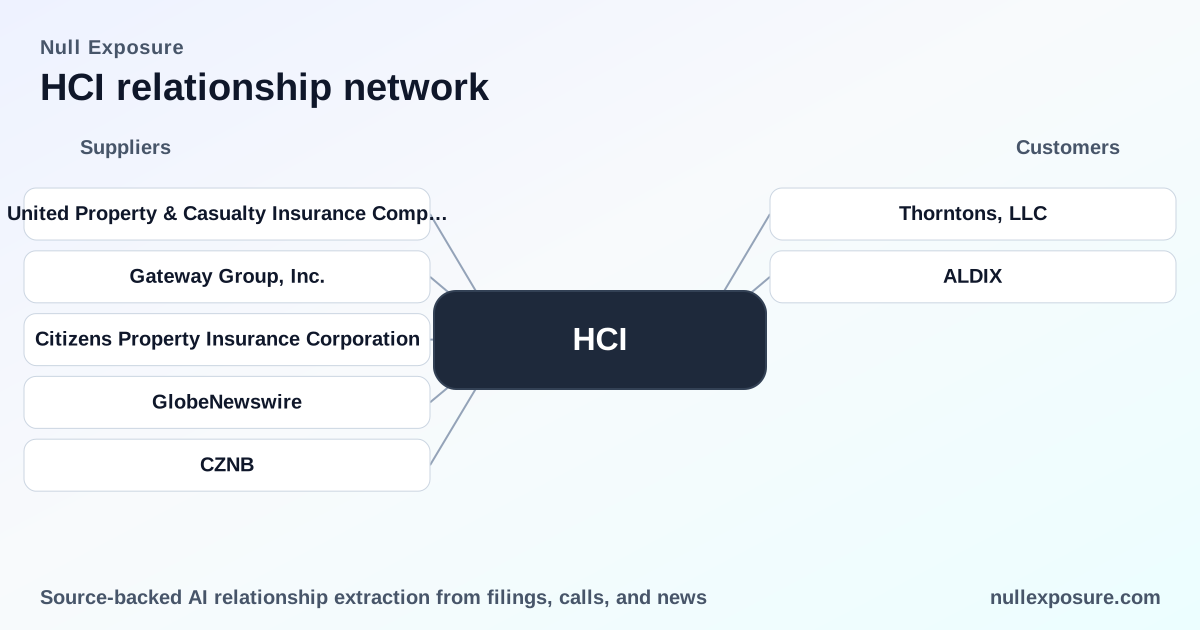
HCI Group: the supplier risk map investors need to read
HCI Group writes homeowners and related property insurance policies in Florida, monetizes through underwriting profit and investment income on a concentrated book of premium, and scales by assuming “take-out” blocks from state-backed Citizens and purchasing annual reinsurance protections that reset on a treaty year beginning June 1. The company earns margin from disciplined underwriting, fee-like ceding commissions on quota-share arrangements, and spread on large fixed-income and equity investments, while its operating leverage is driven by technology-enabled claims and policy administration. For more supplier and counterparty intelligence on insurers, visit https://nullexposure.com/.
What to watch first: operating model and how suppliers matter
HCI’s operating model is a hybrid of insurance carrier and platform operator. It is highly dependent on annual reinsurance buys, a small set of critical third‑party vendors for IT and claims services, and state programs (Citizens, FIGA, Florida Hurricane Catastrophe Fund) that influence capacity and pricing. Reinsurance costs and coverage levels are synchronized to its June 1 treaty year, creating an annual cliff that determines risk transfer economics for the full year. Long-term capital commitments exist (convertible notes, promissory notes, and real‑estate leases), but the company’s operational supplier relationships are predominantly annual or short-term renewals. If you track counterparty credit or contract renewal cycles, HCI’s June 1 reinsurance renewal is the single most material recurring supplier event.
Explore HCI supplier profiles and relationship data at https://nullexposure.com/ for deeper due diligence.
The relationship directory — every item in the record, explained
Below are the relationships captured in the source set; each entry is a plain-English summary with its source.
United Property & Casualty Insurance Company
HCI discloses that the insolvency and receivership of United Property & Casualty Insurance Company is a direct counterparty event that can adversely affect its financial results, because funds and reinsurance arrangements tied to United are implicated. (HCI 2024 Form 10-K, filed Feb 2026)
Gateway Group, Inc. — SahmCapital dividend notice
Press distribution of HCI investor contacts referenced a Gateway Group contact line in a dividend announcement, indicating Gateway Group is serving investor‑relations or PR distribution roles for HCI press releases. (SahmCapital, Jan 17, 2026)
Gateway Group, Inc. — GlobeNewswire dividend release
A GlobeNewswire release for HCI’s dividend listing the same Gateway investor contact confirms third‑party distribution firms are used for investor communications. (GlobeNewswire press release, Jan 16, 2026)
Gateway Group, Inc. — GlobeNewswire earnings‑call notice
GlobeNewswire again distributed HCI’s earnings‑call notice and listed Gateway contact details, reinforcing consistent use of that distributor for quarterly communications. (GlobeNewswire, Feb 4, 2026)
Gateway Group, Inc. — QuiverQuant conference call reference
A QuiverQuant entry referencing HCI’s conference call directs users to Gateway Group support lines for connection issues, further evidence of an ongoing vendor role in investor engagement. (QuiverQuant / HCI press release summary, Feb 2026)
Citizens Property Insurance Corporation (news coverage)
Multiple financial writeups describe HCI’s origin as a Florida “take‑out” insurer that assumed policies from state-backed Citizens and uses that source for opportunistic growth, a core distribution and portfolio-accumulation channel. (Finviz coverage and related articles, 2026)
GlobeNewswire (AI summary notice)
A QuiverQuant-cited disclaimer noted that one GlobeNewswire summary was AI‑generated, which is a disclosure about press distribution content provenance rather than a commercial counterparty to HCI’s operations. (QuiverQuant/GlobeNewswire disclaimer, 2026)
Citizens (ticker CZNB cited in analysis pieces)
Analyst pieces and bull‑case commentary reference Citizens (ticker CZNB in some scraped coverage) as the origin of blocks that HCI has periodically assumed, highlighting Citizens as a recurring supply source of policy inventory. (Finviz analysis pieces, 2026)
How constraints and signals define supplier posture
HCI’s supplier footprint shows coherent tradeoffs relevant to investors:
- Contracting posture: Reinsurance relationships are predominantly short‑term/annual with a treaty year effective June 1, exposing HCI to annual pricing and capacity resets; at the same time HCI holds longer-term leases and debt instruments (leases up to nine years, promissory notes and convertible notes through the 2030s), creating a mixed maturity profile.
- Concentration and geography: Supplier activity is highly concentrated in the U.S., specifically Florida, with a material operations node in Noida, India for IT (15,000 sq. ft. leased). This geographic split lowers some cost risk but concentrates regulatory and catastrophe exposure in a single hurricane‑prone jurisdiction.
- Criticality and materiality: Reinsurers and a set of third‑party service providers (claims adjusters, IT hosting, investment advisors, auditors) are material and critical; HCI reports large reinsurance recoverables and explicit risk that a reinsurer’s failure would be material to results.
- Maturity and spend profile: Operational vendor spend ranges from small (sub‑$100k transactional items) to meaningful investment and securities purchases (tens to hundreds of millions) that drive the company’s investment book; audit and advisory engagements sit in the low‑mid six‑figure range annually.
One relationship‑specific flag: HCI’s 10‑K explicitly calls out United Property & Casualty’s receivership as an event that affected trust accounts and recoverables, a supplier counterparty event with tangible prior impact.
Investment implications and actionables
- Risk focal point: Reinsurance renewal on or before June 1 should be a calendar priority for analysts — pricing or capacity deterioration there instantly changes HCI’s underwriting economics.
- Operational dependency: The company’s reliance on third‑party adjusters, IT hosting (Atlanta facility and cloud providers) and investment managers creates outsized operational risk relative to pure balance‑sheet insurers.
- Catalyst monitor: Watch communications distributed through Gateway Group/GlobeNewswire around earnings and dividend events for tone and disclosure changes; these vendors are the channel for material updates.
If you want ongoing surveillance on HCI counterparty shifts and supplier materiality, start with our supplier profiles at https://nullexposure.com/.
Bottom line
HCI runs a concentrated, reinsurance‑dependent operating model anchored in Florida policy flow from Citizens and an annual reinsurance cadence that creates a concrete renewal risk every June 1. Third‑party vendors are numerous and material for operations; United’s insolvency history illustrates that a single counterparty failure can have measurable balance-sheet consequences. For systematic monitoring and deeper supplier diligence, visit https://nullexposure.com/ and set alerts for treaty‑year renewals and reinsurer credit developments.