The Hackett Group (HCKT): strategic services, targeted AI bets, and what suppliers reveal about operating leverage
The Hackett Group is a global technology consulting and strategic advisory firm that monetizes through a mix of professional services, managed solutions, and alliances with software vendors. Revenue is primarily driven by client engagements and higher‑margin Oracle/technology practice work, complemented by strategic acquisitions to add capabilities (notably AI engineering). Investors should view Hackett as a services company with margin upside tied to platform and alliance scaling, balanced by operating leverage risks from third‑party infrastructure and cybersecurity exposures. For a deeper supplier and risk map, visit https://nullexposure.com/ for enterprise-grade supplier intelligence.
How Hackett’s business model translates into supplier risk and contracting posture
Hackett runs a services-led model with a clear mix of recurring and project revenue. Financials show $301M revenue TTM, EBITDA of $31.8M, and operating margin near 12%, reflecting typical consulting economics: high fixed-cost base in people and investment in delivery infrastructure, offset by scalable hours and licensing/partner revenue. The company funds growth and liquidity through a revolving credit facility sized up to $100M that matures in 2027, and it maintains operating leases for offices through 2029—signals of medium-term capital commitments and predictable overhead.
From the corporate disclosures and risk language, several company-level characteristics emerge as actionable signals for investors and operators evaluating supplier relationships:
- Contracting posture: a blend of long‑term financial commitments (credit facility, leases) and short‑term commercial engagements with service providers. The company discloses long‑term debt and operating leases alongside short‑term office leases.
- Concentration and spend profile: Hackett executes strategic M&A and share repurchases at scale (a $116M tender offer in 2022), yet individual supplier engagements often fall in the $100k–$10M bands, with some corporate expenditures and debt paydowns in the $10M–$100M range.
- Criticality and maturity: third‑party service providers are operationally critical—hosting, HR, communications, and security providers underpin delivery—and some vendor relationships are mature (e.g., long‑standing auditors since 2015).
- Geographic footprint: the company operates globally with delivery centers in APAC (Hyderabad, India) and LATAM (Montevideo, Uruguay) to optimize costs and build capabilities.
- Cybersecurity and regulatory risk: Hackett explicitly cites material risk from third‑party cybersecurity incidents and maintains a formal third‑party risk management program with contractual flow‑downs and assessments.
If you want a structured supplier risk scorecard for HCKT, start here: https://nullexposure.com/.
Supplier snapshot: the two relationships that shape near-term execution
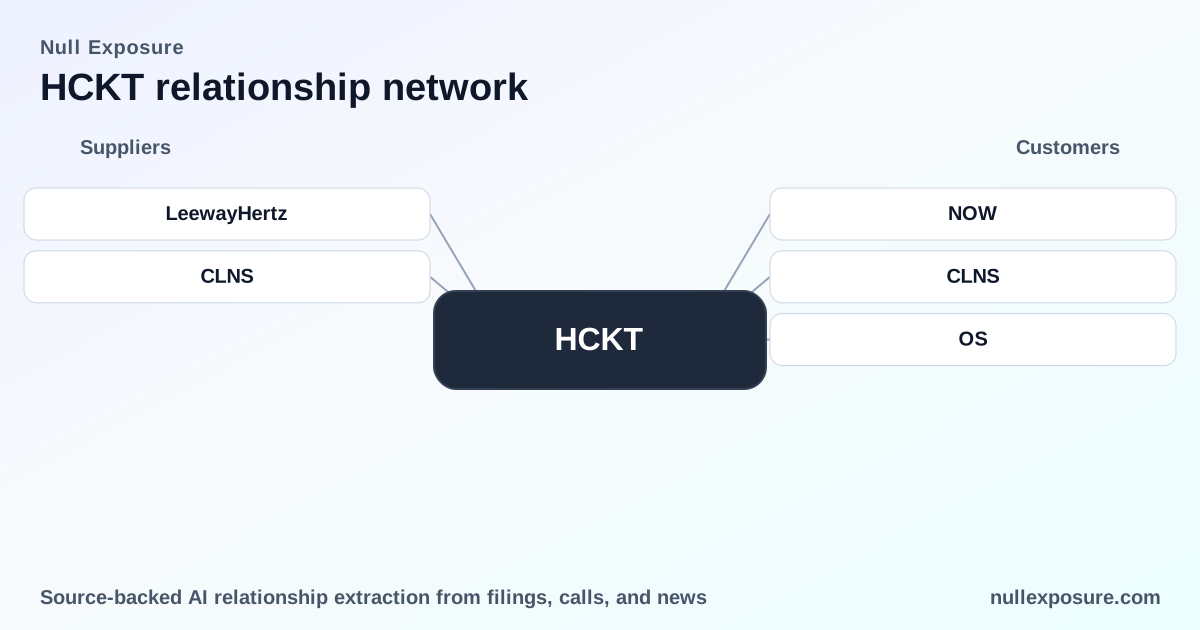
Hackett’s public disclosures and earnings calls highlight two supplier/partner relationships that are directly relevant to technology capability and service delivery.
LeewayHertz — an acquisition to accelerate GenAI engineering capabilities
Hackett acquired 100% of LeewayHertz Technologies (a Hyderabad‑based AI engineering firm) in September 2024 to add agentic design and GenAI build capabilities, and the company explained it as a capability play during its 2025 Q4 earnings commentary. According to the company filing and subsequent earnings remarks, Hackett paid a provisional purchase consideration of $7.8 million and granted RSUs to key employees as part of the integration. This is a small, strategic tuck‑in acquisition intended to expand Hackett’s AI delivery capacity and offshore engineering scale (Company 2024 Form 10‑K and 2025 Q4 earnings call).
Celonis — an alliance to deliver process intelligence to clients
Hackett launched an alliance with Celonis, a leader in process intelligence software, during 2025 Q3 to pair Hackett’s advisory services with Celonis’ operating‑insight platform. The partnership is presented as a complement to Hackett’s transformation and process optimization work, enabling clients to convert process telemetry into actionable improvement programs (2025 Q3 earnings call). This is positioned as a platform alliance rather than an equity investment, aimed at accelerating sales of higher‑value engagements.
What these relationships mean for investors and operators
The two relationships reflect different strategic levers: capability acquisition (LeewayHertz) and product alliance scaling (Celonis). Together they illustrate Hackett’s approach to growing addressable market and margins:
- Strategic scale without heavy capital outlay. The LeewayHertz deal ($7.8M provisional consideration) is opportunistic and capability‑focused, not a transformational balance‑sheet commitment. It provides incremental engineering capacity in APAC and reduces time-to-market for AI services.
- Revenue mix and margin lever. Alliances like Celonis increase the potential for higher‑margin, license‑adjacent engagements where Hackett sells advisory plus platform consumption—a path to lift operating margin if the firm captures attach rates on platform rollouts.
- Operational dependencies increase supplier criticality. Hackett’s reliance on cloud and infrastructure providers (HR, communications, financial systems) and offshore delivery centers raises cybersecurity and continuity risk, which the company identifies as potentially material.
- Spend and financial flexibility. Company cash flows support moderate repurchases and dividends, while the $100M credit facility and past $116M tender offer show balance‑sheet flexibility that can support opportunistic M&A or absorb one‑off supplier disruptions.
If you are vetting a supplier relationship or underwriting contract exposure to Hackett, prioritize cybersecurity due diligence, contractual flow‑downs, and clarity on scope for any alliance integrations. For vendor benchmarking and supplier discovery, see https://nullexposure.com/ to compare counterparties and contract terms.
How to act on this analysis
- For investors: watch attach rates for Celonis and utilization trends from the LeewayHertz engineering team as leading indicators for margin expansion; monitor the credit facility utilization and lease commitments for signs of capital strain.
- For procurement and operators: require explicit data protection flow‑downs and incident response SLAs in any engagement with Hackett given the company’s dependence on third‑party infrastructure.
- For partners and integrators: treat Hackett as a services anchor for process modernization deals—alliances can scale revenue if go‑to‑market and delivery models are tightly coupled.
Learn more about supplier footprints and risk ratings at https://nullexposure.com/ — the quickest way to turn disclosure language into operational decisions.
Final takeaway: Hackett is a services firm carefully augmenting its delivery mix via targeted acquisitions and platform alliances. That strategy improves market relevance and margin optionality but increases supplier criticality and cyber exposure—issues that both investors and counterparties should prioritize in underwriting relationships.