HCW Biologics (HCWB): supplier relationships and what they mean for investors
HCW Biologics is a small-cap biotechnology company developing immunotherapies and vaccine technologies. It monetizes by advancing clinical-stage biologics through partnerships, licensing arrangements, and public equity financings—relying on third-party manufacturers and placement agents to secure clinical supply and working capital. Revenue today is negligible relative to operating losses, and the company consistently uses placement-agent-led at‑the‑market financings and third‑party manufacturing relationships to sustain operations and progress clinical programs.
If you evaluate supplier risk or counterparty exposure for HCWB, start with how those funding and manufacturing arrangements shape runway and clinical timelines. For quick access to a supplier-risk view and ongoing monitoring, visit the NullExposure homepage: https://nullexposure.com/.
How HCWB’s contracting posture shapes the business
HCW Biologics runs a hybrid contracting model: short-duration operational agreements coexist with a small set of long-term commitments. The company carries short-term leases and numerous one-year service arrangements for clinical sites and contractors, while also relying on long-dated financing (a secured property loan) and stock‑based incentive plans that tie key people to the business long-term. This posture delivers flexibility for an early-stage biotech but concentrates operational risk in a few critical third parties.
- Manufacturing is highly concentrated and operationally critical. The company depends on a small number of contract manufacturers for cGMP production; loss or failure of a manufacturer would materially delay clinical programs and commercialization. The constraints emphasize potential delivery and capacity risks across global supply chains.
- Funding is execution‑driven and placement-agent dependent. HCWB repeatedly uses placement-agency agreements to raise cash via at‑the‑market offerings, indicating an ongoing need to monetize equity as milestones and expenses arise.
- Legal and construction spend creates lumpy, material obligations. The company disclosed multi-million dollar legal and construction liabilities that are non-trivial relative to its market capitalization and cash generation.
Collectively, these signals describe a firm with high operational leverage, concentrated supplier risk, and financing-dependent runway—a profile familiar to early-stage clinical biotechs but one that requires active counterparty monitoring.
The explicit supplier relationships investors should know
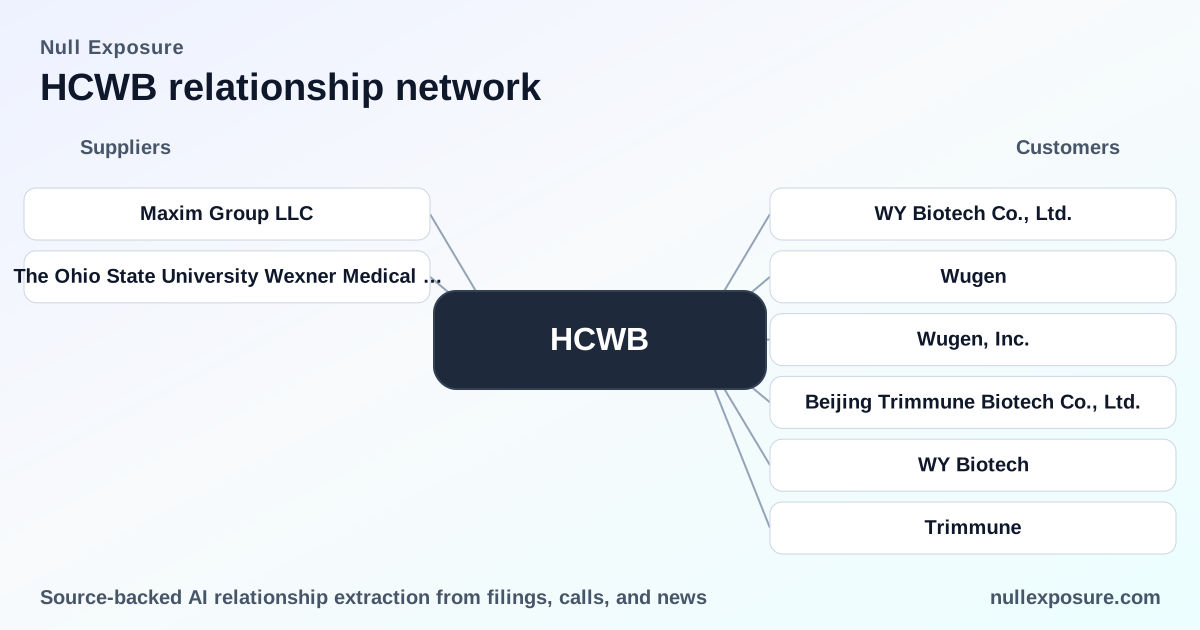
Below are every supplier/service relationship captured in the public reporting results for HCWB. Each entry is a concise, plain-English summary with the public source.
-
Maxim Group LLC — acting as sole placement agent for a $5.0 million at‑the‑market offering priced in mid‑May 2025; Maxim handled placement logistics and fees for that financing. According to a GlobeNewswire press release dated May 14, 2025, Maxim Group LLC served as the sole placement agent for the offering.
Source: GlobeNewswire press release (May 14, 2025). -
Maxim Group LLC — acting as sole placement agent for a $1.5 million at‑the‑market offering priced in February 2026; this is a repeat engagement that signals continued reliance on the same placement channel for near‑term liquidity. A GlobeNewswire press release dated February 18, 2026 reports Maxim as the sole placement agent for the offering.
Source: GlobeNewswire press release (Feb 18, 2026). -
Maxim Group LLC — retained as exclusive financial advisor for a $4.0 million warrant inducement transaction announced in November 2025; the firm advised on structuring and execution of the capital transaction. HCWB disclosed Maxim Group LLC as the exclusive financial advisor in a GlobeNewswire release dated November 19, 2025.
Source: GlobeNewswire press release (Nov 19, 2025). -
The Ohio State University Wexner Medical Center — served as the lead/first clinical site to dose the first patient in HCW9302 Phase 1 company‑sponsored trial for alopecia areata; this indicates active clinical implementation and site engagement. A QuiverQuant news item (reported in March 2026) noted the first patient dosing at The Ohio State University Wexner Medical Center for HCW9302’s first‑in‑human study.
Source: QuiverQuant news (March 2026).
How these relationships connect to risk and runway
HCWB’s public filings and press releases create a consistent narrative: capital markets activity and third‑party manufacturing are the twin operational levers. The repeated use of Maxim Group as placement agent across multiple financings and advisory mandates signals that the company relies on equity issuance for near-term funding rather than internal cash flow. Financials show negative EBITDA and modest revenue (Revenue TTM ~$0.83M, Market Cap ~$5.4M), and material legal and construction obligations that amplify funding needs.
Manufacturing and supply constraints are the operational choke points. The company lists a long-standing relationship with a contract manufacturer (EirGenix) and flags a separate supply dependency requiring a supply agreement with ImmunityBio for a key program—loss of manufacturing capacity or delayed supply agreements would materially impair clinical timelines. The reporting also highlights both short-term leases and short‑duration vendor contracts that favor flexibility but create renewal risk.
Key investor takeaways:
- Funding concentration: repeated placement-agent financings indicate ongoing dilution risk and dependency on Maxim Group for execution of equity raises.
- Supplier concentration: reliance on a small number of contract manufacturers and unresolved supply agreements for specific programs create a single‑point failure risk for clinical progress.
- Material cost drivers: litigation, construction, and contract manufacturing are material expense buckets—any escalation tightens runway.
If you want a consolidated, continually updated view that maps these supplier dependencies against financial exposure, explore our monitoring hub: https://nullexposure.com/.
What to watch next — operational indicators that move value
Operators and investors should track a short list of binary and timing events that will change HCWB’s trajectory:
- Finalization and terms of the supply agreement for HCW9218 (ImmunityBio‑related disclosure): availability and duration of supply are pivotal for that program’s development.
- Upcoming capital raises via Maxim Group and the gross proceeds and fees realized—these determine runway and dilution. GlobeNewswire filings around each financing will be the primary signal.
- Clinical readouts and enrollment progress at The Ohio State University and other sites for HCW9302; first‑in‑human dosing is important but the pace of subsequent cohorts and safety signals will determine next funding needs.
- Manufacturing qualifications and any FDA/EMA inspection outcomes for third‑party manufacturers; cGMP compliance and capacity expansions are critical path items.
Bottom line and recommended actions
HCW Biologics runs a capital‑intensive, partner‑dependent model: small revenue, material cash burn, concentrated manufacturing and financing partners. For investors and procurement teams, the priority is active surveillance of supply agreements and placement-agent activity because those levers will decide whether programs advance on schedule or stall.
For ongoing supplier-risk intelligence, portfolio monitoring, and alerts tied to HCW Biologics’ counterparties and financings, visit NullExposure: https://nullexposure.com/.