Healthy Choice Wellness (HCWC): Supplier relationships that shape margin and operational risk
Healthy Choice Wellness operates a chain of natural-foods grocery stores and monetizes primarily through retail sales of packaged foods, produce and supplements, augmented by targeted acquisitions and distribution partnerships that lower logistics cost and expand assortment. The company drives revenue through same-store sales and acquired-store rollups, while relying on third‑party distributors and transitional service arrangements to scale operations with limited corporate overhead. HCWC reported $79.15 million in trailing revenue and $31.45 million in gross profit, but negative EPS and a small market capitalization ($5.3M) mean supplier arrangements strongly dictate near-term liquidity and margin outcomes. For a concise supplier exposure read, visit https://nullexposure.com/.
Why suppliers determine HCWC’s near-term performance
HCWC sources from roughly 1,000 suppliers and offers over 4,000 brands, creating a mixed supplier base that includes small independent producers and very large distributors. That supplier mix gives HCWC access to differentiated product assortments while concentrating risk in a handful of partners that handle volume and distribution.
- Concentration matters: HCWC purchased approximately 70–75% of goods from its top 20 suppliers in 2024 and 2023, and a single distributor has historically accounted for a very large share of purchases.
- Contract posture is mixed: the company runs both short-term transitional agreements and multi-year distribution contracts and leases, creating a layered risk profile where operational continuity depends on successful transition from parent-provided services to owned infrastructure.
- Operational criticality and cybersecurity are top-tier risks: third‑party vendors have privileged access to HCWC data and logistics, elevating vendor cyber risk into a meaningful operational consideration.
Key operating constraints that affect supplier relationships
HCWC’s public filings reveal a set of operating-model signals that frame how supplier relationships are negotiated and executed:
- Short-term contracting for transitional services: multiple excerpts describe Transition Services Agreements (TSA) and commitments “for a period of up to one year following the spin-off,” which signals a near-term reliance on third‑party/parent services while HCWC builds standalone capabilities.
- Long-term distribution and lease commitments: HCWC carries operating leases with weighted-average remaining terms measured in years and a distribution agreement that has an initial term to 2027, signaling multi-year fixed-cost commitments alongside short-term operational contracts.
- Usage-based obligations: variable lease payments and other usage-based expenses are recognized as incurred, so some cost lines scale with activity rather than remain fixed.
- Supplier breadth: sourcing from ~1,000 suppliers and a mix of small and very large vendors reduces single-supplier pricing power but retains concentration in top suppliers.
- Financial concentration and liquidity: the company holds cash in excess of FDIC limits at a single large bank and has material lease liabilities totaling in the tens of millions, creating cash-concentration and lease‑obligation considerations for treasury and vendor payment strategies.
- Cybersecurity criticality: filings frame vendor access to systems as a top operational vulnerability and identify third parties as integral to supply-chain and IT security posture.
Relationship inventory — who HCWC counts on (complete)
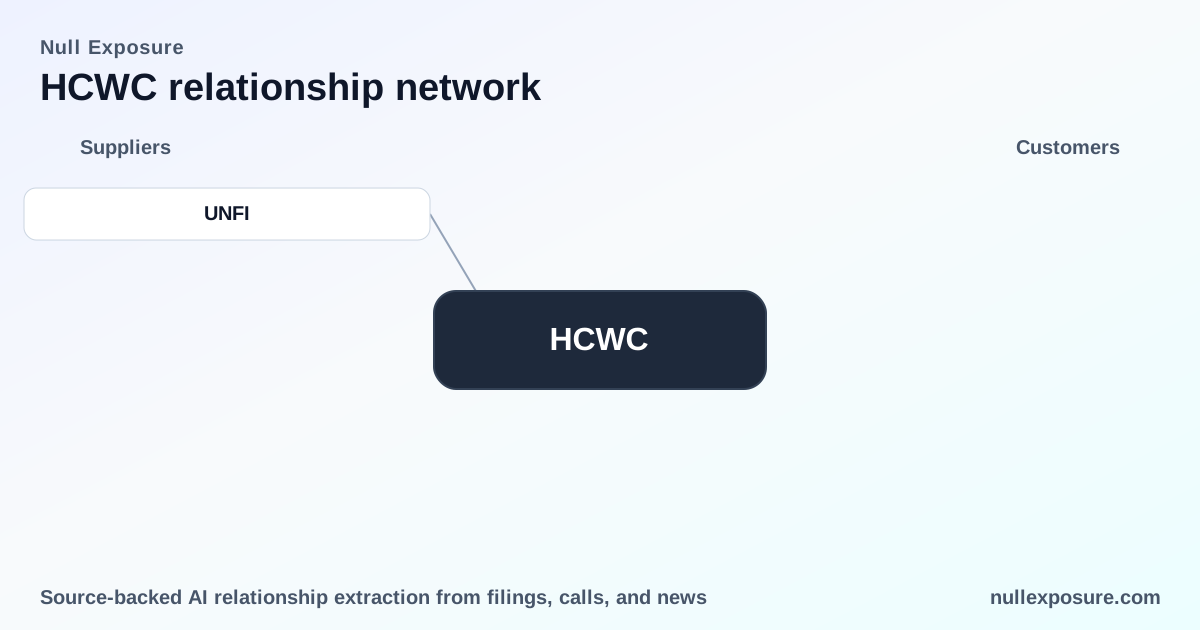
HCWC’s filings identify one explicitly named supplier/distributor relationship in the publicly available supplier disclosure set: UNFI.
UNFI
UNFI is HCWC’s primary distributor for dry grocery and frozen food products, and HCWC’s customer distribution agreement with UNFI commenced September 1, 2022, with an initial term through September 1, 2027; in FY2024 UNFI supplied roughly 25% of HCWC’s purchases (down from 41% in FY2023), making UNFI a material and contractually committed distributor for the business. According to HCWC’s FY2024 Form 10‑K, approximately 25% and 41% of total purchases were from UNFI for the years ended December 31, 2024 and 2023, respectively, and the distribution agreement has an initial term through September 1, 2027 (FY2024 10‑K).
How the UNFI relationship changes the risk-return calculus
The UNFI relationship is both a growth enabler and a concentration risk:
- Material supplier role: UNFI accounted for a material share of purchases in consecutive years, which supports scale economics and consistent store replenishment. The FY2024 filing quantifies that share at 25% of purchases in 2024.
- Contracted distribution through 2027: a fixed-term distribution agreement provides operational stability and predictability of logistics capacity, but it also creates a renewal cliff that investors should monitor as the 2027 expiration approaches.
- Distributor vs. manufacturer roles: HCWC functions as the buyer and retailer, while UNFI functions as a distributor; this reduces HCWC’s merchandising exposure but increases reliance on UNFI’s warehousing and fulfillment execution.
Operational and financial implications investors should track
HCWC’s supplier posture produces a set of clear, monitorable implications for investors evaluating the company’s supplier strategy and counterparty exposure:
- Watch the UNFI renewal and renegotiation cycle: the initial term through 2027 is a clear milestone that will determine distribution economics and potential costs of switching or diversifying distribution partners.
- Monitor supplier concentration metrics: even as UNFI’s share declined from 41% to 25% year-over-year, the top-20 supplier concentration (70–75% of purchases) keeps supplier risk elevated and gives top suppliers leverage over terms and promotions.
- Assess TSA wind‑down and internal capability build: short‑term TSAs indicate a transitional dependency on parent or third‑party services; successful internalization of IT, HR and payroll functions will reduce recurring service fees charged under TSA arrangements.
- Cybersecurity and third‑party access are operational risks: HCWC explicitly flags vendor access to systems as a major vulnerability; vendor due diligence and SOC reporting will be a continual governance priority.
- Lease and financing commitments: substantial operating lease liabilities and a $7.5M credit facility (of which a portion funded an acquisition) create fixed-cost pressure that intersects with supplier payment cycles.
If you want a consolidated supplier risk profile, start here: https://nullexposure.com/.
What to watch over the next 12–24 months (investor checklist)
- Track renegotiation activity with UNFI ahead of 2027 and any announced diversification to reduce single-distributor exposure.
- Monitor progress on TSA transitions and the timing of HCWC’s independent payroll and IT services to quantify recurring cost reductions.
- Review quarterly disclosures for vendor concentrations and accounts payable composition; shifts in top-supplier shares will materially affect gross margins.
- Evaluate cybersecurity investments and third‑party SOC attestations as part of operational due diligence; breaches or vendor outages would have outsized effects given HCWC’s vendor access profile.
For an investor-ready supplier risk brief and continuous monitoring of HCWC relationships, visit https://nullexposure.com/.
Final assessment
HCWC runs a hybrid supplier model that balances assortment breadth against concentration risk. The UNFI distribution agreement gives HCWC operational scale and logistics capability but creates a material counterparty dependency with a renewal cliff in 2027. Short-term transitional services, long-term leases and concentrated purchases mean HCWC’s margin and liquidity outlook are tightly linked to successful vendor management, timely TSA wind-down and careful renegotiation of major contracts. Investors should prioritize monitoring of UNFI contract status, supplier concentration metrics and vendor-related cybersecurity controls as primary drivers of downside risk and upside operational leverage.
Take action: if you are evaluating HCWC supplier exposure or preparing a diligence memo, begin at https://nullexposure.com/ for a structured supplier-read on HCWC and comparable retail supplier footprints.