Hercules Capital (HCXY): Supplier relationships, credit signals, and what investors should price
Hercules Capital operates as a publicly traded business development company that provides customized debt and equity financing to growth-stage life sciences and technology companies, monetizing through interest income, equity upside on warrants or convertible instruments, and dividends returned to shareholders. For investors and procurement operators assessing counterparty risk and supplier posture, Hercules’ filings and public notices reveal a capital structure centered on long-dated funding commitments, strategic liquidity arrangements, and outsourced third‑party service relationships — all of which influence credit optionality and operational resilience.
Explore supplier-relationship intelligence and counterparty signals at Null Exposure.
Why the recent rating affirmation matters for counterparties and creditors
A March 2026 news release reported that Morningstar DBRS affirmed Hercules’ investment-grade corporate and credit rating at BBB (high). This affirmation signals that rating agencies view Hercules’ credit and corporate profile as consistent with an investment-grade borrower, which directly affects Hercules’ cost of capital and the pricing of letters of credit, debentures, and large financing facilities. A March 10, 2026 posting on AIJournal covered the DBRS announcement: https://aijourn.com/hercules-capital-receives-a-bbb-high-affirmed-investment-grade-corporate-and-credit-rating-from-morningstar-dbrs/.
Key takeaway: the DBRS affirmation reduces headline credit volatility for counterparties and supports access to institutional liquidity channels.
Relationships disclosed in public results
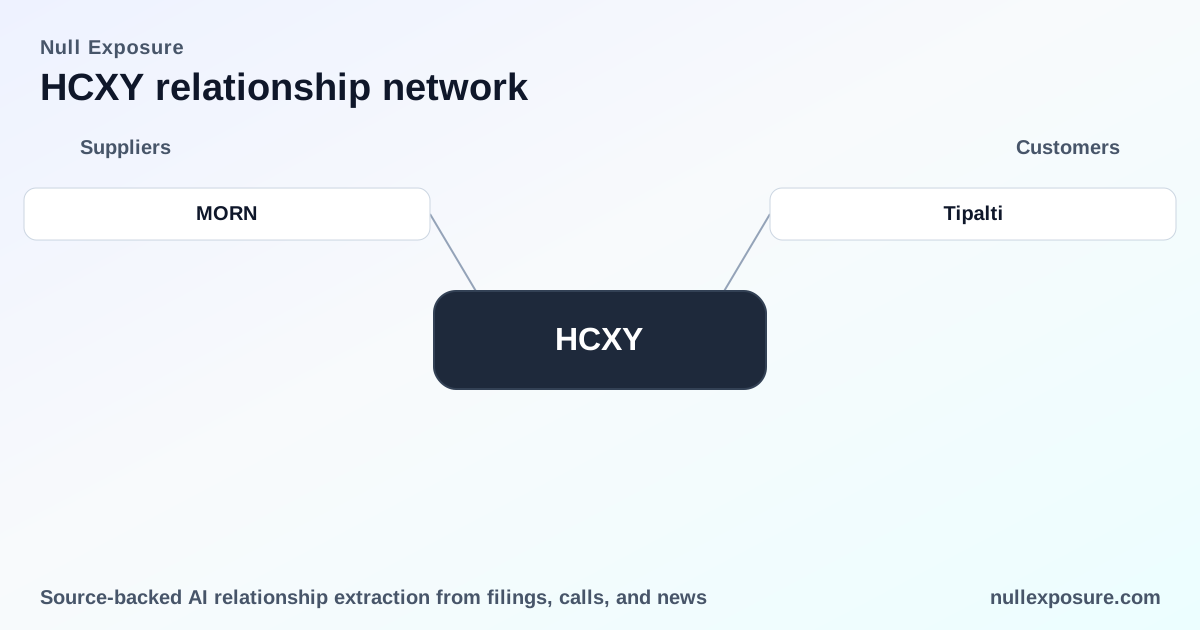
- Morningstar DBRS — A news release on March 10, 2026 reported that Morningstar DBRS affirmed Hercules’ corporate and credit rating at BBB (high), reinforcing the company’s investment-grade standing and influencing counterparty pricing and covenant negotiation leverage. (Source: AIJournal coverage of the DBRS announcement, FY2026.)
This item constitutes the complete set of supplier-scope relationships surfaced in the provided results.
What Hercules’ contractual posture and procurement signals reveal
Hercules’ public excerpts and constraint evidence describe several company-level signals that are material to suppliers, treasury desks, and risk teams:
- Long-term funding profile: Hercules issues SBIC debentures guaranteed by the SBA with ten‑year maturities (examples referenced through maturities in 2031, 2032 and 2035), and it holds a letter of credit facility with Sumitomo Mitsui Banking Corporation that was amended to a final maturity date of February 5, 2028 and a commitment amount of $175.0 million with an accordion to $400.0 million. These are company-level contract features that establish a long-dated funding base and durable liquidity commitments.
- Buyer behavior in capital markets: The company operates a distribution reinvestment plan (DRIP) and can purchase shares in the open market or issue new shares to satisfy reinvestment, indicating an active role as a share buyer under specified program rules.
- Dependency on outsourced expertise: Hercules engages external cybersecurity assessors, consultants, auditors, and other service providers — an explicit signal that critical operational controls and vendor management functions rely on third parties.
- Material counterparty exposure: The scale of the SMBC letter of credit facility (initially $175M with conditional expansion) and the use of SBIC debentures imply material credit lines and contingent obligations that influence liquidity planning and counterparty concentration.
These company-level constraints translate directly into operating-model characteristics: a contracting posture skewed to long‑term, concentrated credit relationships; a reliance on third‑party service providers for critical functions; and a maturity profile that aligns asset cash flows with extended liability tenors.
For procurement and operations teams, those signals mean supplier negotiations should factor in Hercules’ liquidity cadence and long-dated obligations, and legal teams should expect covenant language aligned to investment‑grade financing.
Explore more relationship intelligence and supplier risk context at Null Exposure.
Operational and investment implications
- Liquidity and capital costs: The combination of SBIC debentures and a large letter of credit facility demonstrates that Hercules structures financing with a bias toward multi‑year commitments, which supports stable funding but also requires disciplined asset/liability matching. Investors should price the company’s dividend yield (4.89% per latest overview) and its trailing P/E (19.54) against the cost and tenor of those liabilities.
- Counterparty risk and concentration: The SMBC facility’s size and accordion feature point to single‑counterparty exposure that is material to liquidity planning; vendor-risk teams should treat major bank facilities and SBA‑guaranteed instruments as critical relationships for operational continuity.
- Operational resilience: Use of external cybersecurity assessors and other service providers signals structured governance of outsourced risk, but it also makes vendor management and third‑party contracts a focal point for operational due diligence.
- Balance of stability vs. growth: Hercules is an income‑oriented vehicle with an investment mandate tilted to higher‑growth sectors; its business model is growth-supportive financing rather than short-term trading, so counterparties should align contract tenors and performance metrics with that strategic posture.
Major risk factors for counterparties include concentrated bank facility exposure, long-dated contingent obligations, and vendor dependence for specialized controls. Major upside is the investment-grade rating affirmation that supports pricing advantage in capital markets.
Recommended actions for investors and operators
- For credit and procurement teams: review clauses tied to the SMBC LC Facility and SBA-guaranteed debentures for change-of-control, collateral, and covenant triggers; structure service-level agreements to reflect long-term funding horizons.
- For treasury and investors: monitor DBRS commentary and any future rating changes, as rating drift will affect Hercules’ cost of letters of credit and its access to accordion capacity.
- For vendor-management: prioritize cybersecurity and auditor-service continuity, since Hercules explicitly outsources those functions and operational interruptions could have outsized indirect effects on portfolio performance.
If you want a targeted report on HCXY counterparty posture, covenant footprints, and supplier concentration maps, get tailored intelligence at Null Exposure.
Bottom line
Hercules Capital runs a financing platform built on long-term funding instruments, a meaningful bank credit relationship, and outsourced operational controls. The Morningstar DBRS affirmation at BBB (high) is a positive credit signal that lowers headline financing risk for counterparties today, while the company’s structural reliance on large credit lines and third-party service providers creates operational and concentration risks that prudent counterparties must manage. For investors and operators, the right questions are about maturities, covenant detail, and vendor continuity — not headline yield alone.
Start a deeper supplier-risk review or schedule a briefing through Null Exposure.