Super Hi International (HDL): How underwriting ties and supplier posture shape investor risk
Super Hi International (NASDAQ: HDL) operates as a strategic investment firm that monetizes through a diversified holding model across digital and traditional business platforms, with notable exposure to the restaurants industry. The company generates revenue from operating subsidiaries and portfolio companies, preserves cashflow through operating margins, and accesses capital markets for growth via public offerings; capital partners and underwriting relationships therefore are directly relevant to liquidity, valuation, and execution risk for investors. For background research and relationship intelligence, visit https://nullexposure.com/ for ongoing coverage and supplier-level context.
Snapshot: financial posture and what matters to counterparties
Super Hi presents as a mid-cap listed vehicle with meaningful scale and institutional ownership. Key operating signals for counterparties and procurement teams:
- Market capitalization roughly $926 million and trailing revenue of $820.9 million (TTM), indicating a material public-market footprint.
- EBITDA of $87.8 million and a trailing profit margin of 2.5%, suggesting modest operating leverage across diversified holdings.
- Institutional ownership ~81.6%, a high concentration of professional investors that increases market discipline on governance and disclosure.
- Sector exposure: Consumer cyclical / Restaurants, which implies revenue sensitivity to discretionary spending cycles.
These metrics inform contracting posture and bargaining power: Super Hi has the scale to command market terms, yet thin operating margins increase the strategic value of low-cost capital and reputable underwriting partners. For primary-source company materials and deeper supplier risk analytics, see https://nullexposure.com/.
The underwriting relationships you need on your radar
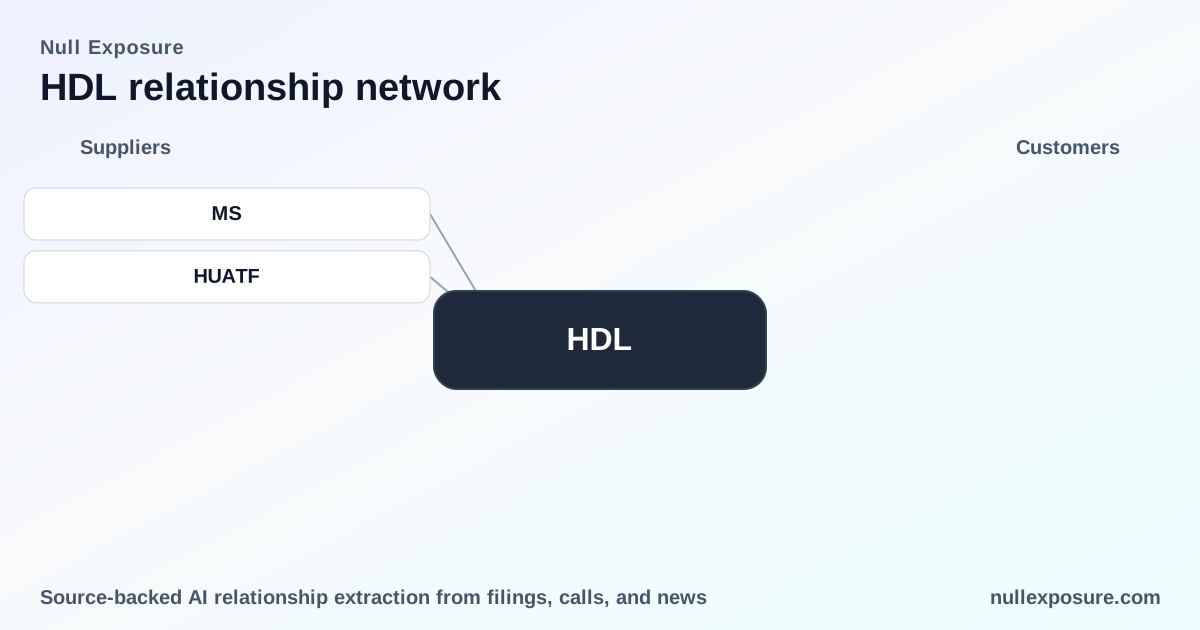
A recent market report identifies two investment banks involved in Super Hi’s U.S. offering. Both relationships are capital-markets service engagements rather than ongoing operational suppliers, but they carry direct implications for valuation, timing, and reputational risk.
Morgan Stanley
Morgan Stanley is named as an underwriter for Super Hi’s U.S. offering. This placement signals access to top-tier institutional distribution and potential pricing credibility for the transaction (Business Times, March 10, 2026: https://www.businesstimes.com.sg/international/global/spotlight-1/haidilao-restaurant-operator-super-hi-targets-us-1-38-billion-valuation-us-ipo).
Huatai Securities
Huatai Securities is also listed as an underwriter for the same offering, indicating cross-border capital support and regional distribution capability that complements the international placement strategy (Business Times, March 10, 2026: https://www.businesstimes.com.sg/international/global/spotlight-1/haidilao-restaurant-operator-super-hi-targets-us-1-38-billion-valuation-us-ipo).
Both relationship entries in public reporting are brief and focused on the underwriting role; they are critical for transaction execution but do not, in isolation, reveal long-term supplier dependencies.
For more supplier-level signals and to track relationship evolution, consult https://nullexposure.com/.
What the underwriting choices reveal about Super Hi’s operating model
Underwriter selection is a window into strategic priorities and contracting posture. From the available disclosures and company financials, draw these company-level signals (these are not assigned to any specific supplier unless explicitly named):
- Contracting posture: transactional and market-driven. Engaging established underwriters suggests the company negotiates from a position that values distribution reach and execution reliability over bespoke, long-term supplier lock-ins.
- Concentration: engagement is event-focused. Underwriting relationships are episodic for capital raises; ongoing supplier concentration risk is not evidenced by the underwriting notices alone.
- Criticality: high for capital events, low for everyday operations. Underwriters are critical for IPO/liquidity outcomes; their role does not substitute for operational suppliers such as logistics, foodservice inputs, or technology partners.
- Maturity: professionalized capital access consistent with institutional ownership. The roster of investment banks and reported market metrics indicate a company operating with market-standard sophistication in capital markets.
No supplier constraints are recorded in the publicly surfaced relationship data for HDL, which is itself a company-level signal: the public record contains limited granular contractual disclosure about supplier terms, increasing the importance of investor diligence around vendor concentration and contingent liabilities.
Operational and investor implications
For CFOs, procurement heads, and investors evaluating supplier and partner exposure, the underwriting relationships and company signals drive a few practical conclusions:
- Liquidity and valuation hinge on execution of capital events. Well-regarded underwriters reduce execution risk and support pricing, which is material for a firm that uses equity markets to scale holdings.
- Operational counterparties still require independent review. Underwriter names do not replace vendor due diligence for high-frequency operational suppliers in restaurants and technology platforms.
- High institutional ownership accelerates governance scrutiny. Investors should expect heightened demands for disclosure around supplier concentration and contractual terms given the governance profile.
Actionable step: map capital-market service providers separately from operational suppliers when modeling counterparty risk and stress scenarios.
Risk checklist for supplier relationship monitoring
To translate these insights into a monitoring program, prioritize:
- Verification of counterparty roles (e.g., underwriting vs. advisory) and the scope and fees tied to each transaction.
- Assessment of vendor concentration for revenue-critical inputs in the restaurants portfolio.
- Tracking of reputational and execution risk tied to capital partners during listing or refinancing events.
- Regular review of public filings and press coverage for updates on partner engagements.
These monitoring items align with the company-level signals noted above—particularly the lack of granular supplier constraints in disclosed materials.
Bottom line and recommended next steps
Super Hi’s engagement with Morgan Stanley and Huatai Securities for its U.S. offering is a clear, transactional signal of access to institutional capital and regional distribution capacity. Investors and operators should treat underwriting relationships as strategically important for liquidity events but not as proxies for operational vendor health. Prioritize direct vendor diligence for day-to-day suppliers while maintaining active monitoring of capital-market partners during financing cycles.
For ongoing supplier intelligence, due-diligence tools, and relationship tracking tailored to investors and operators, visit https://nullexposure.com/. For immediate briefing requests or customized supplier risk reports, consult the resources at https://nullexposure.com/ and integrate these relationship signals into your counterparty risk framework before the next capital event.