Hudson Technologies (HDSN): Supplier relationships, strategic posture, and what investors should price in
Hudson Technologies operates and monetizes a blended refrigerant business: it buys virgin refrigerants, reclaims and repackages used refrigerants, and sells both products and reclamation services to contractors and distributors across North America. The company expands distribution and field access through targeted acquisitions while funding operations with an asset‑backed credit facility and selective leases; investors should value Hudson as a cyclical specialty‑chemicals distributor with service margins and balance‑sheet sensitivity to refrigerant supply cycles. Learn more about supplier exposure and competitive positioning at https://nullexposure.com/.
How Hudson makes money and why supplier relationships matter
Hudson’s core revenue stream is the resale of virgin HFC/HFO refrigerants and the sale of reclaimed refrigerants processed in its proprietary reclamation systems. Revenue is therefore driven by three levers: volumes recovered in the field, access to contractor networks that return used refrigerant, and the company’s ability to source new product from upstream manufacturers and brokers. Financial context underpins this model: FY‑TTM revenue roughly $246.6M, market capitalization about $253M, and an EV/EBITDA multiple near 8.3 — consistent with a mid‑cycle distributor where working capital and inventory sourcing determine near‑term profitability.
The firm operates with a mixed contracting posture: material long‑term commitments (leases up to 11 years and multi‑year credit arrangements) alongside short‑term leases when flexibility is advantageous. Hudson relies on a $75 million asset‑based Wells Fargo facility to manage inventory and acquisitions, and management uses targeted M&A and selective capital spend to scale field reach. These structural choices make supplier access and distribution relationships central to operating leverage.
More detail on supplier exposure and counterparties is available at https://nullexposure.com/.
Strategic acquisition: Refrigerants Inc. expands field reach
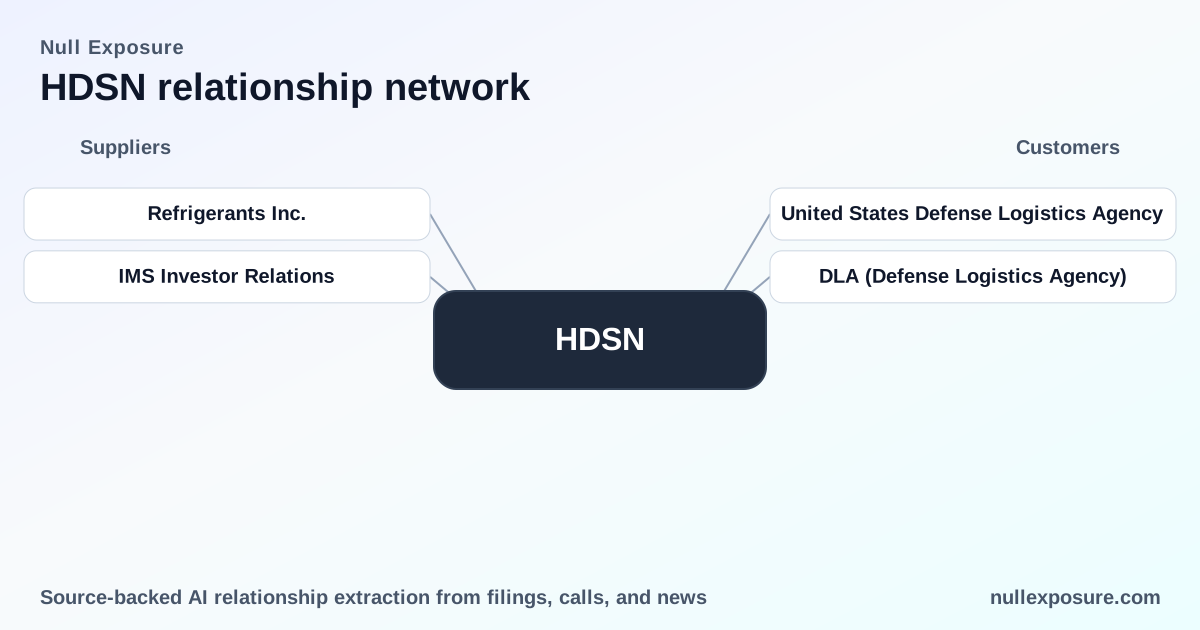
Hudson announced an acquisition of Refrigerants Inc., a longtime partner, to deepen contractor access and recovered‑refrigerant volume. The transaction is presented as accretive and is designed to broaden Hudson’s network of field technicians who recover and return aftermarket refrigerant. (See Hudson press release on GlobeNewswire, Dec 17, 2025: https://www.globenewswire.com/news-release/2025/12/17/3207309/0/en/Hudson-Technologies-Announces-Accretive-Acquisition-of-Refrigerants-Inc.html; industry coverage at ACHR News and CityBiz also reported the deal.)
- According to GlobeNewswire (Dec 17, 2025), Refrigerants Inc. brings a “large and longstanding customer base of contractors” that improves Hudson’s access to recovered refrigerant.
- Industry press at ACHR News covered the same operational rationale, highlighting the partner‑to‑owner transition and expected volume gains (ACHR News article: https://www.achrnews.com/articles/165658-refrigerant-firm-hudson-acquires-longtime-partner).
- CityBiz provided local business context for the acquisition and its role in expanding field technician reach (CityBiz report: https://www.citybiz.co/article/785990/hudson-technologies-acquires-refrigerants/).
This acquisition raises Hudson’s distribution density and recovery capability, directly supporting margin improvement in reclaimed product sales.
Investor communications partner: IMS Investor Relations
Hudson uses IMS Investor Relations as its external investor‑relations contact for earnings and conference calls. Recent disclosures list IMS contact details for the fourth‑quarter and full‑year 2025 results. (See GlobeNewswire conference‑call notice, Feb 18, 2026: https://www.globenewswire.com/news-release/2026/02/18/3240226/0/en/Hudson-Technologies-to-Host-Conference-Call-to-Discuss-Fourth-Quarter-and-Full-Year-2025-Results.html; and notice reposted by Sahm Capital: https://www.sahmcapital.com/news/content/hudson-technologies-to-host-conference-call-to-discuss-fourth-quarter-and-full-year-2025-results-2026-02-18.)
- The company’s use of a professional IR firm shows a standardized external communications posture, helping maintain analyst and institutional coverage during periods of operational change.
Constraints and company‑level signals that shape supplier risk
Several disclosed constraints are material to underwriting Hudson’s supplier and operational risk profile:
- Capital structure and financing framework: Hudson operates under an Amended Wells Fargo asset‑based facility with a $75 million capacity and defined covenants, including a minimum liquidity covenant. The credit package includes a FILO tranche and revolving borrowing base tied to receivables and inventory, establishing a framework lending relationship that directly links supplier inventory and working capital to liquidity availability.
- Mix of contract terms: Hudson carries long‑term lease liabilities and multi‑year equipment/real‑estate commitments, but also uses short‑term leases where flexibility preserves optionality. This mix signals deliberate tradeoffs between fixed capacity for reclamation and nimbleness in a volatile commodity environment.
- Geographic concentration: Operations and regulatory exposure are concentrated in North America, which focuses regulatory and demand risk but reduces complexity from global logistics.
- Materiality and criticality of supplies: Hudson states that failure to source virgin or used refrigerants would have a material adverse effect on margins. The business is critically dependent on access to both new and reclaimed refrigerant inventories and on contractor networks that return product.
- Spend and transaction scale: Financing and transactional evidence—the use of an $85 million term loan in prior facilities, acquisitions priced in the low‑tens of millions, and capital expenditures tied to ERP implementations—position Hudson’s spend profile predominantly in the $10M–$100M band, with smaller tactical outlays below $1M for letters of credit and local site expenses.
These signals combine to portray Hudson as a distribution and services operator with material working‑capital sensitivity, significant financing covenants, and targeted M&A as its growth lever.
What investors and operators should monitor next
Monitor the following to assess supplier risk and upside capture:
- Inventory turns and availability under the Wells Fargo facility, because borrowing base rules will determine Hudson’s purchasing power for virgin refrigerant during seasonal peaks.
- Post‑acquisition integration of Refrigerants Inc.: recovery volumes and contractor retention will drive the anticipated uplift in reclaimed‑refrigerant margins.
- Regulatory developments under the AIM Act and EPA rules, which alter production and consumption allowances and therefore price and availability dynamics for HFCs/HFOs.
- Lease maturities and any material covenant amendments that could constrain liquidity if market prices move against Hudson.
Key items to track:
- Quarterly updates on recovered refrigerant volumes and gross margins.
- Borrowing base utilization and any covenant waivers or amendments.
- Integration milestones from recent acquisitions and the company’s ability to convert contractor relationships into sustained refill/reclaim flows.
For a deeper read on supplier exposure mapping and to track these signals in real time, visit https://nullexposure.com/.
Bottom line
Hudson is a capital‑intensive, distribution‑centric refrigerant operator whose near‑term performance is driven by sourcing, reclaimed‑volume growth, and borrowing‑base availability. The Refrigerants Inc. acquisition strengthens field access and reclamation scale; the Wells Fargo facility ties operational flexibility to working‑capital mechanics. Investors should price Hudson as a mid‑cycle play with upside tied to successful integration and stable regulatory environments. For further coverage and supplier risk analytics, return to https://nullexposure.com/.