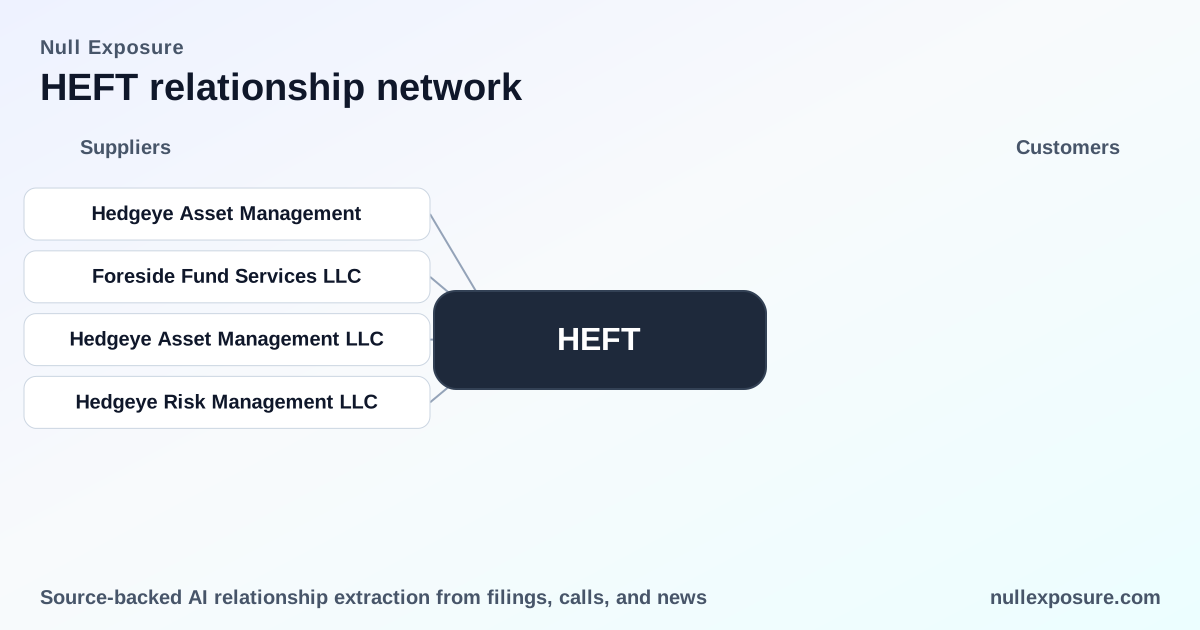
HEFT supplier map: who runs, advises, and distributes the ETF
Investor thesis — HEFT is an exchange-traded fund structured and operated by Hedgeye-branded entities, monetizing through advisory and issuer fee streams while outsourcing distribution to a third-party fund services firm. Control of portfolio strategy, brand, and issuer functions sits with Hedgeye affiliates; distribution and middle-office plumbing rely on external specialists. This structure concentrates operational and governance leverage inside the Hedgeye group while creating a single external dependency for investor-facing distribution. Learn more about supplier risk monitoring at https://nullexposure.com/.
What the supplier stack looks like in plain language
HEFT’s public record lists four counterparties that matter to investors: the advisor, the issuer, the asset manager behind the strategy, and the distributor. Each relationship defines a revenue channel or an operational dependency: advisory fees and issuer economics are internal to Hedgeye, while distribution is outsourced. That balance creates a business model where brand and strategy control are concentrated, and distribution execution is delegated.
Hedgeye Asset Management
Hedgeye Asset Management is presented in public reporting as the primary advisor connected with HEFT’s investment strategy and product launch activity. According to TradingView’s AMEX-HEFT page (first captured March 2026), Hedgeye Asset Management LLC is listed as the primary advisor. Key takeaway: advisory economics and portfolio decision-making are vertically integrated under the Hedgeye brand.
Hedgeye Risk Management LLC
Hedgeye Risk Management LLC is identified as the issuer of HEFT, making it the legal vehicle responsible for fund governance and regulatory compliance obligations. TradingView’s listing for AMEX-HEFT (March 2026) names Hedgeye Risk Management LLC as the issuer. Key takeaway: legal and issuer-level control sits inside the Hedgeye corporate family, concentrating regulatory responsibility and liability.
Foreside Fund Services LLC
Distribution and certain fund services are handled by Foreside Fund Services LLC, which TradingView’s AMEX-HEFT page lists as the fund distributor (March 2026). Key takeaway: investor access and intermediary distribution are outsourced to an established third-party distributor, creating a single external dependency for capital flow and shareholder servicing.
Hedgeye Asset Management (ETF launch context)
Beyond the structural listings, Hedgeye Asset Management has public-facing product activity: a November 26, 2025 press report noted Hedgeye launched a new ETF themed on the “Fourth Turning” framework, demonstrating active product development and marketing at the firm level. That same product initiative contextualizes HEFT as part of a broader Hedgeye ETF growth strategy (news report from Sahm Capital, Nov 26, 2025). Key takeaway: Hedgeye is actively building ETF products under thematic branding, which drives advisory revenue and distribution demand.
What these relationships mean for investors: structure, concentration, and execution
The supplier relationships for HEFT reveal a vertically integrated product model with limited external dependencies:
- Contracting posture: HEFT’s core operational and fee-generating roles (advisor and issuer) are internal to the Hedgeye group, indicating contracts and governance remain under centralized control rather than split across multiple unrelated service providers.
- Concentration: Control of strategy and issuer responsibility is concentrated in Hedgeye entities; this reduces counterparty fragmentation but increases single-group operational risk and reputational coupling.
- Criticality: Distribution via Foreside is a material external dependency for investor access and compliance filings; failure or friction in that relationship would directly affect shareholder servicing and distribution continuity.
- Maturity: Public signals (advisor, issuer, distributor listings and a recent ETF launch) point to an early but operationally complete ETF product — governance and distribution are in place, but scale and track record should be evaluated separately.
Investor implication: concentrated internal control accelerates decision-making and captures advisory economics, while the single third-party distributor requires focused operational due diligence.
Learn more about mapping supplier concentration and operational risk at https://nullexposure.com/.
Constraints and company-level signals
There are no explicit contractual constraints listed in the available supplier records for HEFT. As a company-level signal, the absence of disclosed constraints suggests filings and public disclosures for HEFT center on standard ETF relationships (advisor, issuer, distributor) without additional flagged limitations in the reviewed sources. Investors should treat this as neither a guarantee of zero contractual obligations nor a substitute for review of the fund prospectus and regulatory filings for fee schedules, redemption mechanics, or service-level commitments.
Practical due diligence checklist for investors and operators
- Confirm advisory and issuer fee schedules and fee-splitting arrangements in the official prospectus and recent regulatory filings.
- Validate the distribution agreement and service-level expectations with Foreside, including shareholder servicing and regulatory filing responsibilities.
- Review governance documents for potential conflicts of interest given internal advisor/issuer alignment.
- Monitor product rollout cadence and marketing claims tied to Hedgeye thematic frameworks to assess scalability and brand-driven flows.
- Track any future additions of third-party administrators or custodians that could diversify the supplier footprint.
Bottom line and action items
HEFT is a Hedgeye-controlled ETF product with advisory and issuer control concentrated inside the Hedgeye group and distribution outsourced to Foreside. That model delivers control and fee capture to the sponsor while creating a single, identifiable external dependency that investors should monitor. For stakeholders evaluating supplier risk or negotiating operational protections, the immediate focus should be on fee mechanics, governance disclosures, and the distributor agreement.
For a deeper supplier-risk view and continuous monitoring tools, visit https://nullexposure.com/ — the best place to begin mapping counterparty concentration and operational exposures for fund investments.